Seattle has seen a series of violent attacks: a woman bit off part of a passerby’s face, while in West Seattle a group of men beat and robbed a woman. Against this backdrop, residents are calling for the city’s next police chief to be someone from the local community.
Woman Bit Part of Passerby’s Face in Downtown Seattle: Witness Account
A shocking incident in downtown Seattle has captured the city’s attention. In broad daylight on an ordinary street, 36-year-old Camilia Chadli attacked Diana Gonzalez, who was walking along the sidewalk near the Arctic Hotel. Prosecutors allege that Chadli not only knocked the woman to the ground but also bit off part of her forehead, spat it into a storm drain, and calmly walked toward a bus stop. The seemingly unprovoked incident shocked even the hotel’s experienced staff, who rushed to separate the women.
A hotel employee named Holt, who was working part-time as a valet, witnessed the confrontation begin. He said Chadli was acting aggressively toward Gonzalez, and the situation quickly spiraled out of control. Holt saw the attacker knock the victim to the ground and began calling for other employees to help. He and a colleague tried to separate the women, but at that moment Chadli leaned down and bit a piece of flesh from Gonzalez’s forehead. “There are no words to describe it. I’ve never seen anything like it. Her face just turned into blood,” Holt told KOMO News. After the women were separated, Chadli surprisingly simply walked across the street. Holt’s colleague followed her to a bus stop in front of the King County Courthouse, where he managed to attract the attention of a court security officer, who detained the suspect until police arrived.
Gonzalez, left with a serious injury, was disoriented and tried to call for help, but heavy bleeding made it impossible for her to use her phone. “She was clearly confused—she pulled out her phone and tried to dial 911, but she couldn’t because of the amount of blood pouring from her head. It was horrifying. She kept wiping the blood away, but it only got worse,” Holt recalled. The victim eventually received medical treatment. Gonzalez told KOMO News that she is scheduled to undergo skin-flap surgery during the first week of October, which will leave a permanent scar on her forehead. “It’s so strange. I can’t believe she bit a piece of my face off,” she said.
Chadli is scheduled to appear in court for arraignment on Monday, September 28, on a charge of second-degree assault. The court set bail at $150,000. According to court documents, Chadli lived in a shelter across the street from the hotel. Previous police reports indicate that she had “a history of mental-health and substance-abuse issues, as well as ongoing conflicts with her family.” She had previously been “taken into emergency custody for an involuntary psychiatric evaluation.” Holt noted that people experiencing homelessness are often on the sidewalks near the hotel because of the shelter’s proximity, but said he had never encountered violence like this during his time working there. “We constantly see homeless people going about their business, but we definitely haven’t seen violence against other people, especially without provocation. I would say this is a very unusual situation,” he added.
City data reviewed by KOMO News shows that the attack was the first recorded crime of all of 2026 in the 700 block of Third Avenue and at the intersections with Cherry and Columbia streets. The same area recorded three violent crimes in 2025 and six in 2024, reflecting the broader decline in violent crime downtown since 2024. However, this particular case—with its extreme brutality and lack of an apparent motive—has once again raised questions about how effectively the city is addressing mental-health and homelessness issues that, according to the documents, were directly connected to the attacker. For residents and tourists, the incident was a reminder that an unpredictable tragedy can occur even in relatively safe neighborhoods. For Diana Gonzalez, it marked the beginning of a long road to both physical and psychological recovery.
West Seattle Attack: Police Search for Five Suspects as Woman Hospitalized With Head Injury
An incident in West Seattle on Thursday evening has once again drawn attention to public safety in the city. A woman was brutally beaten and robbed by a group of four or five men as she returned to her car. Police are investigating, but the suspects and their vehicle have not yet been found. The case is not the first in recent weeks in which street attacks in Seattle have sparked public concern.
According to a Seattle Police Department (SPD) report, officers responded at about 6:05 p.m. Thursday to a report that several men were beating a woman and taking her purse in the 4500 block of 42nd Avenue Southwest. A witness who heard screaming began recording the incident from her apartment window. The video shows a white Honda Accord without license plates pulling into a parking lot, after which four suspects surround a woman lying on the ground. One of them allegedly takes an item from her, and the group then returns to the car. According to police, a fourth suspect stomped on the woman twice before the vehicle drove south on 42nd Avenue. A fifth suspected participant remained behind the wheel the entire time.
Officers later found the victim at an urgent-care clinic, where Seattle firefighters were already treating her. The woman said four or five men approached her as she walked back to her car. One of them yelled, “Hey, that’s my phone!” before the attackers pounced on her. She said she did not know the men and had never seen them before. They knocked her to the ground and kicked her in the head twice, but she did not lose consciousness. Police documented a laceration to the back of her head and a large hematoma on her forehead. American Medical Response transported her to Harborview Medical Center, where doctors reported a serious injury. A blue iPhone was stolen from the woman.
Police described four of the suspects as thin Black males between the ages of 16 and 22. The fifth suspect, the driver, did not leave the Honda Accord. Officers searched the area but found neither the suspects nor the vehicle. They collected video from the witness and identified additional surveillance cameras that may have captured the incident. The victim’s glasses and a bottle of unlabeled prescription pills, believed to contain benzodiazepines, were also found. The woman confirmed that the medication belonged to her, and police entered the bottle into evidence for latent-print testing.
The attack was not an isolated case. Earlier, a downtown Seattle valet intervened in a confrontation after a suspect bit part of a woman’s forehead. Incidents like these raise questions about how effectively city officials and police are addressing street crime. In this case, the attackers acted boldly and quickly, suggesting possible organization or, at minimum, a willingness to use violence. Police continue to search for the suspects, and any information about the unlicensed white Honda Accord or the individuals involved could assist the investigation. The original report was published on the KOMO News website. Residents are advised to remain alert and report suspicious activity.
Several terms require clarification for context. “Benzodiazepines” are a class of psychoactive drugs commonly prescribed to relieve anxiety, treat insomnia, or control seizures. The unlabeled bottle in this case is evidence, but it is not necessarily connected to the motive for the crime. “Latent-print testing” is a method for detecting invisible fingerprints on a surface that can be used to identify suspects. A “hematoma” is a collection of blood beneath the skin—in other words, a bruise—but on the forehead it may indicate a serious blow. The Honda Accord is a popular car model, and the absence of license plates can indicate an attempt to avoid identification. Finally, an “urgent-care clinic” is a medical facility that treats conditions not requiring immediate hospitalization. In this case, however, the victim had to be transferred to Harborview, underscoring the severity of her injuries.
The key takeaway is that the attack was sudden and violent, using numerical superiority and possibly a diversionary tactic (“That’s my phone!”). Police have not yet identified the suspects, but video footage and witness statements provide leads. The presence of a fifth participant behind the wheel points to an action that was carefully planned—or at least coordinated. The victim suffered significant injuries, including a possible concussion, and her testimony will be important to the investigation. The public is awaiting the results of the inquiry, as well as answers to questions about why such attacks appear to be occurring more frequently and what is being done to protect residents.
Seattle Searches for a New Police Chief: Residents Want “One of Their Own”
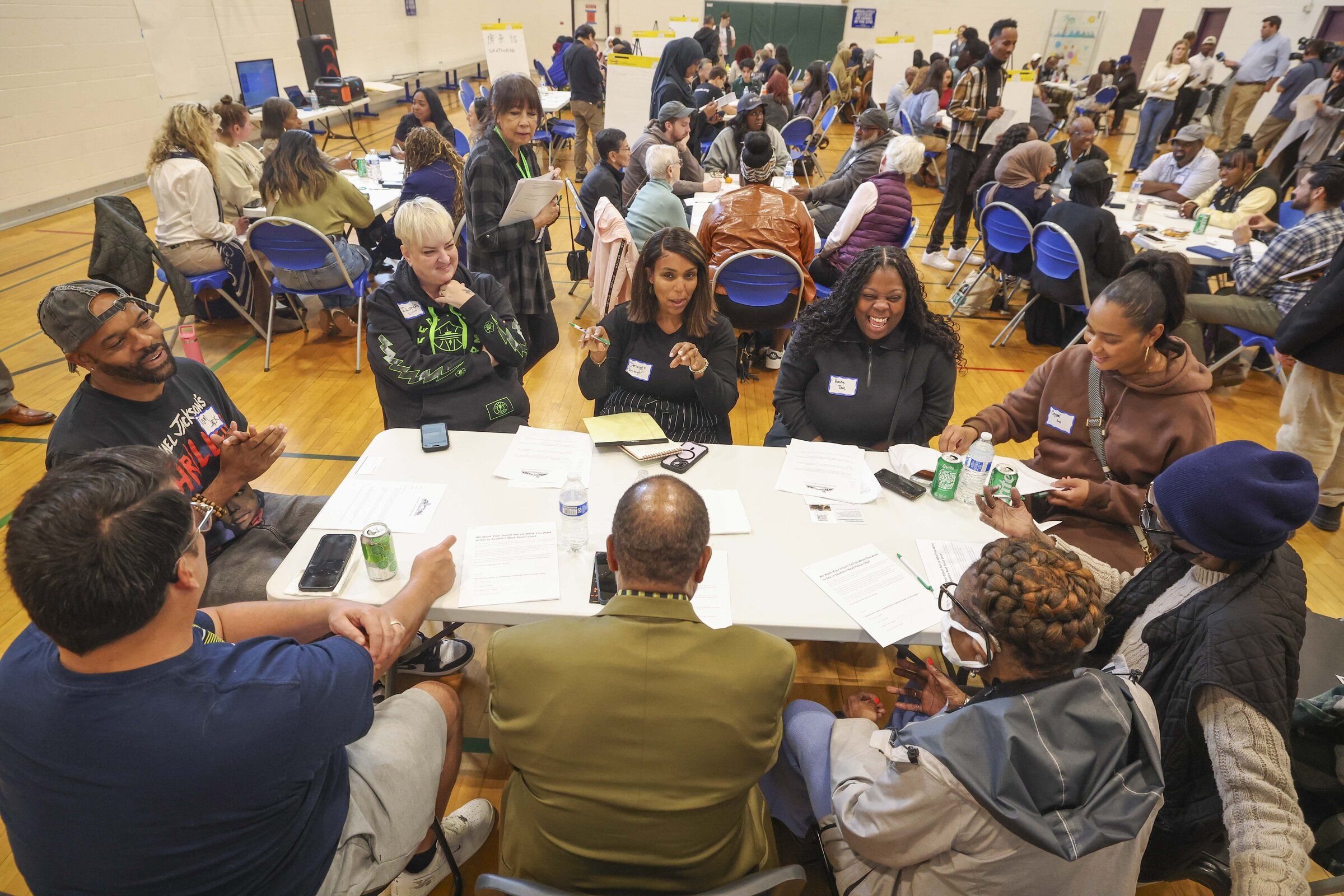
Seattle residents, weary of a succession of outside appointments and constant turnover among police leaders, are increasingly saying that the city’s next police chief should be someone who knows the city from the inside. The demand emerged during public consultations organized by the mayor’s office and became the central theme of a meeting at the Van Asselt Community Center in South Seattle. Among those attending was Lonnisha Landry, a mother who lost her son, Xavier, to gun violence. Her story, shared in a crowded and noisy room, provided an emotional backdrop for a broader discussion about what the next police chief should be and what role residents themselves should play in the selection.
According to a report by The Seattle Times, the search for a new police chief has become a platform for a more fundamental debate about trust between communities and law enforcement. Residents—particularly those from neighborhoods most affected by crime and, at the same time, by excessive police presence—insist that it is not enough to find a professional administrator with an impressive record from another city. They want someone who understands local circumstances, knows community leaders, is familiar with troubled neighborhoods through experience rather than reports, and, most importantly, can build long-term relationships instead of leaving after two or three years when the political climate changes.
Seattle has a history with outside police chiefs. In recent years, the department has been led by people who came from other cities and left under pressure from circumstances ranging from scandals and protests following George Floyd’s killing to conflicts with the City Council. Each transition was accompanied by promises of reform, but communities were repeatedly disappointed: the new chief did not have time to build relationships before another search began. That is why the demand for a “local” candidate is about more than geography; it is about stability and accountability. Residents want someone whose life and career are tied to Seattle, who does not view the position as a stepping stone but is prepared to invest in the city for the long term.
It is worth clarifying that participants do not necessarily mean someone born in Seattle when they call for a “local” candidate. They mean someone who has worked in the region for a substantial period—for example, someone who rose through the local police system and knows it from the inside, or who has led community-safety programs in affected neighborhoods. This is fundamentally different from a model in which City Hall hires a “star” administrator from another major city who promises to apply universal best practices. As recent years have shown, universal solutions work poorly in places where complex relationships have historically developed between police and Black, immigrant, and low-income communities. “Local” also means knowing specific people: trust does not emerge at the level of abstract “communities”; it is built through personal relationships with activists, pastors, small-business owners, and school boards.
The story of Lonnisha Landry, who lost her son to gun violence, illustrates how much is at stake. For her and other parents who have experienced similar losses, the police are not an abstract institution but a force that determines whether crimes will be investigated and whether families will feel supported. At the same time, these residents are demanding both reform and an end to aggressive practices. This dual demand—for safety and justice—is extremely difficult to satisfy, and residents believe it should form the basis of the selection criteria. An outsider may offer a fresh perspective, but may fail to understand what lies behind the statistics: decades of mistrust, a lack of resources in certain neighborhoods, and fears of contacting police because of immigration status or concerns about retaliation.
The central insight from the current hearings is that the question of a new chief is no longer merely a personnel matter; it has become a question about the model for managing public safety. If City Hall ignores the demand for a “local” candidate, it risks another contentious transition, protests, and alienation among communities, along with the loss of already fragile trust. If it chooses someone from the local system, it will have to address the department’s internal culture: a “local” chief may be closer to communities while also carrying the burden of the department’s past mistakes. This choice—between outside legitimacy and inside understanding—will shape how Seattle provides public safety in the coming years. It is at meetings like the one held at the Van Asselt center that the public mandate for that decision is now being formed.