In Seattle, three people were rescued from a wrecked car, rallies both for and against strikes on Iran took place, and ferries are introducing a card-payment fee.
Three rescued after car plunged into a ditch near the Arboretum in Seattle
On Friday, Feb. 27, Seattle saw a crash that required a complex rescue operation. A car left the roadway and ended up in a ditch on a busy street, leaving three people trapped inside the vehicle. Fortunately, thanks to the quick work of firefighters, all were rescued.
The incident occurred near the intersection of Lake Washington Boulevard East and East Foster Island Road, close to the famed Washington Park Arboretum and Botanical Garden, according to KOMO News. Responding firefighters found three people trapped in the damaged vehicle. Specialized techniques were required to free them: rescuers stabilized the vehicle to prevent further movement and then removed the car’s roof to safely extract the occupants. This method, known as vehicle extrication (often referred to as cutting the roof or “depacking” the vehicle), is standard when doors are jammed or the body is deformed to the point that a normal exit is impossible. All of the injured were reported to be in stable condition at the time of rescue, Seattle Fire Department representatives said.
The crash occurred in the area between the upscale neighborhoods of Montlake and Broadmoor, causing expected traffic disruptions. Authorities urged the public to avoid the area to allow emergency personnel to work unimpeded. While details about the cause of the crash or possible injuries were not released, the successful rescue without serious harm highlights the importance of rapid response by professional rescue teams and their technical capabilities for working in difficult roadway situations—especially in urban areas where every minute counts.
Car caravan in Seattle: Iranian diaspora backs U.S. strikes while activists call for peace
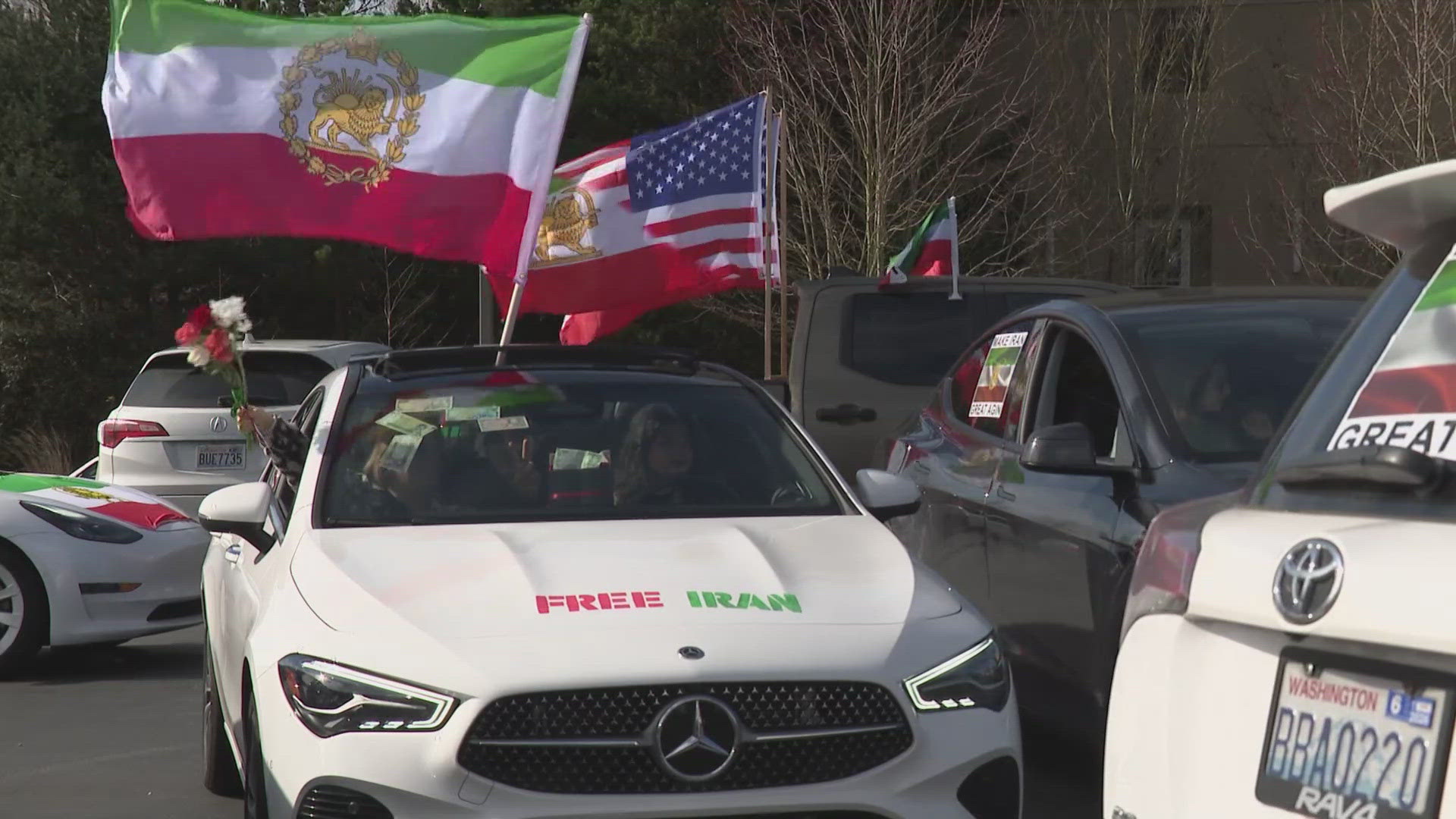
On Saturday, an unusual and divisive scene unfolded on the highways around Seattle: more than 300 cars decorated with U.S., Israeli and Iranian flags formed a large caravan in support of recent U.S. military strikes on targets in Iran. At the same time, in the city center at the famous Pike Place Market, another group of protesters demanded an immediate halt to U.S. and Israeli military actions. These parallel demonstrations, reports KING5.com, highlighted deep divisions in American society and among diaspora communities over the escalation of the conflict in the Middle East.
The motorcade, organized by the group “Voice of Iran in Washington,” started from a Bellevue parking lot and drove along I-5 and I-405, drawing attention from other drivers with honking and waving flags. This nonprofit advocates for democracy in Iran and supports international intervention aimed at changing the current regime. For many participants, such as Iranian refugee Arash Seifiandju, the event was a historic moment. “I have waited for this moment my whole life,” said the 46-year-old organizer, who fled Iran due to religious persecution. He explained that people like him in Iran lack basic rights, such as access to schooling or university. Seifiandju, who has lived in the U.S. since 2004, expressed support for the strikes, hoping external pressure will lead to political change, the collapse of the theocratic government and a transition to a peaceful democratic system.
The strikes in question, according to NBC News, were carried out by U.S. Central Command forces by air, land and sea in the early morning Eastern time. Targets included facilities of the Islamic Revolutionary Guard Corps (Iran’s elite military force reporting directly to the Supreme Leader), air defense systems, missile and drone launchers, and military airfields. U.S. officials described the operation as a measure to eliminate imminent threats to American forces and interests.
Not everyone in Seattle shares that view. Almost simultaneously, an antiwar rally was held at Pike Place Market organized by the coalition “Seattle Against the War,” which includes local chapters of the Democratic Socialists of America, Students for a Democratic Society and Veterans for Peace. Participants characterized the strikes as an unprovoked attack, warning of the risks to civilians and further escalation in the region. Their main demand was “Hands off Iran,” along with calls for the U.S. Congress to oppose further intervention. Washington Sen. Patty Murray joined those calls, urging Congress to convene urgently and vote to end what she called a “war with Iran,” warning against slipping into a conflict without clear objectives or strategy.
Saturday’s events in Seattle thus became a microcosm of the global debate. On one side, part of the Iranian diaspora that has suffered persecution sees U.S. actions as a chance to liberate their homeland from an authoritarian regime. On the other, left-wing activists and antiwar groups fear another cycle of violence and American imperialism. Both sides appeal to values of peace and human rights but diverge sharply on the methods to achieve them. This polarization, visible on the streets of American cities, shows how complicated and emotionally charged U.S. foreign policy in the Middle East remains.
Washington ferries’ new fee: what changes for passengers starting March 1
Against the backdrop of a setting sun at the Fauntleroy terminal, Washington State Ferries (WSF) are preparing a small but noticeable change for passengers. Beginning Sunday, March 1, WSF is introducing an additional fee for paying fares with bank cards. The change, initiated by state lawmakers, could affect the wallets of thousands of daily riders—especially those accustomed to cashless payments.
The decision to charge the new fee was made at the state legislative level, and ferry leadership, according to West Seattle Blog, is informing riders through regular communications. In a weekly bulletin, WSF director Steve Navy explained details of the forthcoming change. A technical nuance drew particular attention from readers: many assumed such fees could not apply to debit-card transactions. However, WSF clarified that their infrastructure does not support processing debit cards in their pure form. Therefore, when paying with a debit card the transaction is processed as a credit transaction and the new fee will apply. To explain: the difference between debit and credit cards in this context lies in how the payment is processed by the acquiring bank. The ferry system technically does not distinguish between them, which leads to a single rule for the fee. This change reflects a broader trend of transportation and government services shifting some operational costs related to bank fees onto end users. The introduction of the fee may push some passengers to seek alternative payment methods if available, or to plan trips more carefully. While the specific fee amount was not provided in the excerpt, the mere fact of its introduction signals adjustments in funding for one of the region’s key transportation arteries on which many West Seattle and other waterfront residents depend.