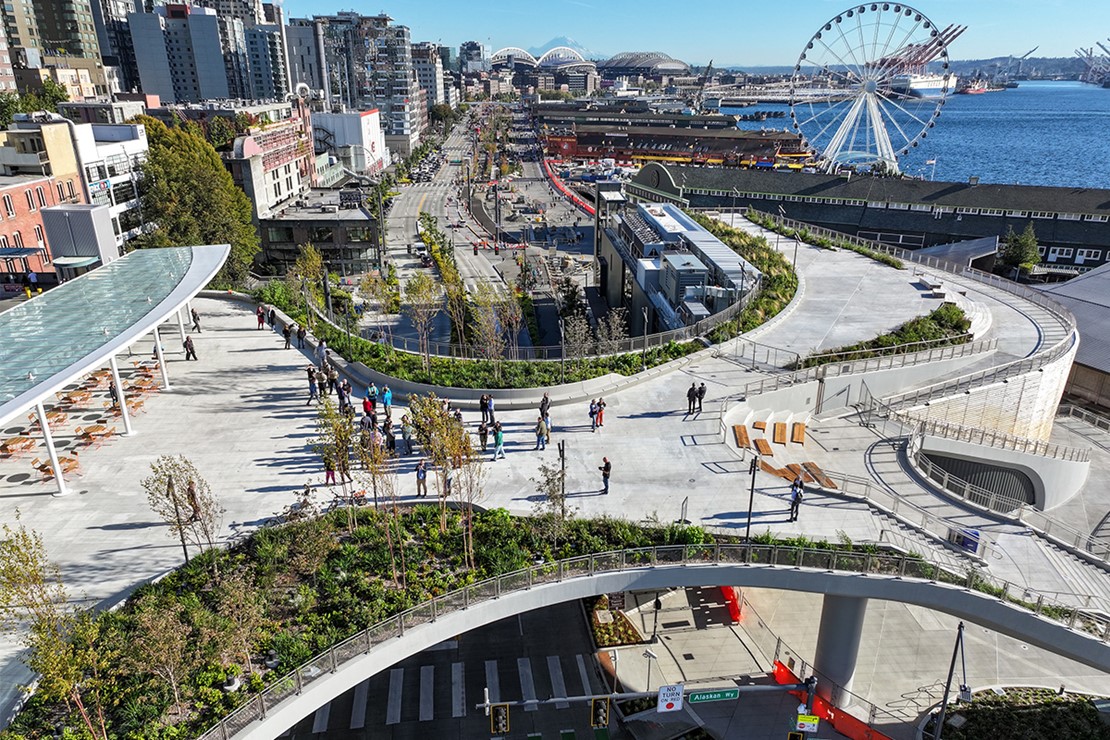
In the roundup: a bat attack on camera operators at a Pride event, the Future Arts Way augmented reality project for the 2026 World Cup, and a take on why Seattle Seahawks’ championship has been overlooked.
Seattle police investigate bat-swinging attack on camera operators at Pride event
Last Saturday, during a Pride event in the area of Cal Anderson Park in Seattle, an incident drew the attention of police. A man armed with a baseball bat attacked two people holding cameras. Fortunately, nobody was hurt, but, according to police, footage shows the suspect nearly striking one of the operators in the head. The incident occurred at the intersection of 10th Avenue and Denny Way. The suspect—a 39-year-old man—appeared in court on Monday. His attorney argued that the target was the equipment, not the people behind it. The judge found the evidence sufficient to bring charges for assault and obstructing justice and set bail at $35,000.
Details of the case, including video from the scene, were published in a KOMO News report: KOMO News. Notably, despite the aggressive actions, nobody was injured—something that can be considered good luck in this case. For those unfamiliar with the American legal system, a “probable cause” finding means the court has sufficient grounds to believe a crime was committed, allowing a full investigation to begin or the suspect to be held in custody. Bail of $35,000 means the suspect can be released before trial if he posts that amount or pays for a surety bond.
The incident again raises questions about safety at public events, especially ones like Pride, where large crowds gather. Aggressive behavior toward members of the media can be interpreted as an attempt to intimidate and restrict free speech. Police continue to investigate, and additional details may emerge. For now, the court has determined that the suspect must remain in custody—or at least under a substantial bail amount—indicating how seriously the allegations are being taken.
Seattle meets the FIFA World Cup with augmented reality and art
While Seattle prepares to host FIFA World Cup matches and thousands of visitors from around the world, a local nonprofit is using a mix of art and technology to show the city in a new light. Future Arts, a women-led nonprofit founded by Julia Brooke, created a walking route featuring augmented reality elements called Future Arts Way. Its goal is to welcome visitors “through technology and through technology-based stories of local communities,” as Brooke puts it.
The route, roughly four kilometers long, starts under the arches of the Pacific Science Center and ends at King Street Station. Along the way, there are 35 vinyl “drops” with works by local artists—by scanning the QR code on each one, a passerby can learn the story of the place where they are standing. As project curator Ashanti Davis explains, the theme was “Another Earth 2026,” and it is meant to reframe the very concept of “othering.” “When we talk about othering, we usually mean what happens to other people—those who are from somewhere, those who belong to historically marginalized communities, who are pushed away. We want to take that concept, flip it, and create something new,” Davis says.
Organizers envisioned the walk as a family-friendly activity: you can not only view the works, but also stop by local cafés and shops. One of the artists, Azure Bourret, a coordinator of traditional food and medicine programs for the Suquamish Tribe, created a project dedicated to an edible mollusk—the cockle. This shellfish was a traditional source of food for her people. Bourret admits that taking part in the project changed how she sees herself: “I didn’t consider myself an artist, but as the project gained momentum, my understanding of what it means to be an artist completely changed.”
At Bourret’s stop near Colman Dock ferry terminal, you can see a crocheted cockle and even play an interactive game. The special feature is that the stories are told in Lushootseed—the indigenous language of the local tribe. “It creates a real connection: you learn the story, you see the images, and you hear it in our language—everything comes together into a beautiful reality that you want to step into,” the artist says. Each participant, the curator adds, decided how they wanted to present their story.
Organizers hope visitors will not only enjoy the walk and learn about Seattle’s history, but also support local businesses. The Future Arts Way route will run through September. To participate, you need a phone with a camera, and for those without one, device rentals are available. You can read more about the project in a WJLA article. Augmented reality overlays digital layers (sound, animation, text) onto the real image captured by a smartphone camera, and “othering” is a sociological term describing the process by which certain groups of people are treated as “outsiders” because of their origins or status.
Disrespect for the Seattle Seahawks championship: why people are talking about it seriously
After winning the Super Bowl, it would seem the team should be basking in glory, but the Seattle Seahawks faced the opposite situation. After capturing the trophy in one of the most dominant stretches of the past 25 years, the Pacific Northwest club has consistently found itself in the shadow of its divisional rivals—the Los Angeles Rams, who attracted all the attention of the national press with high-profile acquisitions in the offseason. ESPN analyst Kevin Clark, in a recent social media post, called the Seahawks among the most “disrespected” Super Bowl champions in his lifetime, comparing them to the teams of Eli Manning and Peyton Manning/Von Miller. And, surprisingly, that claim is gaining even more supporters.
It’s not just a subjective feeling. The numbers speak for themselves: during the regular season and playoffs, the Seahawks posted a point differential of +246—that’s the best mark among all Super Bowl champions since the 1999 St. Louis Rams. The team won 14 of its last 15 games, and in the deciding match, their defense—which was the best in the league in points allowed—literally smothered the opponent. At the same time, the team’s roster is one of the youngest in the NFL: by snap-weighted age (average player age weighted by the number of snaps played), the Seahawks ranked fourth from the bottom. And more importantly, nearly the entire core stayed intact: 14 of the top 15 offensive players and 14 of the top 17 defensive players will return next season. In other words, this isn’t just a team that won—it’s a team ready to take another leap.
Former NFL receiver and now Seahawks analyst for the Radio Network Michael Bumpus agreed with Clark’s assessment on Seattle Sports’ Brock and Salk: “I think it’s partly about being from the Northwest— you get lost in the crowd. I understand respecting the Rams, but you can praise both them and us. It’s funny, but I like it—it keeps the fire in the team.” Indeed, when the media immediately shifted attention after the Super Bowl to other teams, while the Seahawks seemed to be forgotten, that looks at least strange.
A Seattle Sports analysis article notes that a culture of being overlooked has long been part of the region’s identity. But in this case, it’s not a “playing around” posture—it’s an objective reality: champions who dominated all season long and kept a young roster deserve more attention than simply being mentioned in the context of, “What about the Rams?” Maybe it’s exactly this underappreciation that will give the Seahawks extra motivation to surprise the skeptics again.