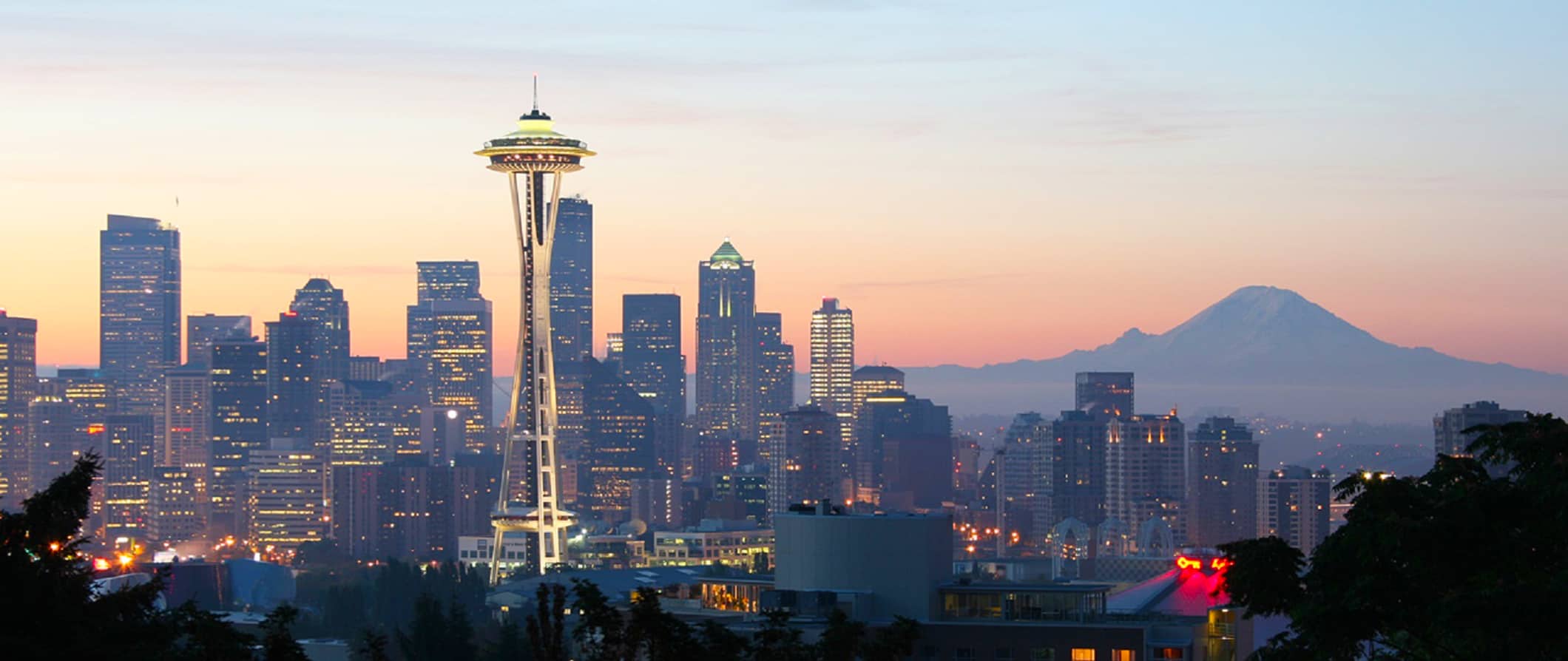
News from Seattle: the unveiling of the first statue of Swami Vivekananda in the U.S., a Kraken goalie almost scoring in his debut, and a flea market as a symbol of the city's alternative culture.
Seattle installs the first life-size statue of Swami Vivekananda on city government grounds in the U.S.
A landmark cultural and diplomatic event took place in Seattle: for the first time in U.S. history, a city government has placed a monument to an Indian spiritual leader and philosopher on its grounds. A life-size bronze statue of Swami Vivekananda was ceremonially unveiled in Westlake Square Park, becoming the first such monument installed at the initiative of and on the property of a city government in the United States.
The unveiling ceremony, held today, brought together representatives of both American and Indian authorities: the statue was jointly presented by Seattle Mayor Kshama Sawant and the Consul General of India in Seattle. According to an official statement from the consulate, this is a unique precedent for the U.S. The choice of location underscores its significance: Westlake Square is a prestigious site in the heart of downtown Seattle, a kind of "melting pot" visited daily by more than 400,000 people, with monthly foot traffic measured in the millions. Thus, the image of the thinker will be seen by a huge number of residents and tourists. The nearby landmarks are equally symbolic: within walking distance of the new monument are the Spheres (Amazon’s headquarters), the Seattle Convention Center, and the monorail leading to Seattle Center. This places Vivekananda’s philosophical legacy at the very epicenter of the city’s modern tech and business life.
Swami Vivekananda (1863–1902) was an Indian monk and philosopher, a key figure in popularizing Vedanta and yoga in the West. He rose to prominence after his speech at the World’s Parliament of Religions in Chicago in 1893, where he called for religious tolerance and universal brotherhood. His ideas about harmony among religions and the spiritual unity of humanity resonate in today’s globalized world. Installing his statue in Seattle is not only a gesture of respect for Indian culture but also a powerful symbol of dialogue between civilizations, recognition of the contribution of Indian thought to world philosophy, and strengthening cultural bridges between India and the U.S. As noted in the News on Air statement, this step highlights the growing influence of the Indian diaspora and India’s soft power in American society, as well as the intent of progressive cities like Seattle to emphasize values of diversity and cross-cultural understanding in public spaces. (https://www.newsonair.gov.in/city-of-seattle-becomes-first-city-govt-in-us-to-host-life-size-statue-of-swami-vivekananda/)
Seattle goalie’s debut: almost a goal and a confident performance
In professional hockey, a young goaltender’s NHL debut is always an emotional event, full of nerves and hope. But when, in the final seconds of a game, that goalie attempts a bold and spectacular shot into the opponent’s empty net, the story becomes truly memorable. That’s how 22-year-old Finnish netminder Nikke Kokko finished his first NHL start for the Seattle Kraken.
In Saturday’s game against the Calgary Flames, which the Kraken won 4–1, Kokko not only confidently stopped 26 shots and helped secure the team’s second straight win, but he also nearly made history at the very end of the game. With seconds left and Calgary having pulled their goalie for a sixth skater, Kokko saw the empty net and sent the puck the length of the ice. Unfortunately for him and for the drama of the moment, Flames forward Morgan Frost deflected the puck while still in his own zone. “This year I maybe tried it three times before,” Kokko said about similar attempts in the American Hockey League (AHL). He added with relief: “Good thing they didn’t score after my attempt.”
The bold, if unsuccessful, shot provided a vivid punctuation to an assured debut. Kokko admitted he was nervous before the game, but warm-ups and the presence of familiar faces helped calm him. His Coachella Valley Firebirds teammate (the Kraken’s AHL affiliate), Viktor Östman, attended the game, as did goaltending coach Colin Zullianello, who worked with him in the AHL. Most of Kokko’s family and friends watched from Finland, unable to make the trip to Seattle in time, though his girlfriend did manage to get to Climate Pledge Arena.
Kokko’s start was a forced measure for the Kraken: starter Joey Daccord and backup Phillip Grubauer were sidelined with lower-body injuries, and Matt Murray was absent for personal reasons. That chain of events even led the Firebirds to sign their own goaltending coach to a tryout contract just to have an emergency backup. Thus Kokko’s debut was a test not only for him but for the club’s entire system.
Although the season has not gone as hoped for Seattle—the team failed to make the playoffs for the third straight time, a fact confirmed on the day of this game by a Los Angeles Kings win—Kokko’s arrival gives hope for the future. Kraken head coach Lane Lambert noted that the team helped the young goalie well, and that he himself made several key saves when needed. “With Nikke making his first start in the NHL, I think our guys handled it well and made coordinated efforts to help him as much as possible,” Lambert said in his interview for Seattle Sports. (https://sports.mynorthwest.com/nhl/seattle-kraken/kraken-rookie-attempts-goalie-goal-in-1st-nhl-start/1845497)
Forward Freddie Gaudreau smiled about Kokko’s attempt: “I don’t think I’ve ever seen a goalie almost score in his first game. But that would have been amazing.” Lambert was more restrained but understanding about the adventure: “Well, if there’s time and place for it, fine. The main thing is it doesn’t backfire.”
The episode symbolizes not only the young player’s ambition but also his confidence. Kokko, the youngest goalie to debut in the NHL this season (his first appearance was on February 25 against the St. Louis Blues), showed he’s ready to play at this level and isn’t afraid to take a calculated risk. His play and attitude impressed, proving that even in a disappointing season there are reasons for optimism and signs of promising talents who could become the foundation for future Kraken success.
Punk Rock Flea Market: can it save Seattle’s soul?
In an era when cities are becoming increasingly sanitized and expensive, Seattle hosts a unique phenomenon that challenges the logic of neoliberal capitalism. It’s the Punk Rock Flea Market — a flea market that over the past twenty years has evolved from an underground fair into a cultural institution trying to preserve the city’s alternative soul.
Walking through Capitol Hill, the historic center of Seattle’s queer culture and arts scene, you can hear unexpected sounds: an a cappella version of “Caravan of Love” or songs from Kermit the Frog. This cacophony emanates from a former QFC supermarket, which, four times a year for two years now, transforms into the Punk Rock Flea Market. For a symbolic dollar — a fee unchanged since 2006 — visitors enter a parallel universe. As The Guardian describes, this 20,000-square-foot space is simultaneously an outsider-art gallery, a surreal garage sale, and a curated vintage market. Where the produce section used to be you’ll now find an artist working with dried seaweed, an anarchist book vendor, and a seller of carved wooden daggers. In the old storage room hangs a collection of hundreds of Hot Wheels and figurines reminiscent of an ’80s toy store. Every inch of wall, floor, and ceiling is covered with graffiti, stickers, and drawings — the collective work of hundreds of local artists. Over a weekend more than 8,000 people come through, and in December the numbers reach tens of thousands. It’s a boiling pot of alternative economy where 204 vendors offer everything from treasures to outright junk. (https://www.theguardian.com/us-news/2026/apr/12/seattle-punk-rock-flea-market)
The context is essential. Over the past two decades, a city once an affordable cultural incubator of the grunge era has become a global center of corporate capitalism. The cost of living here has risen by 78%, and Seattle is now the 12th most expensive city in the world. In such conditions, artists, musicians, and all those the market’s founder Josh Okrent calls “freaks” can hardly survive in the city they helped make famous. The market, however, not only survived but thrived, answering a pressing need for an alternative economic reality. The event’s DJ, Rob Zverina, calls it an example of a “parallel polis” — a concept from Czech philosopher Václav Benda describing a self-governing society that exists as a mirror and alternative to the status quo.
The spirit of the market is best embodied by vendor Rae Myzell-Bones: “I’m an aging punk. I’m a weirdo. This is a place safe for ‘neuro-quirky’ people. It’s also the kind of communal current people say we’ve lost, but we haven’t. It just lives somewhere else.” The term “neuro-quirky” is a contemporary, positive, inclusive slang describing people with neurological differences, such as autism or ADHD, emphasizing their uniqueness rather than deficit.
What began as an anti-establishment venture has itself become an establishment, but it hasn’t lost its values. The market operates as a nonprofit, donating proceeds to the Seattle Affordable Housing Institute and hiring formerly homeless people. A low barrier to entry (the same $1 admission and affordable vendor terms) ensures maximum accessibility. Founder Josh Okrent, 57, a professional fundraiser for nonprofits, explains the philosophy: “Punk comes from a musical style, but behind it is a whole worldview that goes beyond music. We’re punk in the sense that we define our own identity. We’re not political in the sense of actively resisting something, but we organize trade among ourselves in a way that refuses to recognize any other order and doesn’t compromise.” Asked whether it’s an anti-capitalist market, he replies: “Trade is a natural human activity. It existed long before capitalism and will exist long after it dies. All the money stays within the community, and that’s the point.”
The market’s path has been rocky. Over 20 years it has moved 13 times — former post offices, pharmacies, strip clubs — each time relocating when space was demolished for upscale housing. During the pandemic, with support from the city’s Storefronts program, the market occupied an abandoned Bartell Drugs pharmacy of 15,000 square feet in the emptied downtown, an area that became an epicenter of homelessness and the fentanyl crisis. “We had people not only living on our doorstep but dying on our doorstep,” Okrent recalls. Staff member Ruby Tuesday Romero, herself recently out of homelessness, put out fires set by squatters and administered naloxone (Narcan) to those overdosing. That hard experience, however, gave the market credibility — reputational resilience and trust that ultimately helped it settle on Capitol Hill.
Today the market receives grants from 4Culture and, surprisingly, rents space from major developer Hunters Capital. Seeing the derelict supermarket deteriorating and being vandalized, the company took a chance by leasing it to the temporary tenant. “These folks are so talented, creative, and have such an amazing volunteer team that they turned the space into what it is today,” admits Hunters Capital COO Jill Kronauer. Okrent, usually sparing with praise for landlords, calls them fantastic partners, rare developers genuinely focused on community needs.
This apparently chaotic organism is run like an anarchist commune: 11 paid staff and many volunteers make decisions collectively through debates and compromises. They lease the space on six-month renewable terms and plan to stay until construction begins on the proposed six-story residential development. The market’s idea has already outgrown Seattle: independent Punk Rock Flea Markets inspired by the Seattle example have sprung up worldwide, from Philadelphia and London to Berlin and Toronto.
Ultimately, the strength of this phenomenon is not in the goods but in the people and the culture they create. “There’s no amount of money that could replace the culture we made for ourselves,” Josh Okrent concludes. “In the end, it’s about the people who do it. We love each other and we like working together. There’s something beautiful about coming together in the face of an abandoned building and turning it into something beautiful — beautiful by our standards.” In a city where the soul is gradually displaced by glass and concrete, the Punk Rock Flea Market remains a living, breathing space where you can still hear the pulse of Seattle’s alternative heart.