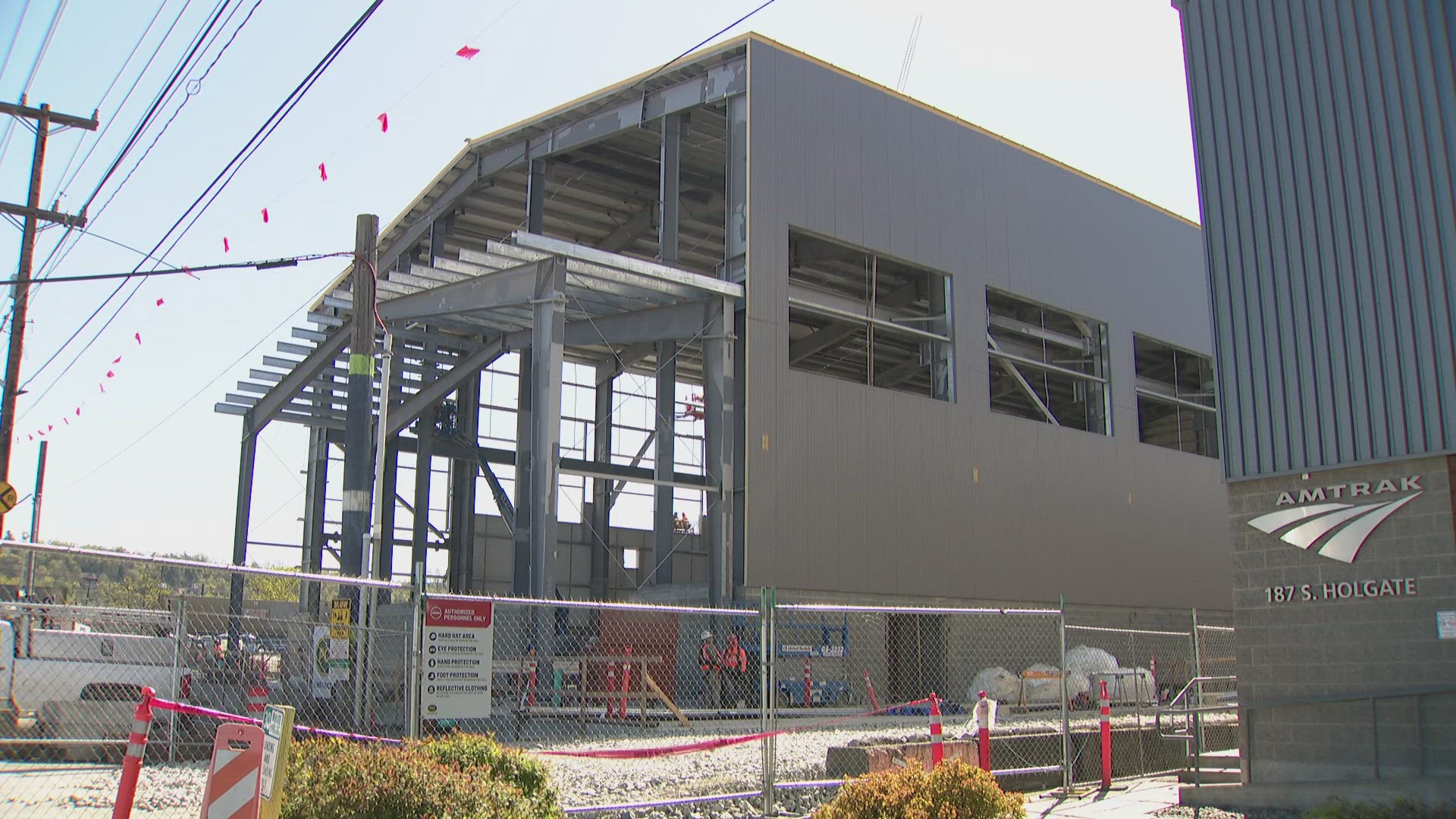
Seattle is opening a new Amtrak train maintenance center, marking a modernization of the railways. At the same time, Washington state faces a threat to its water supply due to a snow drought. A violent robbery with injuries also occurred in the city.
New Amtrak Train Maintenance Center in Seattle: a Key Part of U.S. Rail Modernization
A modern Amtrak train maintenance center is under construction in Seattle and will become an important part of a nationwide overhaul of rail infrastructure. The $300 million project in the SODO area is now more than halfway complete and is expected to open this fall. The facility will not only strengthen the Pacific Northwest’s role as a major transportation hub but also mark the start of a new era for U.S. passenger rail service.
The construction of the new maintenance depot at King Street Yard is not just a local initiative but part of Amtrak’s national strategy to replace aging rolling stock. According to KING5.com, the facility will be the first of six such centers in the country and will be intended to service the new generation of Airo trains. These modern trains, planned to begin service on the Cascades route as early as this summer, are expected to dramatically improve service quality and efficiency. Interestingly, the other five centers will be located on the East Coast, underscoring Seattle’s special role in this nationwide network.
The $300 million funding for the project was made possible by the federal Infrastructure and Jobs Act. During a site press tour, Amtrak Vice President for Capital Projects Laura Mason emphasized the importance of the facility: “We are at the south end of our new maintenance facility that will be built to service our new Airo fleet. To fully transition the fleet to these modern trains, we absolutely need to complete this building. We are very excited to be able to open it this fall.” However, despite optimistic plans, Amtrak has confirmed that the new Airo trains will not be ready for service in time for the FIFA World Cup matches taking place in Seattle.
Alongside the infrastructure changes, Amtrak is also making operational adjustments. For example, last month the company announced staff optimization on the long-distance Empire Builder route that connects Seattle with Chicago. These measures aim to increase efficiency and strengthen the intercity network. At the same time, the introduction of the Airo fleet is expected to create new onboard jobs for local workers. Thus, the modernization covers not only the technical base but also personnel policy, aiming to make rail travel more competitive and attractive to passengers.
Snow Drought Threatens Washington’s Water Supply
A new federal report paints a worrying picture for Washington state and the entire Western U.S.: despite wet weather in March, mountain snowpack remains disastrously low, threatening water supplies, agriculture, and ecosystems for the coming summer.
According to the federal report published on KIRO 7 News Seattle, Washington is experiencing what experts call a “snow drought.” The paradox is that, although precipitation since the start of the water year has been above average in some places, abnormally high temperatures have caused much of that precipitation to fall as rain rather than snow. As a result, mountain snowpack in the state is only about 50% of normal. This is the fourth consecutive year that authorities have declared a drought emergency. The problem is regional rather than local: record low snow levels on April 1 were recorded across eight Western states, from Arizona to Wyoming. In Washington, a snow drought is observed at 88% of weather stations, and in neighboring Oregon at 100%.
The key concept here is “snow drought.” It doesn’t mean there is no precipitation. It means that because of a warm winter, precipitation falls as rain, which runs off quickly, rather than as snow, which accumulates in the mountains and melts slowly in spring and summer, feeding rivers and reservoirs. That natural reservoir is now at risk.
The consequences could be severe. The Washington Department of Ecology warns that farmers, especially in central regions such as the Yakima River basin, may face irrigation restrictions due to insufficient snowmelt runoff. Ecosystems are also threatened: low levels of cold meltwater endanger salmon and other cold-water fish populations that are critical to the region. Fire services are also sounding the alarm: less snow and earlier melt mean soils and vegetation will dry earlier, significantly increasing the risk of large wildfires during the summer months.
Long-term forecasts, unfortunately, do not promise improvement. The report indicates that much of the West is expected to see above-normal temperatures and below-normal precipitation at least through the start of summer. That means replenishing snowpack is unlikely, and states will have to contend with the consequences of the current shortfall. Thus, snow drought is not just a meteorological phenomenon but a complex crisis affecting water security, food stability, biodiversity, and fire risk in one of the country’s key regions.
Armed Robbery in Seattle: One Shot in the Head, Another Beaten
A serious incident has drawn the attention of Seattle law enforcement — an armed robbery with gunfire in the Belltown area. The early-morning incident resulted in one person being hospitalized with a gunshot wound to the head and another being taken into police custody after being beaten.
According to information provided by the Seattle Police and reported by FOX 13 Seattle, the incident unfolded inside an apartment near the intersection of 4th Avenue and Battery Street. The call came in shortly before 5:30 a.m. on Thursday. Preliminary reports indicate two victims. One suffered a gunshot wound to the head and was rushed to Harborview Medical Center — one of the region’s leading trauma hospitals. The wounded person’s condition remains unknown at this time, causing serious concern. The second victim was not shot but was assaulted using a firearm as a blunt instrument — so-called “pistol-whipping,” when a victim is struck with the grip or barrel of a gun. After the incident, that person was taken not to a hospital but to police headquarters to give a statement to detectives.
The investigation is in its early stages, and many details remain unclear. Police confirm that at least one suspect is being sought, but the exact number of assailants has not been determined. No arrests have been made so far. The Belltown incident again raises sharp questions about safety in central Seattle neighborhoods, especially during the early hours. Belltown, known for its vibrant nightlife, mixed residential development, and proximity to the waterfront, periodically appears in crime reports, prompting residents and authorities to seek a balance between urban development and public safety. Given the severity of this case — the use of a firearm with grave consequences inside a residence — it goes beyond routine street crime. Police continue to work at the scene, collecting evidence and interviewing witnesses to reconstruct the full picture of motives and circumstances.