
Mayor of Seattle Katy Wilson on Wednesday announced a major change aimed at speeding up the chronically late Route 8 bus: this summer 13 blocks of Denny Way that were previously general travel lanes will become red bus lanes. Denny Way connects Capitol Hill with Belltown, running through downtown — a key artery used daily by thousands of drivers and buses, providing a direct route between residential neighborhoods, business districts and freeways, including I-5. The corridor carries 6,000 to 7,000 transit riders a day, and the city’s transportation department believes that after the red lanes are installed those riders will move more efficiently, though an exact time savings has not yet been forecast. Meanwhile, the 20,000–30,000 cars that drive Denny each day will encounter the eastbound direction reduced to one general-purpose lane instead of two, forcing many drivers to adapt.
Project leaders hope roughly 25% of drivers will shift to parallel routes or switch to transit when car congestion increases and bus service speeds up. As part of the redesign, the direct ramp from Denny to diagonal Yale Avenue and southbound I-5 will be closed — currently one of the choke points. Seattle Department of Transportation will place planters to physically block that right turn, directing drivers to other freeway access points and effectively moving congestion onto other streets. The new lane configuration will cover a 2.1 km stretch from Queen Anne Avenue to Stewart Street, with a three-block gap at the Seattle Center where buses and cars will continue to mix.
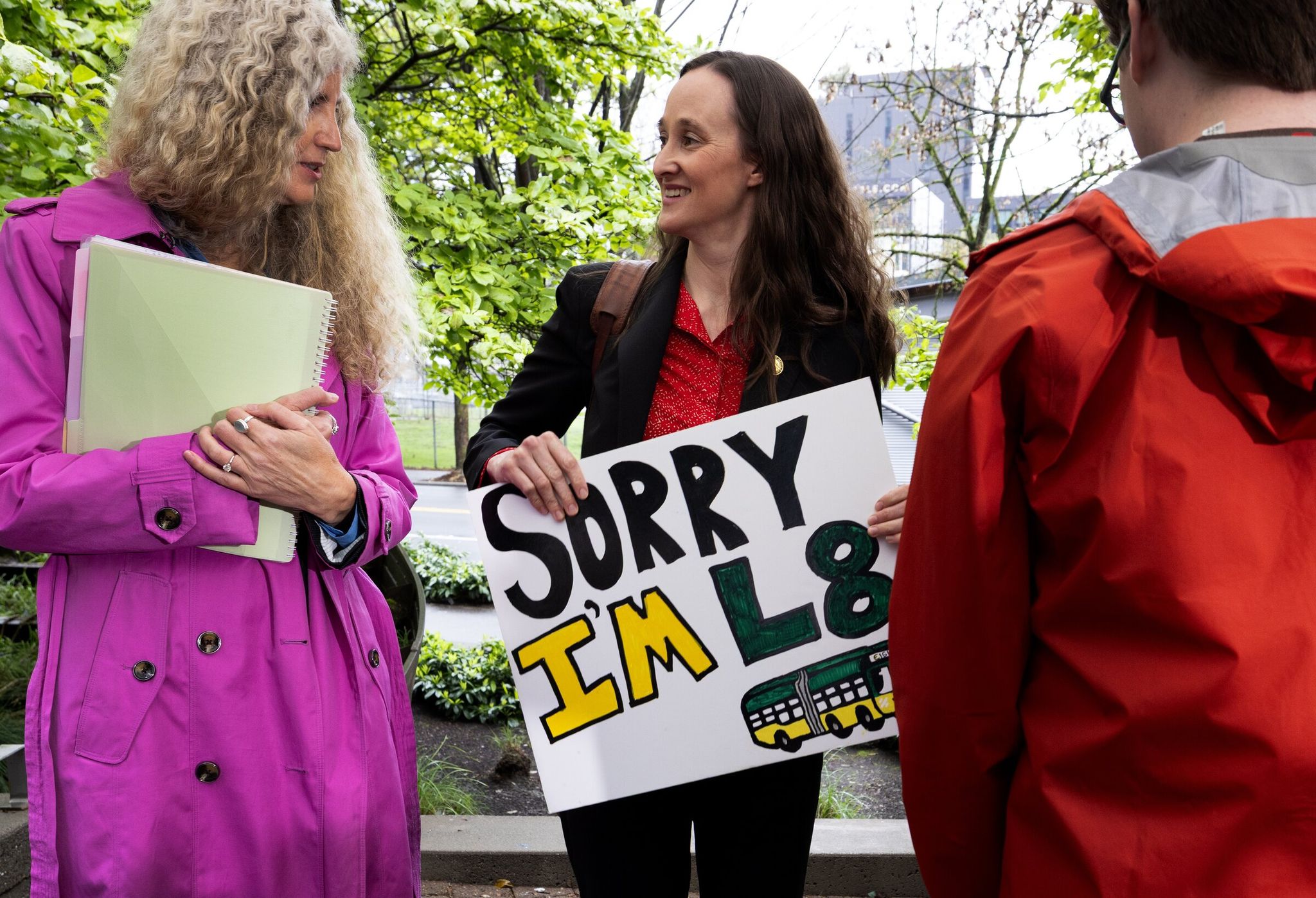
Fixing what riders call the “Late 8” or “L8” (a play on the word “late”) was one of two key promises Wilson made in her successful 2025 mayoral campaign against Bruce Harrell, who previously served as mayor and was active in transportation planning, including advocating for repairs to SR 520. Along with quickly adding 500 shelter beds for people experiencing homelessness, Wilson signed executive orders on both initiatives on Jan. 15, accelerating work that department staff say began under the Harrell administration but gained urgency after Wilson took office. Speaking on Earth Day at the intersection of Denny and Westlake Avenue amid heavy traffic in South Lake Union — the lakeside neighborhood north of downtown that’s a center of tech growth with offices of Amazon, Google and others, where congestion arises from narrow streets, dense development and intense peak-hour traffic — Wilson said, “This is probably one of my favorite moments since I became mayor.” She framed the effort as personal, noting that as a car-free Capitol Hill resident she relies on Route 8 to get to downtown Seattle and to her daughter’s preschool.
Wilson called the line “a real workhorse,” emphasizing its role in everyday mobility through dense neighborhoods. That reality contrasts with the route’s unreliable performance: only 31% of afternoon runs arrive on time, and 67% meet schedule standards over the whole day, placing Route 8 among the least punctual in King County. Riders’ frustration has become part of local lore: many call it the “Late 8” or “L8,” and Seattle indie-rock band Tacocat even wrote a song called “Late 8,” poking fun at how city residents wait for the bus. Before becoming mayor, Wilson led the Transit Riders Union and helped organize a “Beat the L8” event last summer, where pedestrians sometimes passed the bus to highlight the delays.
Construction of the new bus-priority scheme will focus on pavement markings, new signs and traffic-signal adjustments rather than concrete work, allowing the transportation department to minimize lane closures. Work is planned in two waves — in May and August — accounting for a construction blackout in June–July 2026 tied to the FIFA World Cup. The agency aims to finish work by Aug. 29, when Metro will implement another systemwide schedule change that includes increasing Route 8 frequency to a bus every 12 minutes all day, not just during peak periods.
The plan builds on a 2018 change when the department converted a westside general lane to an eastbound bus lane near Stewart Street, allowing Route 8 to avoid congestion at Yale Avenue and I-5. In the new configuration the existing red lane in the middle of Denny will be moved to the right and widened, taking the space drivers currently use to queue for the turn to Yale Avenue and I-5. On the west side near the Seattle Steam plant, Denny will expand from one to two general-purpose lanes.
Based on: Unsticking the ‘Late 8’ bus: Wilson will add 13 blocks of red lanes