
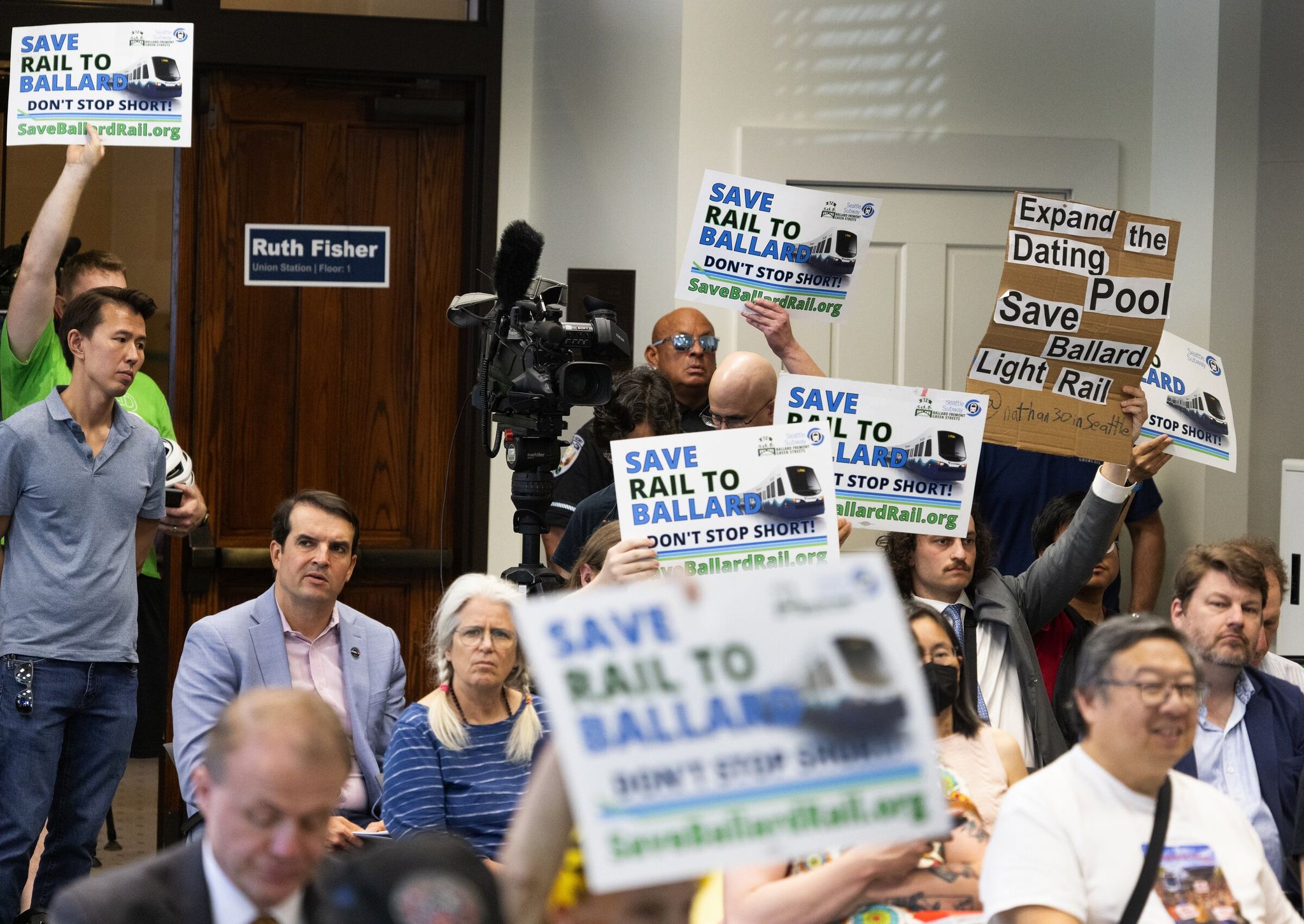
Good news: after decades of struggle, the Seattle area finally has a fairly good light-rail system. The bad news — its expansion has run into catastrophic cost overruns, and activists staged “funerals” for future projects, carrying a coffin through downtown. The protest was triggered by the decision to effectively cut the line to Ballard because its cost had skyrocketed.
Sound Transit, the agency that runs the trains, announced a $35 billion budget gap. That is an astonishing overspend, given that the total cost of the ST3 expansion program, approved by voters in 2016 with 54% support on about 40% turnout, was once estimated at $54 billion, and none of the new lines have yet been built. Budgets for some segments have more than tripled: for example, the Ballard branch rose from $6.8 billion to $23 billion.
The reasons are construction inflation and politicians’ habit of understating costs. But the gap is so large it could wreck the whole program. Sound Transit board members openly admit a loss of trust. Everett Mayor Cassie Franklin is outraged that her city won’t see trains until 2041 — 45 years after taxes in support of the agency began. Ballard fared even worse: the board voted that the line will not go beyond Seattle Center, which is geographically far from Ballard itself, a neighborhood that was historically a center for Norwegian fishermen and the timber industry and is now a desirable residential area with an economy based on tech, restaurants and breweries. “We should rename it,” said board member Dan Strauss, who represents Ballard. “This is no longer the Ballard extension.” Residents who have already paid taxes for that branch and who depend heavily on cars because of chronic congestion saw the cancellation as a broken promise.
How did it come to this? Seattle abandoned “lightness” in its light rail. Originally, in 1996, routes were planned to run on streets and median strips, like in Portland, where the MAX system costs $100–200 million per kilometer and carries about 150–170 thousand riders per day. That’s not as fast, but it allows a city to be covered by five lines without bankrupting itself. In Seattle, however, tunnels and elevated structures are used almost exclusively, and stations resemble temples — this makes the project “the most complicated in the world,” according to Sound Transit chair Dave Somers, but also the most expensive. Seattle’s geography is unique: the city sits on a hilly isthmus between Puget Sound and Lake Washington and is crossed by the Ship Canal. Tunnels and viaducts minimized intersections with existing infrastructure and overcame difficult terrain, whereas building only at-grade tracks would have required demolishing many buildings, creating dozens of level crossings and disrupting water traffic through the canal. As a result, the cost per kilometer in Seattle reaches $400–500 million, compared with $100–200 million in Portland and $200–300 million in San Francisco.
The irony is that after the first phase’s 86% overspend, Sound Transit insisted it had learned its lessons. Critic John Niles in 2016 even called the $54 billion estimate inflated, saying “they won’t get caught again.” And yet — they were caught again. Board member Claudia Balducci admitted this is already the fourth “rebuild” of the plan due to uncontrolled costs.
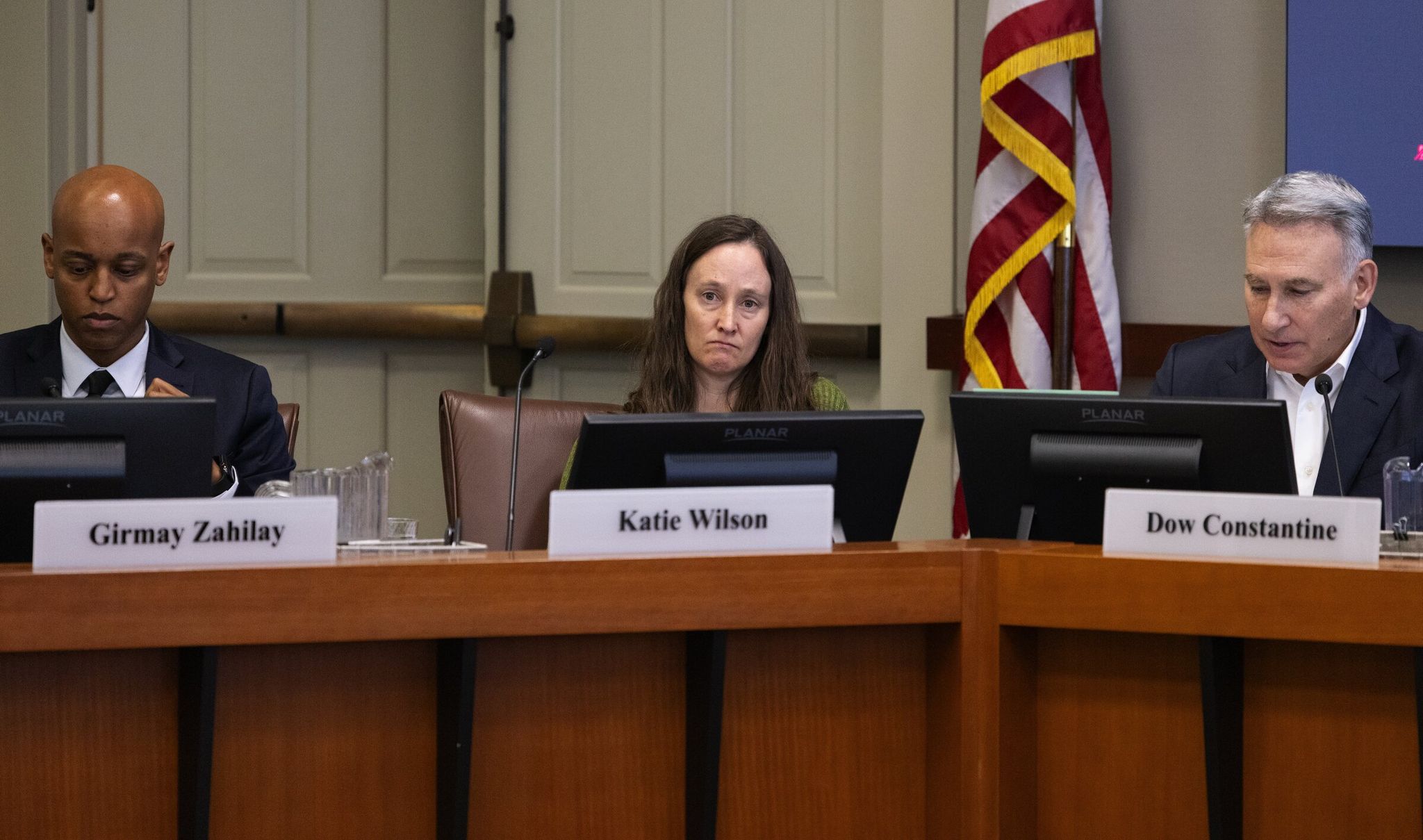
The obvious solution is to ask taxpayers for more money by creating an “ST4,” planned for a vote in 2024–2025, which could require yet higher taxes. The agency is already collecting roughly $700 per year from each regional resident: a sales tax of 0.9% on purchases (about $300–350 per year for the average resident), a property tax of up to $0.30 per $1,000 of assessed value (about $200–250), and a vehicle registration tax of up to $80 per year (about $100–150). Funds are distributed proportionally by population and route mileage: King County, where Seattle is located, receives 60–65%, Pierce County (Tacoma) 20%, and Snohomish County (Everett) the remaining 15–20%. Seattle Mayor Jenny Durkan—note: in the original Russian the name was given as Кэти Уилсон; if you meant Mayor Kate Wilson, replace appropriately—proposed exactly that, but suburban mayors resist. Nonetheless, the board voted for Durkan’s resolution — they understand that cutting Ballard alone won’t save the program. Residents may agree to pay more again because congestion in the region is growing, and alternatives — building new highways — are even more expensive and less popular.
Interestingly, only 3.5% of Sound Transit’s revenue comes from fares. In a crisis, it might be time to crack down harder on fare evaders. But back to the good: the system already runs very well — 122,000 riders per day, a 73% increase since 2019; trains connect Eastside campuses, stadiums, the airport and the university. Almost all the city’s key points are on the map. Seattle’s ridership is comparable to San Francisco’s (120–140k), but lags Portland, and technologically the system uses overhead power on dedicated tracks, which allows higher speeds but also higher infrastructure costs.
It’s time to ask: when will we say “this is good enough” and stop? Activists have already held funerals, hinting that a limit has been reached. Perhaps, instead of endless expansion, we should appreciate the great things already built.
Based on: Maybe the light rail system we’ve got is good enough