Three incidents involving injuries occurred in and around Seattle: a girl was hurt on a trail, a man was stabbed on a train, and a cyclist collided with a light-rail vehicle.
Girl Seriously Injured on Popular Washington Trail as Rescuers Took Two Hours to Reach Her
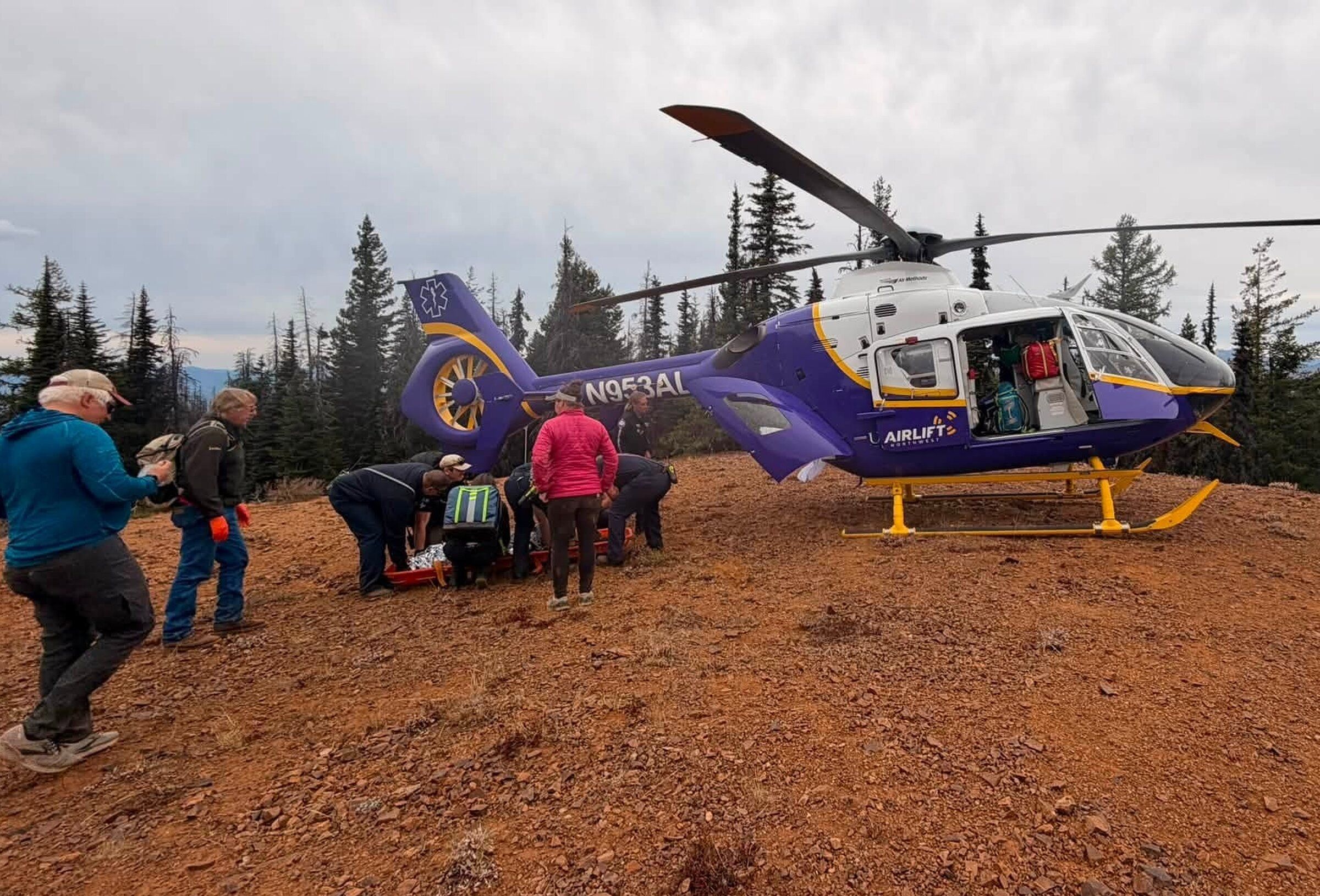
The incident occurred Saturday afternoon on the Red Top Lookout Trail in Kittitas County, about a two-hour drive east of Seattle. A 9-year-old girl who was hiking with her family fell from an agate deposit—a rocky outcrop popular with rock collectors—and suffered a deep wound to her right leg. Erin Meador, acting lieutenant with Kittitas County Fire District No. 7, said the girl’s parents called at 1:24 p.m. The incident was also reported by The Seattle Times.
About 30 rescuers from several agencies were dispatched to the scene. According to County Fire Chief Aaron Lowe, crews had to hike approximately two miles to reach the patient. Later that afternoon, the girl was airlifted to Harborview Medical Center in Seattle, the region’s largest trauma center.
The agate deposits near Red Top are well known among “rockhounds,” who search the area for thunder eggs and other glittering minerals. The trail leads to an old fire lookout and is considered relatively accessible for family outings, but the terrain remains rocky and dangerous in places. The combination of an apparently easy route and the area’s remote location makes incidents like this especially serious: even when rescuers are called quickly, it takes time to reach an injured person.
Lowe used the opportunity to remind visitors of basic wilderness-safety rules. He said people traveling in remote areas should be prepared for emergencies because help can be significantly delayed in such places. In practical terms, that means carrying extra water, a first-aid kit, warm clothing and communication equipment, as well as making an honest assessment of one’s abilities and the difficulty of the route—especially when children are part of the group.
This case is a typical example of how quickly an uneventful family outing can turn into a rescue operation involving dozens of people and a helicopter. It also serves as a reminder that the popularity of natural attractions such as agate fields is growing, along with the demands placed on emergency services that must work in mountainous and forested terrain. The girl’s condition was not reported as of publication; it was known only that her injury was serious.
Stabbing on Seattle Light Rail: Suspect at Large
Another incident in downtown Seattle has raised fresh questions about public-transit safety. A man was stabbed aboard a northbound Link light-rail train Sunday afternoon. The victim was taken to a hospital, while the attacker fled and had not been arrested when police released their initial reports. The case adds to concerns about how well passengers are protected in a system used by thousands of people every day.
According to information published by KOMO News, the call came in at 4:23 p.m. local time. The Seattle Fire Department responded to a report of a stabbing near the 1300 block of Third Avenue. Medics treated a man believed to be about 30 years old. His condition was described as stable, and he was transported to Harborview Medical Center. Seattle police confirmed that the incident occurred on the train but noted an important jurisdictional detail: the area falls under the jurisdiction of the King County Sheriff’s Office, so KCSO personnel responded. This division of responsibility is more than a formality. It can affect the speed and coordination of the response—especially when a suspect remains at large.
The stabbing occurred on a weekend, when downtown ridership is often higher than during work hours because of events, sightseeing and restaurant visits. Link light rail is not merely a transit service; it is a key artery connecting Seattle neighborhoods with the airport and surrounding communities. When a weapons-related crime occurs within such a system, it inevitably alarms passengers—particularly when the suspect is not immediately caught. For people who ride the trains every day, news that someone carrying a knife may be nearby and still free can feel like a direct warning of their vulnerability.
Several points may not be obvious from the brief report. Link light rail is a light-metro system operated by Sound Transit, but safety at stations and on trains may involve different agencies depending on the location. In downtown Seattle, the city police department and the King County Sheriff’s Office may have overlapping areas of responsibility, creating a complex response structure. When a report says an incident occurred within KCSO jurisdiction, it means that agency will likely lead the investigation rather than Seattle police, although city services may have provided the initial response. It is also important to understand that “stable condition” is a medical term that does not guarantee the absence of serious consequences; it indicates that the patient’s condition was not considered immediately life-threatening at the time of hospitalization.
It remains unknown what prompted the attack—whether it stemmed from a confrontation between passengers or was a random act of violence. Police did not release a description of the suspect, say whether anyone else was threatened with a weapon, or disclose how many people were in the train car at the time. That uncertainty is itself a source of stress for the community. In recent years, Seattle Link light rail has repeatedly become the focus of debates about safety, as passengers and transit employees have reported growing numbers of incidents involving drugs, aggression and mental-health crises. Each such attack fuels calls for increased patrols, more cameras and faster responses to alerts.
The central problem is not only the individual crime but also the systemic gap between passengers’ expectations and the actual capabilities of security services. When an attack takes place on a moving train, victims and witnesses have little time to summon help before the train reaches a station. If a perpetrator exits at one of the downtown stops, the person can quickly disappear into the crowd. That is why an immediate arrest is often impossible, leaving the suspect at large—as happened in this case.
The incident is a reminder that public-transit safety depends not only on cameras and fare gates but also on coordination between agencies, the speed of information-sharing and passengers’ willingness to report suspicious behavior. While police continue searching, Link light-rail riders must rely on vigilance and hope their next trip does not become the subject of another incident report.
Cyclist Injured in Collision with Light-Rail Train in Seattle
A cyclist was injured in a traffic incident in Seattle on Sunday afternoon. The collision occurred at the intersection of Martin Luther King Jr. Way and South Dawson Street, where a cyclist struck a light-rail train, known locally as Link light rail. According to a KIRO 7 News report, the injuries were not life-threatening, and train service resumed in less than an hour.
According to the Seattle Police Department, the victim received medical treatment. The train involved continued along its route within an hour of the incident, suggesting that neither the infrastructure nor the vehicle sustained significant damage. For readers unfamiliar with the local system, Seattle’s Link light rail operates partly on street-level tracks, creating potential intersections with other road users, including cyclists and pedestrians. The intersection of Martin Luther King Jr. Way and South Dawson Street is one such location, where tracks run directly along a city street and require heightened attention from everyone traveling through the area.
The incident once again raises questions about safety in mixed-traffic areas where light-rail tracks share space with cyclists and pedestrians. Although officials have not released details about how the collision occurred, the fact that the train resumed service so quickly suggests that the incident was relatively localized. For a city where light rail is expanding and becoming increasingly popular, incidents like this may signal a need for additional precautions, whether through improved road markings, warning signals or educational campaigns for cyclists and drivers. For now, the most important point is that the injured person received the necessary care and was not in life-threatening condition.