Seattle is facing delays in low-income social housing, losing ground as a technology hub, and at the same time recording a record 9.2 million visits to downtown.
Seattle’s Social Housing Project Stalls: Those Who Need It Most Are Left Outside
Seattle’s social housing program, conceived as a radically new approach to the problem of affordable housing, has encountered an unexpected obstacle at the outset. Seattle Social Housing Developer, the organization created to manage the project, failed to move tenants into its first building on schedule. As reported by The Seattle Times, the delay is particularly frustrating for applicants with the lowest incomes—the very people the initiative was created to serve.
The issue is that Seattle’s social housing is presented not as traditional subsidized apartments, but as a model in which rent is tied to a tenant’s income and does not exceed 30% of it. Access to these apartments is also supposed to be broader than in conventional low-income housing programs, while management is handled by a nonprofit accountable to the city. The first building became a kind of test: could the new developer launch the screening and move-in process quickly and without problems? The answer so far is discouraging—bureaucratic and organizational delays have slowed the move-in process for precisely those applicants whose incomes are at the lowest end of the eligibility range.
Seattle Social Housing Developer has not disclosed all the details of the breakdown, but it has confirmed that it intends to move forward and expand its portfolio of buildings. This suggests that investors and city officials still believe in the model, although the first attempt has not gone smoothly. For people with minimal incomes who have spent years on housing waiting lists, the delay is not merely a technical glitch but a loss of time and hope. Many applied precisely because social housing promised more transparent and less discriminatory selection rules than the private market and even some government programs.
The term “social housing” is important to understand precisely in this context: these are not municipal apartments in the Soviet-era sense, nor shelters for people experiencing homelessness. Rather, they are buildings constructed or acquired by a nonprofit operator, with apartments rented according to a fixed formula and management carried out with the participation of future residents. The key difference from the housing vouchers common in the United States is that social housing is tied to a specific building rather than to an individual, and does not depend on the whims of private landlords. That is why the move-in failure is so painful: it affects the most vulnerable group, for whom there are few alternatives.
The main lesson is that even the most progressive housing policy can be undermined by the routine of approvals and a lack of operational experience. If Seattle Social Housing Developer cannot quickly resolve the situation and demonstrate that the model works, not only the organization’s reputation but also political support for the entire program will be at risk. The question now is not whether the program will expand, but whether the first building will be able to accept residents at all—and when that will happen.
“The Warning Lights Are Already Flashing”: Why Seattle Risks Losing Its Status as a Technology Capital
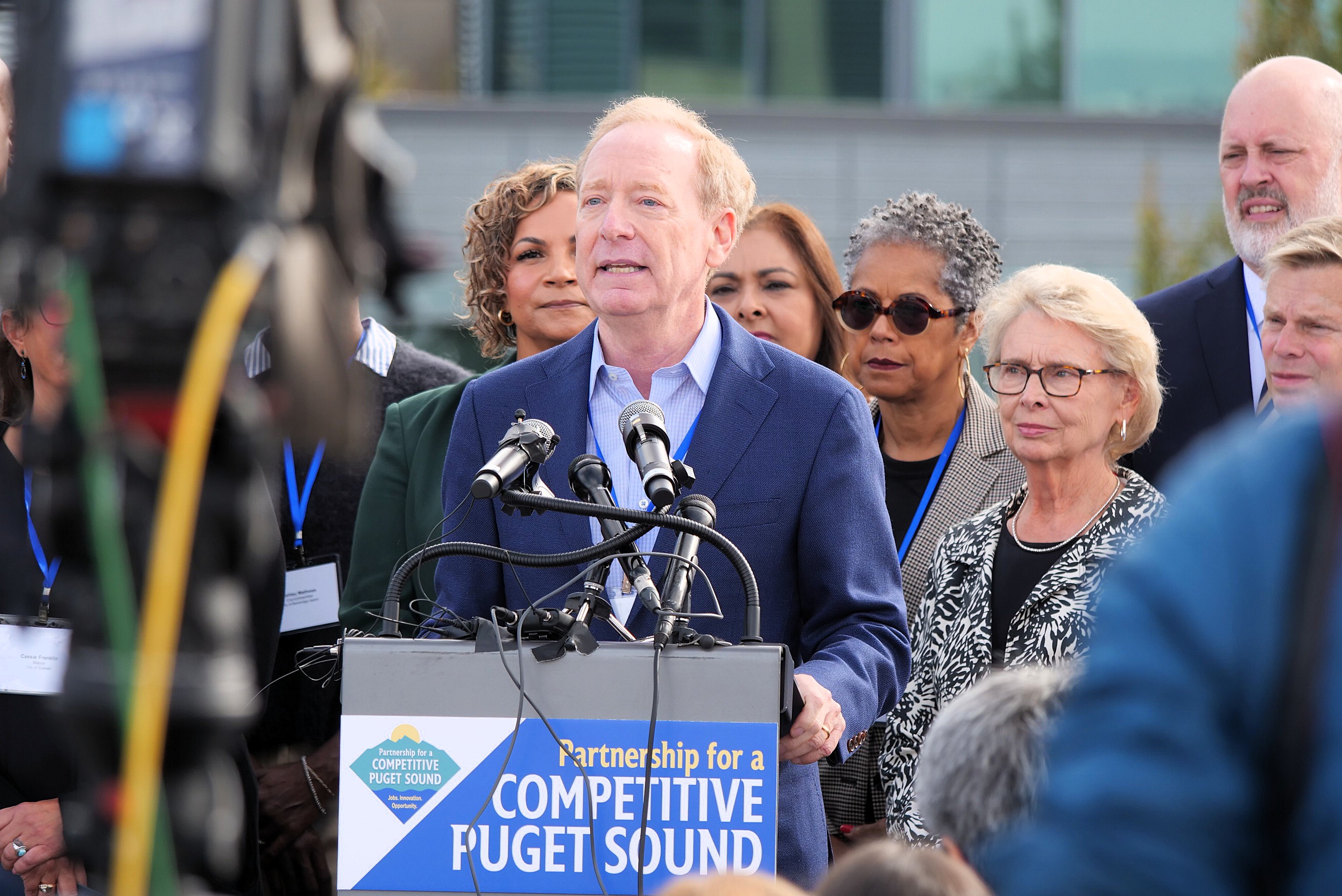
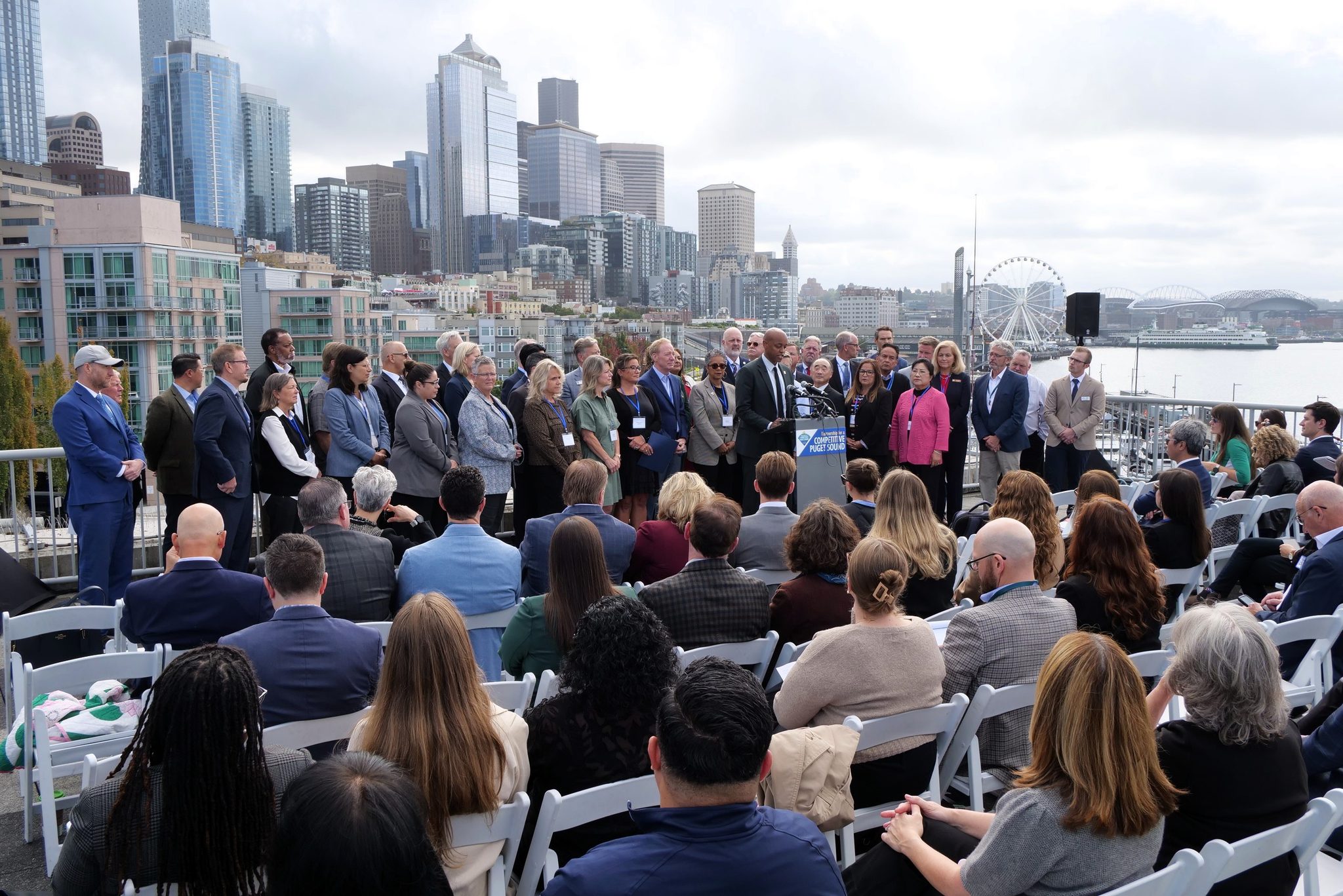
At the beginning of 2026, Seattle hosted an event that organizers deliberately described as a warning signal rather than another showcase of achievements. Against a skyline dotted with the offices of the world’s largest technology companies, roughly 50 elected officials from four counties—King, Kitsap, Pierce and Snohomish—gathered, including two county executives, around 20 mayors, port commissioners and a dozen state legislators, as well as labor leaders and business executives. The occasion was the launch of the “Partnership for a Competitive Puget Sound,” an initiative of Challenge Seattle that presented a 20-point plan to rescue the regional economy.
Brad Smith, Microsoft’s vice chair and president, speaking to those assembled, drew a direct parallel with Detroit, Cleveland and Pittsburgh. Each experienced its moment of glory a century ago, followed by inexorable decline because its leaders failed to notice the warning signs in time. “Well, here we are. It’s 2026,” Smith said. “And the warning lights are already flashing on our economy.”
His words sounded less like a metaphor than a statement of fact. According to the group’s report, the region lost nearly 7,000 jobs in 2025. For the first time in 20 years, excluding recessions and the pandemic, employment growth in the Seattle area lagged behind the national rate. Washington fell from 32nd to 47th in CNBC’s business-cost ranking between 2017 and today. More than one-third of the office space in the city’s central business district is vacant.
These figures provided the backdrop for the report’s central argument: although the technology sector accounts for nearly one in 10 jobs in the region and roughly one-quarter of its total payroll, it still lacks the kind of coordinated regional strategy that exists in the aerospace industry. As the document notes, aerospace knows what it is working toward—the next generation of aircraft, the space industry, sustainable fuel and supplier diversification—whereas technology, “despite being one of Puget Sound’s defining economic anchors, does not yet have an equally deliberate regional strategy.”
Without one, the region risks losing “jobs, technology investment, headquarters, talent and company growth” to the Bay Area, New York, Boston and Austin. The goal is framed not as simply stimulating growth, but as “protecting and strengthening the region’s position as a leading technology hub.”
It is important to understand that Challenge Seattle plans to develop this strategy jointly with the Puget Sound Regional Council, focusing on two priorities: persuading major technology companies to keep their investments in the region and making it easier for startups to scale. Related recommendations concern industrial sites for AI hardware startups, commercial real estate and a regional fusion-technology cluster.
The report contains no budget, measurable success criteria for the technology strategy or deadline beyond a general call for progress within three years. Many of the recommendations, however, involve not new spending but changes in how local governments operate: setting deadlines for permit decisions, appointing a business liaison in every city and county, and developing an approach to taxation at the state, county and city levels.
“This is a wake-up call for us,” said former Washington Gov. Chris Gregoire, who leads Challenge Seattle. “We cannot afford to rely on yesterday’s successes while tomorrow’s jobs are going somewhere else.” April Sims, president of the Washington State Labor Council, added that businesses need predictability and sufficient margins to invest, innovate and take risks—but “working people need margins, too.”
King County Executive Girmay Zahilay said his office had already hired an economic development team and begun an internal audit of permitting procedures, calling the loss of 7,000 jobs “deeply concerning” at a time when “AI is transforming our economy seemingly overnight.”
However, the central moment of the press conference came when GeekWire asked what it would take to bring Microsoft back to Seattle and expand its presence there, given that the company previously had offices in South Lake Union. Brad Smith first gestured toward Redmond Mayor Angela Birney, who was standing in front of him, and, to the laughter of the officials present, said: “We have a wonderful mayor, and every day we get up and happily go to work in Redmond, Washington.”
He then challenged the premise of the question, recalling that Microsoft had moved to the Eastside from Albuquerque in 1979 and had never maintained a large presence in Seattle, so he would not use the city as a point of comparison.
He then turned to taxes—specifically Seattle’s JumpStart payroll tax, adopted in 2021. Under its current structure, he said, the tax “is really a tax on technology jobs, and that’s why you see more and more technology jobs move from Seattle to places like Bellevue and the Eastside.” Smith noted that San Francisco repealed its payroll tax in the same year Seattle introduced its own.
“You should tax what you want to discourage—cigarettes, for example—not jobs,” he said. He linked the issue to AI’s broader impact on employment: “We need people to thrive, to some degree, in an AI world. And you don’t want to make the cost of hiring people higher at a time when AI is adding its own new form of competition.”
In his view, “nothing will lead to job losses in this state faster than replicating the JumpStart tax.” If Seattle wanted to do one thing to increase the number of jobs, he said, it should reconsider whether a payroll tax made sense at all. He added a caveat: “It would probably affect other companies more than Microsoft.”
Amazon, which is reportedly the largest payer of the tax, did not have a speaker at the event, although several company executives are listed in the acknowledgments of the Challenge Seattle report, with a note that participation does not imply endorsement.
The view from Olympia, the state capital, added a political dimension to the picture. State Senate Majority Leader Jamie Pedersen, a Seattle Democrat, was asked whether Washington risked becoming an outlier among states on taxes. He replied that the Legislature was adjusting course, citing two examples from the current session.
The first was the estate tax. Lawmakers raised the top rate to 35% in 2025, the highest in the country, then repealed that decision in March 2026, restoring the rate to 20% effective in July.
The second was the “millionaires’ tax,” a 9.9% rate on household income above $1 million, signed by Gov. Bob Ferguson and expected to generate approximately $3 billion a year. It will not take effect until 2028, and Seattle technology leaders have warned that it will drive founders and investors out of the state.
Pedersen presented the tax as correcting another form of outlier status: Washington’s business and sales taxes are high because it is one of the few states with no personal income tax at all. The new tax, he said, would allow Washington to “join the 41 other states that have a personal income tax.”
The final word will belong to voters in November. Initiative 645, backed by the Let’s Go Washington group, qualified for the ballot in July and would repeal the tax. If the initiative survives, Pedersen said, introducing a statewide payroll tax in the next legislative session would be “extremely unlikely.”
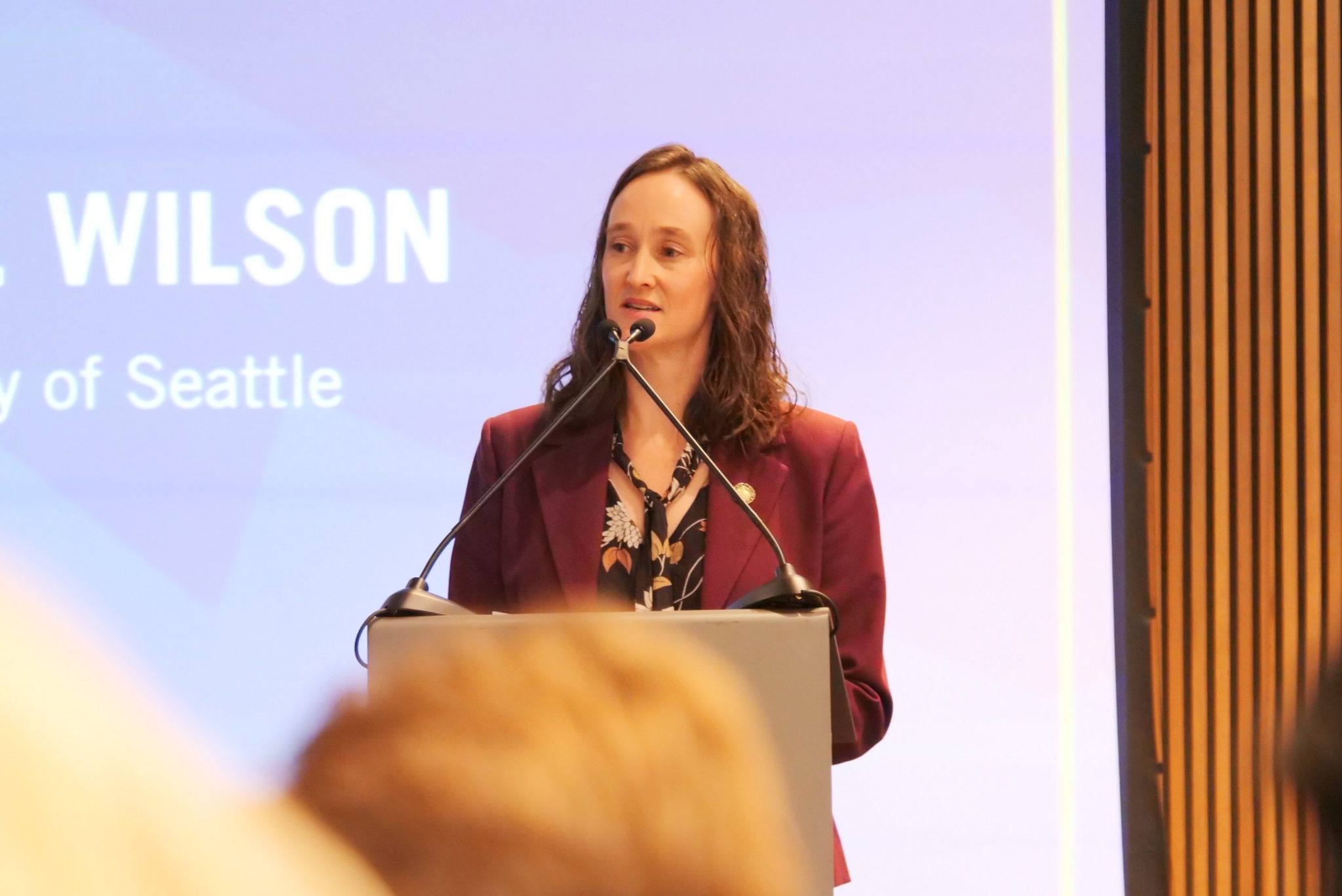
Seattle Mayor Katie Wilson, who helped design the JumpStart tax before running for office, did not speak at the press conference but opened the regional session that followed. She said the region needed to tell its own story better: “We
Downtown Seattle Comes Back to Life: Record 9.2 Million Visits in August
After several years in which downtown Seattle was associated more with troubling news about vacant offices and shuttered storefronts, a new report from the Downtown Seattle Association (DSA) paints a very different picture. According to data published this week, 9.2 million people visited downtown in August this year—12% more than in August 2019, the pre-pandemic period that was long considered an unreachable benchmark. It was also the busiest month in more than seven years, since July 2019.
The figure of 3.8 million unique visitors is impressive as well, although, as the DSA notes in its report, it includes only domestic, or U.S., travelers; international visitors are not included in the statistics.
John Scholes, DSA’s president and CEO, makes no secret of his optimism. “The number of people coming downtown remains one of our strongest indicators of progress,” he said. “August was our busiest month in more than seven years.”
The traffic data supports his assessment: compared with August last year, visitation rose by 24%. This is more than a recovery—it is solid growth, suggesting that residents and visitors once again see downtown Seattle as a place for leisure, not just work.
The hotel sector is particularly revealing. Downtown hotels sold nearly 429,000 room nights in August—6% more than in August 2019 and 3% more than a year earlier. Such occupancy typically indicates that people are staying overnight rather than merely visiting the city for an hour, in order to see the waterfront, theaters, restaurants and cultural events.
Scholes directly attributes this to the fact that “people are choosing downtown Seattle for its waterfront, arts and culture, restaurants, events and other experiences.” Consumer spending is also rising: according to Datafy, $164,958,003 was spent downtown in July, 5% more than the previous month.
Not all indicators have returned to their previous levels, however, and this is an important nuance in understanding the overall picture. Office workers still represent only 62% of the 2019 level—an average of about 150,000 people per day. That figure has remained roughly stable for several months, reflecting a lasting shift toward remote and hybrid work.
In other words, downtown is recovering not because corporate employees have returned, but because of tourists, local residents and cultural-event visitors. This is fundamentally different from the pre-pandemic model.
It is also worth noting that during the first eight months of 2026, the DSA/MID Clean Team collected 731,054 gallons of trash—more than an Olympic-sized swimming pool, as the association itself put it. The detail is a reminder that rising visitation also creates additional pressure on the city’s infrastructure and services.
A March State of Downtown 2026 report showed that downtown visitation exceeded pre-pandemic levels for the second consecutive year: more than 15 million people visited in 2025.
What does it all mean? Downtown Seattle is gradually transforming from a business district into a round-the-clock space for living and leisure. The sustainability of this shift, however, depends on whether the city can maintain a balance between a growing flow of visitors and the continuing problem of half-empty office towers. For now, August’s figures suggest that the chosen strategy is working—but time will provide the final test.