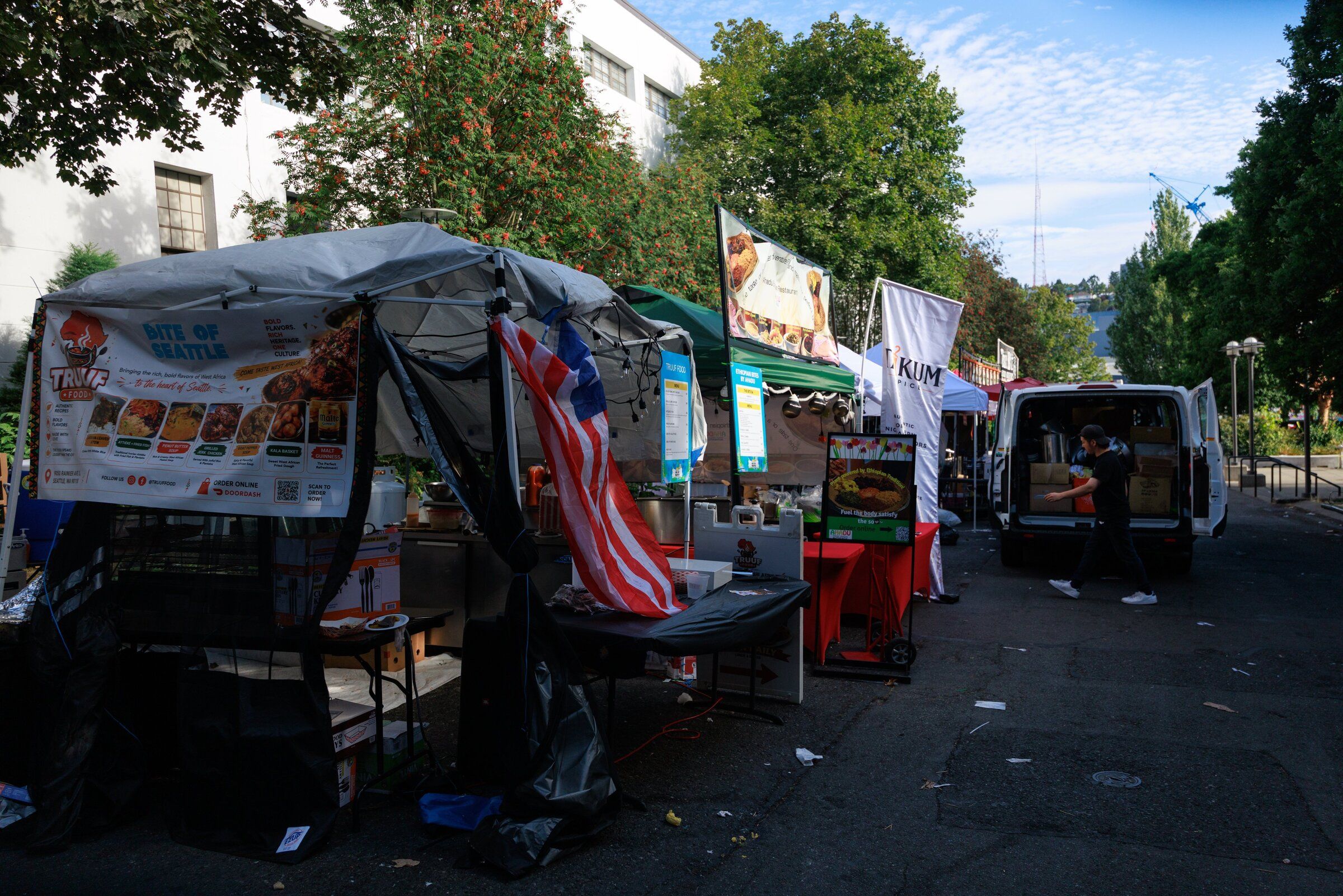
In Seattle, investigators are looking into a shooting at the Bite of Seattle festival: ballistics has shown that the bullets that killed bystanders may not have been fired from the weapon of the arrested teenage suspect. Meanwhile, the Seahawks are looking for a replacement for Nick Emanuwori and preparing for the 2026 season with high expectations from bookmakers.
Shooting at Seattle Center: the bullets that killed bystanders may not have come from the teen’s “ghost gun”
Sunday evening in Seattle, when the Seattle Center hosted the final day of the Bite of Seattle food festival, the scene turned into a full-scale massacre. Three people died, and at least four were injured. Police arrested the only suspect — a 15-year-old teenager — who reportedly had on him what is known as a so-called “ghost gun,” a firearm without a serial number. However, fresh court documents cited by The Seattle Times introduce an unexpected twist: ballistics testing found that bullets recovered from the bodies of two people killed on the scene were not fired from the weapon of the detained teenager. That means the true picture of what happened is far more complicated than it initially seemed right after the tragedy.
The way the incident unfolded raises questions about just how chaotic and dangerous the gunfight was in a crowded public place. According to the King County Prosecutor’s Office, the shootout involved at least four pistols. At the scene, police found three weapons: a homemade Polymer80 9mm pistol with no serial number; a compact Springfield Armory 9mm that, apparently, never fired; and a Glock 45 9mm with an extended magazine and an illegal “switch” that allows automatic fire. The shell casings found on pedestrian walkways west of the Armory building came in different calibers — several clusters of 9mm casings, one separate 9mm casing, and a cluster of .40-caliber casings. Yet police did not find any .40-caliber pistol at the crime scene at all. This further supports the idea that at least one shooter escaped, and police continue searching for him.
A particularly grim detail surfaced in the charging documents. After police escorted the 15-year-old teenager past the body of 19-year-old Jjuniour Niko-Semo, one of the deceased, officers reportedly heard the young man say, “Love you, bro.” The phrase was most likely addressed to the person who was killed, suggesting the shooters were known to each other — or may even have been in the same circle. Police had previously said they believe the shooting may be gang-related, but the charging documents so far do not include any references to anyone’s gang affiliation.
The teenager has been charged with assault in the first degree with use of a firearm, as well as unlawful possession of a firearm. Initially, his arrest and charges appeared to fit an obvious storyline: he was seen shooting at a crowd, he attempted to flee, police found a “ghost gun” with an extended magazine in his jacket along with a grip panel bearing the phrase “1 SHOT 1 KILL” — “one shot — one kill.” But now, with ballistics excluding his weapon as the one that killed two random bystanders — 44-year-old Carlos Israel Sanchez Villalba and 56-year-old Ashley Whitehead — the narrative has become less clear-cut. The deadly bullets appear to have been fired by someone else.
A first-degree charge assumes the teenager shot at the crowd, which in itself is an extremely serious crime, even if his bullets did not kill anyone. But the key question — who exactly fired the shots that killed the victims — remains unanswered. The prosecution can at any time add charges or charge other individuals if it gathers sufficient evidence. For now, police have not turned over a murder case to the court against anyone. The suspect’s fate is also unclear: prosecutors have filed a motion to move his case from juvenile court to adult court. For a 15-year-old, that could mean a much more severe sentence if he is found guilty, though the process of transferring the case could take months.
Witness accounts depict a scene full of chaos. One eyewitness told police that the first shots were fired by a man in a light-blue shirt, who then ran south along the west side of the Armory building. Almost simultaneously, a second man — in a white shirt, jeans, and a black jacket — pulled a pistol with an extended magazine and started shooting at the first man. The witness characterized his shooting as “uncontrolled” and said he heard a sound like an automatic burst. Another video shows no picture, but there is audio: first four separate shots, then an automatic burst, and at the end two more single shots. All of this occurred in front of dozens of people who had come to the festival.
The tragedy once again brings up painful topics for America: the availability of homemade, untraceable weapons, and blurred lines of responsibility when multiple people are involved in a shootout and police arrest only one. “Ghost guns” are firearms assembled from parts kits and have no serial number, making them nearly invisible to authorities. The fact that the 15-year-old had such a gun with a bold inscription raises questions about how a teenager even obtained a weapon capable of automatic fire — and why no one noticed earlier. But an equally pressing question is where the other participants in the shootout are now, who may be responsible for the deaths of two people who had simply come to enjoy the festival.
On Wednesday evening, for the second time in three days, Seattle residents gathered at the plaza by the fountain for an impromptu memorial. People left flowers and notes on wooden boards. One sign read, “Fix the Second Amendment!” Another, simpler and more bitter one was addressed to everyone at once: “So, so sad. What else can you say? I’m sorry.” Those words likely best capture the sense of helplessness gripping the city when, after yet another shooting, there are more questions than answers.
Who will backstop the Seahawks: options to replace Nick Emanuwori at season start
Seattle faces a tough situation: after an ankle operation suffered by standout safety Nick Emanuwori, his availability for the season opener against the New England Patriots on September 9 remains in question. Emanuwori is an exceptionally rare hybrid defensive back who, on his own, can cover multiple roles at once. At 6-foot-3 and 220 pounds, he can play linebacker against heavy offensive packages as well as nickel cornerback in lighter formations. There is no direct replacement for such a versatile player, so the coaching staff will most likely need to take a collective approach, redistributing his snaps among several players.
As senior reporter Albert Breer notes in his impressions from Sports Illustrated’s Seahawks training camp coverage, Emanuwori’s absence gave safety D’Anthony Bell and linebacker Tyrice Knight a chance to step up. Bell, listed at 6-foot-1 and 211 pounds, already has experience in this kind of role: last season he recorded 96 defensive snaps for Seattle, including 33 in Weeks 2 through 4 when he filled in for the injured Emanuwori. Bell’s stat line includes half a sack, one sack for a loss of yards, and 15 tackles, but he missed the team’s Super Bowl-winning run because on December 31 he was claimed off waivers by the Carolina Panthers.
Knight, selected in the fourth round of the 2024 draft, started nine games as a rookie. But due to a knee injury and heart issues that surfaced even before training camp, he lost a spot in the starting lineup to breakout Drake Thomas. Still, when he was called back into the fold — in Week 10 in place of Ernest Jones IV — Knight responded with two nearly identical forced fumbles. He fought through the Arizona offensive line and knocked the ball free from quarterback Jacoby Brissett. In both instances, his teammate DeMarcus Lawrence recovered the loose ball off the bounce and returned it for a touchdown.
Jones and Thomas remain Seattle’s starting linebacker duo for 2026, but the idea of using Knight as an Emanuwori sub has support among local experts. Mike Salek of Seattle Sports, on the Brock and Salk program, said Knight is a fast linebacker and that if he is the second-best player on the field, the team needs to find a way to get him on the field regardless of his formal position. Salek acknowledges that Knight likely won’t drop into coverage as deeply as Emanuwori, and he isn’t a perfect equivalent, but the opportunity to use another good player and play slightly differently is the kind of creative freedom that can benefit the team. The only question is how quickly Emanuwori returns, and whether Bell and Knight can cover the unique zone their hybrid partner typically controls.
Seahawks in 2026: champions among the favorites, but repeating success is a delicate bet
The Seahawks’ remarkable season was just as impressive from a betting perspective. The team that, before the start of the season, almost nobody took seriously didn’t only reach the title — it did so in a way that will become part of sports-betting history. In preseason odds, the Seahawks were priced at 60-to-1 to win the Super Bowl, the longest longshots since the 2001 New England Patriots, and the second-longest odds across the last 50 seasons, according to SportsOddsHistory.com. Against the spread (including the playoffs), Seattle went 15-5, their best mark since the 2016 season, when the Patriots finished the year 16-3 ATS. Now, Mike Macdonald’s team faces a far more difficult task: confirming their status, dealing with inevitable regression, a tougher schedule, and a new offensive coordinator. In eight of their last nine seasons, Seattle finished the regular season above their win-total number, but this year — for the first time in nearly a decade — they’re being asked to clear a line set this high.
Heading into the 2026 season, the reigning Super Bowl champions are among the favorites: a 11-to-1 price on repeating their Valentine’s Day success puts them fourth among all NFL teams. Seattle will also try to defend the title without offensive coordinator Clint Kubiak and without Super Bowl MVP Kenneth Walker III, who has left the team. Kubiak is replaced by Brian Flouree, for whom this is his first experience calling plays. He knows quarterback Sam Darnold from their time working together in San Francisco, and his job is to maintain continuity in the scheme, keep playing at a fast pace, and assign roles in the offense effectively. To make up for Walker’s departure, the Seahawks took a running back in the first round of the draft, Jadarian Price from Notre Dame, who is expected to become the foundation of the backfield until Zak Charbonnet returns. Under Macdonald, and with defensive coordinator Aden Durr still in place, Seattle expects to build the game around its defensive identity, while a tight prime-time schedule will add extra demand and attention.
Interestingly, the Seahawks’ win-total line for the 2026 season is set at 10.5: “over” is minus 115, “under” is minus 105. The price for a Super Bowl win is 11-to-1, for a win in the NFC it’s plus 600, and for winning the NFC West it’s plus 205. A playoff berth is priced at minus 225, versus plus 184 that they miss the postseason. Reminder: last season Seattle finished 14-3 and won the Super Bowl. ESPN analyst Mike Clay projects 11.2 Seahawks wins in the new season, which ranks fourth in the league.
The main bet ESPN highlights is the ground-yard total for rookie Jadarian Price: “over” 749.5 rushing yards at minus 110 odds. There’s a caveat: Charbonnet, who tore his left knee’s anterior cruciate ligament in the divisional round of the playoffs, will need time to recover. Even when he returns, that doesn’t guarantee he will immediately return to his previous level. With Charbonnet out, Seattle used the first-round pick on Price, who at Notre Dame in 2025 had 11 rushing touchdowns and averaged 6.0 yards per carry. He’s viewed as an assertive running back who runs well toward the line and has an impressive ability for long runs. Price is projected to get at least 12 carries per game on average, and if he has a healthy season with an average of at least 4.0 yards per carry, he should top 800 rushing yards already in his rookie year.
For those who aren’t deeply immersed in betting, it’s worth explaining a few key terms. ATS, or “against the spread,” means the bet isn’t on pure wins or losses, but on the point difference accounting for the spread. The win total is the line a sportsbook sets for how many games a team will win in the regular season, and a bettor chooses whether the team will do better or worse than that number. “Over” and “under” are bets on the total being more or less than the line. Minus 110 means that to win $100, you have to bet $110. Plus 600, for example, means a $100 bet would return $600 in profit. In plain terms, the Seahawks aren’t priced as highly as they were last year, but they also aren’t absolute favorites. Several other top teams sit in their place, and the 10.5 win-total line reflects both respect for the reigning champion and doubts about whether the team can repeat that phenomenal season.
In an ESPN piece, it’s emphasized that Seattle has failed to reach its win total only once in the last eight years — but now they face a mark they haven’t seen in almost a decade. The departures of key players, a change in offensive coordinator, and a tougher schedule all create the conditions for Macdonald’s team to find itself in an unfamiliar role as a closely watched favorite. Still, it’s often teams in that situation — like last season proved — that become some of the most interesting betting stories. The question is whether Seattle can handle the pressure of expectations and avoid the fate of many champions who fall the following year. A bet on Price looks sensible, but it still depends on Charbonnet’s health and how quickly the rookie adapts to the NFL level. For now, though, bookmakers and analysts agree on one point: the Seahawks are a team you can’t write off, but nobody is offering guarantees of success in 2026.