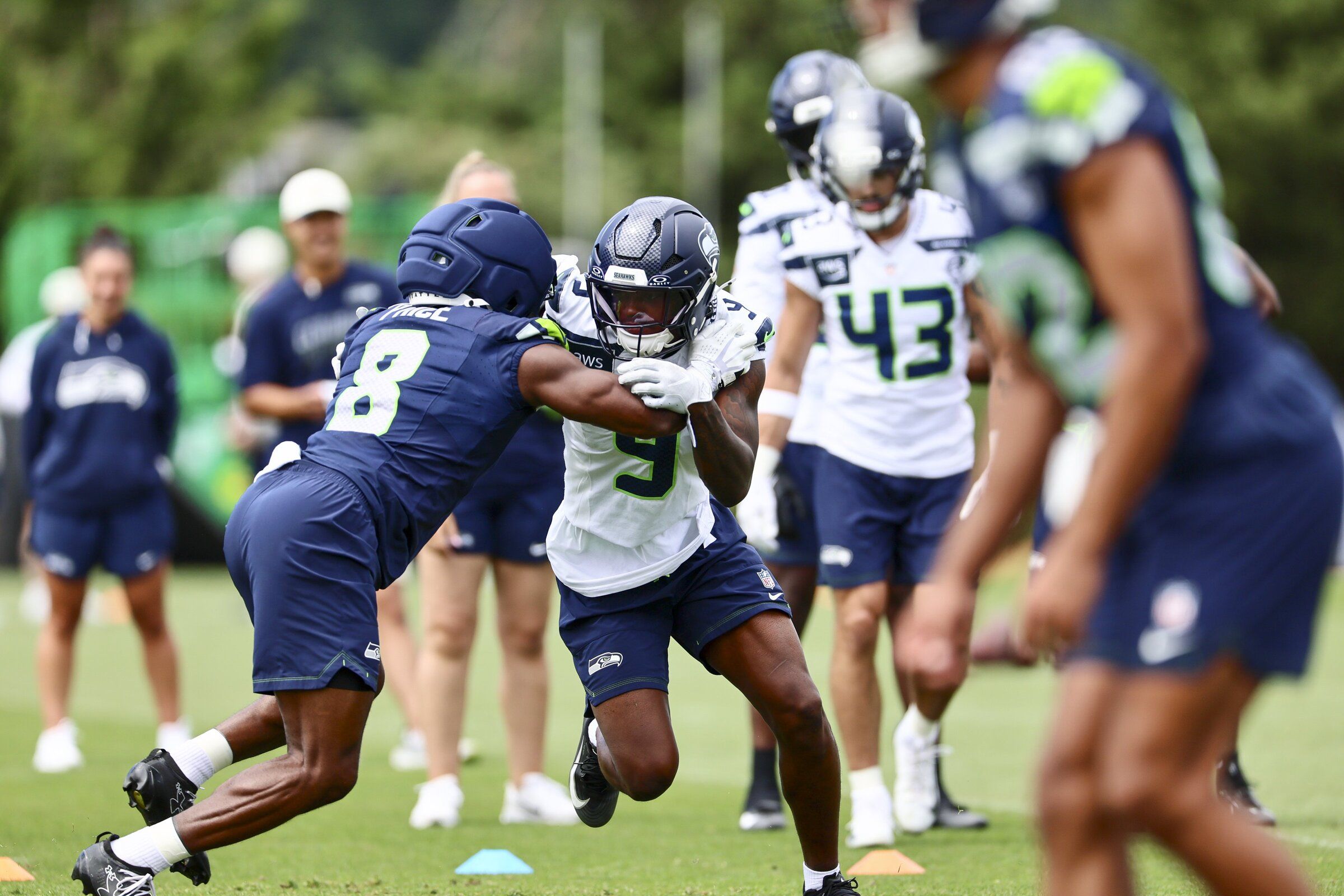
In today’s digest: Seattle’s real-estate market is cooling, but prices remain extremely high; the city has landed in the top ten for the most expensive places to own a car; and the Seahawks training camp has delivered scuffles, injuries, and footage for Hard Knocks.
Seattle: Housing market weakening, but prices still out of reach
After many years of rapid growth, Seattle’s housing market has turned into one of the weakest in the United States. According to fresh data published in a Yahoo Finance piece, home prices in May fell 1.8% year over year— the second-largest drop among major U.S. cities. Inventory of available homes rose by dozens of percent, and the number of deals fell another 6.4%. Even so, amid this noticeable slowdown, Seattle has not stopped being one of the most expensive markets in the country: in June, the median home price in the region was a staggering $738,000.
The market, at the same time, has become oddly polarized. As Keller Williams Realty Greater Seattle broker Lee Pham notes, two buyers can have completely different experiences depending on the neighborhood, price tier, and property type. For example, Pham’s clients who were looking for a single-family home with a yard kept finding themselves at the center of bidding wars, while buyers of new construction could afford to take their time—their options are so plentiful that there’s simply no need to rush. In the northern parts of the city, demand for single-family homes remains very high, while condominiums across the region and high-end housing in expensive eastern suburbs have clearly softened.
There are several reasons for this setup. On the one hand, tech giants continue cutting jobs, undermining buyers’ confidence in the future. On the other hand, even after small price declines, housing remains unaffordable for many. Another factor is the growth of homeowners associations: buyers are increasingly shying away from older condominiums due to concerns about constantly rising fees and special assessments for repairs. At the same time, over the past few years developers have been building aggressively, and now some are running into the fact that finished homes are sitting on the market far longer than usual.
John L. Scott Real Estate broker Madyson Arthur describes the situation well: in the last couple of years, the market slowed down, but low supply meant it didn’t matter critically. Now, she says, a turning point has finally arrived—homes that have been unable to find buyers remain unsold, while more and more new listings hit the market. New construction is especially telling. In recent years, Seattle has approved far more projects than large West Coast cities like San Francisco and Portland, and on a per-capita basis it has even surpassed Los Angeles. That supply is now outpacing demand, particularly as the regional labor market weakens. Analysts at John Burns Research and Consulting say new home sales in Seattle have fallen to levels not seen since the financial crisis. Even D.R. Horton, one of the country’s biggest homebuilders, acknowledges problems in the Northwest: CEO Paul Romanowski says the company is seeing “a little more weakness” there than it would like.
In essence, Seattle has found itself in an unusual position: the market is cooling in multiple directions at once, but prices remain extremely high for most residents—and high costs themselves deter many would-be buyers. This feedback loop makes the current correction especially painful: even a meaningful drop in demand has not yet led to a radical decrease in housing prices, and affordability continues to be the region’s main problem. The market is clearly going through a restructuring phase, where some segments still retain competitive heat while others have already settled into a prolonged cool-down.
Seattle ranks in the top ten for the most expensive places to own a car
A new study by Plasma One, a neobank that works with stablecoins, put Seattle at No. 6 on a ranking of America’s most expensive cities for owning a car. The study’s authors relied not only on obvious expense items like insurance and fuel, but also on less obvious factors such as time lost in traffic, median income, and the overall cost-of-living level. This approach gives a full picture: for some cities, the biggest burden is high gas prices; for others, relatively modest salaries paired with significant spending; and for a third group, the hours spent stuck in traffic also carry a price tag.
Seattle stands out among other major metros with a fairly unusual combination of indicators. On the one hand, it has the second-highest median income among all cities in the top twenty of the ranking—$121,984 per year. On the other hand, residents pay some of the highest fuel costs in the country: on average $2,912 per year, based on the average American driver’s 13,500 miles of driving per year and average fuel economy of 26 miles per gallon. Insurance is also not cheap—about $2,199 per year. But perhaps the most interesting metric is the cost of time lost in traffic. Here, Seattle falls only behind New York and Chicago: the average annual “price” of traffic is $2,373.88. The result is that even with relatively high incomes, Seattle residents still carry a heavy daily burden tied to commuting by car.
Philadelphia topped the unfavorable list, and not so much due to extremely high gas prices or insurance, but because it has the lowest median income among cities in the top twenty. The most expensive places to own a car also include New York, Chicago, Los Angeles, and Houston. Right behind Seattle are Jacksonville, San Antonio, Washington, and Nashville. As MyNorthwest notes, Seattle landed on the list largely because of high fuel costs and significant time losses on the road, which the study converted into monetary terms.
To understand the methodology, it helps to clarify a few terms. Median income is a measure that divides a city’s residents into two equal halves: half earn more, half earn less. Unlike the arithmetic average, it’s less affected by ultra-wealthy residents, so it better reflects the typical income level. A stablecoin neobank is a digital bank that deals with cryptocurrencies pegged to the dollar, reducing their volatility. For this study, it’s less the nature of the company’s business that matters than the methodology: it used publicly available data on insurance, gas prices, traffic statistics, and population income. The calculation of annual fuel costs is built on the national average annual mileage and average fuel economy, so the numbers may differ for a specific driver—but for comparing cities, this approach is fairly indicative.
The main takeaway from the ranking is that high pay doesn’t always offset the costs associated with owning a car. Seattle is a clear example of a city where people earn a lot but still spend a significant portion of their budget simply to be able to get around by car. Traffic is especially telling: each year, drivers lose time that could be spent working or resting, and that’s a real economic loss. For city officials, it’s a signal that investing in public transportation, bike infrastructure, and alternative ways of getting around could prove more beneficial than trying to fight gas prices or insurance rates. For residents, the ranking is a prompt to consider whether leaving the car at home sometimes might be more worthwhile—especially given that car ownership in Seattle is noticeably more expensive than in many other major U.S. cities.
A hot day at Seahawks camp: scuffles, injuries, and footage for Hard Knocks
Day six of Seattle Seahawks training camp turned out to be the most packed and emotional since the team’s practices began. The team worked in full pads for the first time in several days, and it immediately showed: two fights broke out on the field, which will almost certainly become highlights of Hard Knocks, the documentary series that follows the team during the offseason. The first episode of the show is scheduled to air as early as Tuesday, and NFL Films producers clearly got lucky to be in the right place at the right time.
The intensity on the field had been building even during pass-block drills, but the real flare-up came during team work. It started with a sequence in which tight end A.J. Barner caught a pass and ran forward, and safety?—defender?—Leonard Williams tried to stop him. The players exchanged a couple of words, and Barner clearly didn’t like how aggressively he was being met—after all, under camp rules it’s not allowed to take a player to the ground. A couple of plays later, Williams and offensive lineman Bryce Cabledew began shoving, and then linebacker Derrick Hall stepped in, backing Williams and driving Cabledew to the ground. That triggered a mass collision, but it quickly died down. A few plays later, Cabledew was back at the center of another scuffle, this time with Connor O’Toole, but coaches put out that incident just as quickly, sending players back to work.
Despite the hot heads, the locker room after practice was calm. Cornerback Byron Murphy II?—(as written) actually “Byron Murphy II”—explained it simply: in his view, that’s a normal part of the training process, when players try to get better and competition reaches a new level. He stressed that nothing personal is happening in these scrapes—everyone is still family—intensity just sometimes goes over the top.
A far more serious issue was a run of injuries. The biggest concern was reserve linebacker Chris Paul Jr., who after a collision had trouble getting up for a long time and ultimately left the field on an electric cart with suspicion of a leg injury. Late in the session, defensive—? actually the text says “main middle linebacker Ernest Jones IV”—MIDDLE?—Ernest Jones IV also went to the locker room with a coach; he had already had a leg issue earlier. Starting right guard Anthony Bradford missed the second half of practice but stayed on the field, and his situation remained unclear. In addition, defender Mike Morris and linebacker Jamarquis Weston left with injuries of varying severity. After practice, coach Mike Macdonald didn’t speak with reporters, so details on all the injuries are not yet available.
One notable personnel moment was the appearance at right guard with the first team of Mason Richman. Bradford left before team sessions began, and Richman, selected in the seventh round in 2025 from Iowa, got a sizable share of repetitions with the starters. Typically, Christian Haines was viewed as the backup option at that spot—he also received chances with the first group—and Bo Stevens, taken in the fifth round in April. It’s possible coaches just wanted to see Richman in action, but if they start using him more often, the battle for the right-side backup job could take an unexpected turn.
The intrigue at the running back position continues on offense. Zak Charbonnet remains on the injured list, so the current main trio looks like first-round rookie Judarrius Price, third-year George Holani, and free agent Emanuel Wilson. Price is expected to become the primary ball carrier, Holani a specialist on third downs and in the two-minute offense, and Wilson will be used situationally. At practice, Price and Holani split first-team reps about evenly, so a final division of roles is still unclear.
The atmosphere in the stands also deserves special mention. The club’s vice chairman Burt Kold was in attendance, watching from the backdrop of an unfinished sale of the team to the Khosla family group. Legendary coach Tony Dungy also came to camp—McDonald considers him a mentor. After practice, Dungy spent a long time talking with receiver Jackson Smith-Njigba. Safety Nick Ehmmanwori, recovering from an arthroscopic ankle surgery, was on the field and signing autographs for fans.
Among the standout game moments, tight end Elijah Arroyo made a leap to catch one of the longest passes of the day from Jalen Milroe, jumping over defensive back Michael Dan(n)sby’s?—as written “cornerback Michael Dansby.” Tight ends Nick Kalu(r)up? and the previously mentioned Barner also drew praise, with Barner’s burst serving as a catalyst for the scuffles. Josh Job(e)y from the defense made an excellent breakup of a pass by Sam Darnold in the end zone, preventing Cooper Kupp from scoring in the red zone. Milroe worked primarily with the third group again, while Drew Lock was the backup quarterback. Cornerback DeVonta(e) Witherspoon, despite the unresolved contract situation, got on the field for all the drills.
The day showed the team is starting to find its form—emotionally and physically. Training camp is always a balance between intensity and common sense, and for now coaches are managing to keep things under control. However, Jones’ and Paul’s injuries are a troubling sign that adds work for the medical staff. There are still many more days of camp ahead, and how the team handles both losses and high intensity will largely determine its readiness for the season. More on the progress of the camp can be read in a Seattle Times report.