The Mariners’ general manager updates the recovery of four players, a viral video in Seattle shows a bat attack at a pride event, and the World Cup has disappointed small businesses in the Chinatown-International District.
Updates on Four Injured Seattle Mariners: Who and When Will Return?
Mariners general manager Justin Hollander, ahead of Monday’s game against the Los Angeles Angels, went into detail about the status of four players who are on the injured list but are expected to return to the field this season. They are utility player Brendan Donovan and three right-handed relievers: Matt Brash, Cooper Criswell, and Carlos Vargas. Hollander said all are making progress, though their recovery timelines differ.
The most encouraging news involves Donovan, whom the team acquired in the offseason via trade. He has been sidelined since mid-May with a left groin strain. According to Hollander, the past week was a major step forward for Donovan—he completed a full workout in the batting cage and even ran the bases, though the intensity, as the manager assessed, was moderate. The complication is that the injury is further complicated by an offseason surgery to remove a sports hernia—Donovan had previously been told that full recovery could take anywhere from eight months to a year. Hollander emphasized that the nature of the damage makes it impossible to name a precise start date for Donovan’s rehab assignment in the farm system. Still, the player appeared at the stadium before the series with the Angels with a fresh haircut—something even the general manager noted. So far, Donovan has played 25 games, putting up solid numbers: .274/386/.452 with three home runs. He has been the regular third baseman and batted first against right-handed pitchers. As Seattle Sports reports in an article, Hollander hopes that by the end of the current home series it will be clearer when Donovan can begin playing in the lower leagues.
As for the bullpen, Matt Brash and Cooper Criswell are recovering in parallel. Brash is dealing with inflammation of the right lat muscle (the second time in the season with the same issue), while Criswell has a strained chest muscle. Both have a follow-up MRI scheduled for July 6, after which the Mariners will adjust their plans. Hollander expects them back around August—more likely mid- to late-month than early, depending on the scan results. Brash has already logged 20 appearances with an outstanding 0.54 WHIP and 15 strikeouts over 16.2 innings. Criswell, in his first season in Seattle, has comparable numbers: a 3.52 ERA over 30.2 innings across 26 games.
Carlos Vargas is the least clear. He hasn’t played this season at all due to the same right lat muscle injury. His throwing program has continued unchanged since mid-June. Vargas was useful last year, finishing the season with a 3.95 ERA over 77 innings, but when he’ll return remains unclear.
So the Mariners are gradually getting reinforcements, with Donovan the closest—though the exact timeline is still blurry. For a team fighting for a playoff spot, the health of these players will be an important factor in the second half of the season.
Viral Video Shows Bat Attack During Pride Event in Seattle
A video has been circulating online showing a brutal attack during a pride celebration last weekend at Cal Anderson Park in Seattle. The footage shows a man swinging a baseball bat, like a samurai sword, as the confrontation escalates. What began as a peaceful event supporting LGBTQ+ people was derailed by an aggressive clash. As reported by KIRO 7 News, a local resident named Tim, who recorded the video, said he expected trouble after a group of counterprotesters showed up. “They wanted this on purpose—they came here for this to happen,” says Tim, who lives in the Capitol Hill neighborhood. “But I knew they picked the wrong place.” In his account, once the group arrived and there wasn’t enough security around, it became clear that there would be a conflict—so that’s why he started recording. Tim stressed that the right to demonstrate is different from the right to provoke, and he believes these people weren’t trying to exercise their rights lawfully, but instead wanted to provoke unlawful actions. “And they got what they wanted—partly,” he adds.
In response to the actions of the provocateurs, as the Seattle Police Department alleges, the suspect in the video attacked two people from a small group that, according to authorities, came to “antagonize” pride participants. Tim also noted that the attackers used a pepper spray canister—“you can’t spray it into a crowd.” In addition, plastic bottles, beer cans, and eggs were reportedly thrown. An officer spotted the suspect who used the bat by chance and detained him a few blocks away. The man was booked into the King County jail on charges of assault and obstruction of justice. His next court appearance is set for July 1. Reporters reached out to City Hall for comment, but have not received a response yet. The incident again raises questions about the boundaries of the right to protest and how aggressively groups that travel to other neighborhoods to provoke may act. Violence around pride events, unfortunately, is becoming a worrying trend, and this video is just another piece of evidence that peaceful demonstrations can be marred by clashes.
World Cup in Seattle: Disappointment for the Chinatown-International District?
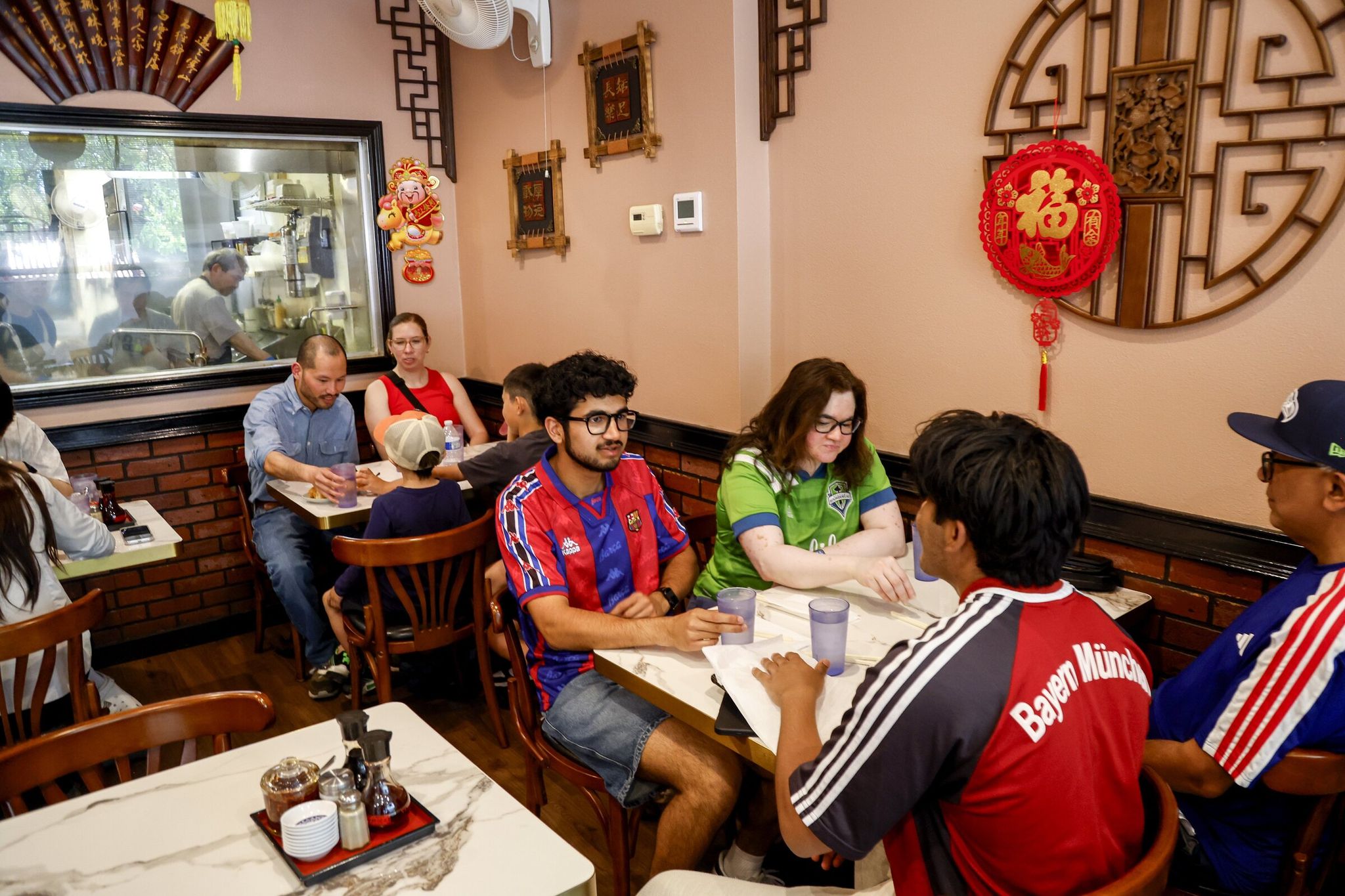
For more than a year, Seattle businesses prepared for a flood of hundreds of thousands of tourists during the World Cup, but in the Chinatown-International District (CID)—just a few minutes’ walk from the stadiums—opinions have been split. Some businesses saw record revenue, while others faced the worst days in their history. On June 22, Vinс Wu, founder of the Anh Ơi Bake Shop, shared on social media that the U.S. vs. Australia match brought his shop “the worst day of sales.” He said bars benefited from the crowd of fans, while cafes like his stayed empty because locals avoided the area on match days. The Seattle Times also highlights a contrasting example: Joe Adams, manager of Joe’s Bar & Grill, reported record sales on Friday after the U.S.–Australia match.
That situation also happened in 2023, when Seattle hosted the MLB All-Star game. At the time, the city promised a $50 million economic boom, but restaurants that stocked up expecting streams of tourists faced empty streets and had to throw away excess food. That experience made many CID business owners treat the forecasts with caution. World Cup organizers, for their part, avoided guarantees: estimates suggested Seattle could host as many as 700,000 guests, and at least $32 million was allocated for preparation (security, transportation, cleaning), as reported at a city council meeting in May.
The local organizing committee had been working with the CID Small Business Relief Team since 2023—conducting surveys, hiring a local coordinator, and creating informational brochures in Chinese and Vietnamese. Leo Flor, the committee’s chief heritage specialist, explained that the goal was to provide accurate information to help business owners make their own decisions. But despite the effort, many residents and office workers still preferred not to come to the area on match days, fearing traffic and crowds. Thuyên Tan, executive director of the CID Business Improvement Area, said regular customers stopped showing up. Anh Huyền from the Preservation and Development Authority added that after matches there is a visitor uptick, but not all businesses benefit—and graffiti and litter have increased as well.
Some establishments were nearly empty, including Wu’s bakery: “I didn’t expect a paper shortage, but I didn’t expect this kind of collapse,” Wu said. “It was much worse than usual—the dining room was empty.” At Chung Chun Rice Dog Mochinut, by noon after the Bosnia vs. Qatar match they served just 22 customers, compared with the usual daily norm of 80–100. Meanwhile, at Mike’s Noodle House on Mainard Avenue, things remained the same: manager Florence Yu admitted she never expected tourists from the start. In her view, World Cup visitors go to the Space Needle and Pike Place Market, not the Chinatown-International District. That pessimism, reinforced by past experience, appears to have been confirmed despite all attempts by organizers to draw attention to the area. The World Cup brought Seattle some bright sports moments, but for many small businesses in the CID it turned out to be more of a disappointment than the anticipated tourist boom.