
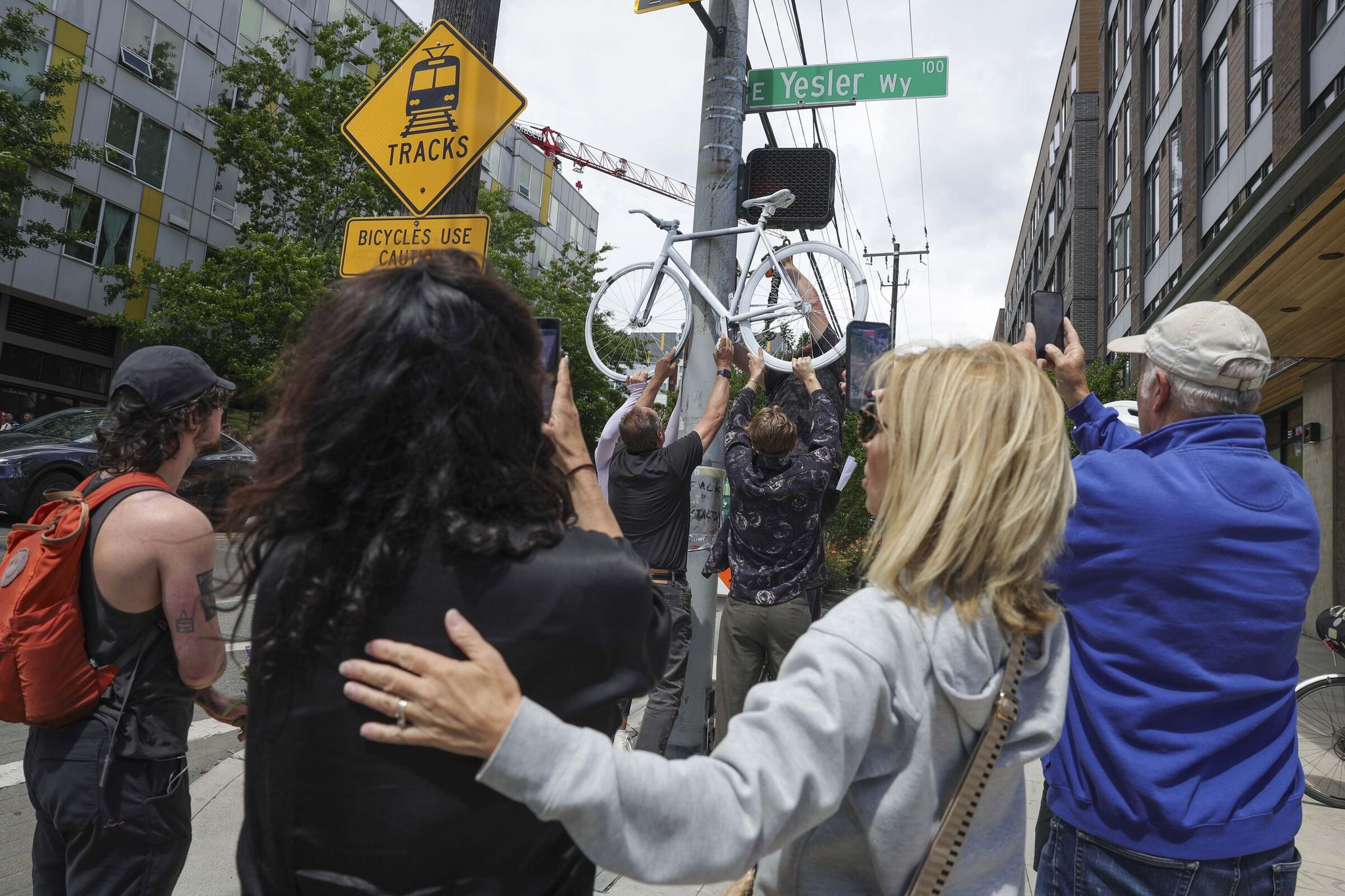
More than 100 cyclists gathered Saturday afternoon at the intersection of East Yesler Way and 12th Avenue South in Seattle to honor 30-year-old teacher Christian Sailer, who was killed under the wheels of a Recology garbage truck. They placed a white "ghost bike" at the site — the traditional memorial for cyclists killed on the road — which became the focal point of an impromptu memorial.
The mourning event unfolded in a somber atmosphere: participants whispered condolences, cried quietly, and activists from Critical Mass Seattle blocked traffic at the busy intersection for nearly two hours to give the family a chance to say goodbye. This informal group, part of a global movement that began in San Francisco in 1992, gathers hundreds of cyclists monthly on the last Friday. Participants draw attention to the lack of safe infrastructure and pressure authorities, although they have no official mandate to negotiate with the city council. Friends and relatives of the deceased stood to the side, hugging one another, still reeling from the loss that occurred just days earlier — on June 1.
Around 1:20 p.m., about 20 cyclists spread out to the four corners of the intersection and began directing drivers. This unofficial checkpoint was largely obeyed by motorists. Then Bartlett, together with Sailer’s family, lifted the white bike about two meters high and chained it to a street pole — a grim reminder that a cyclist died there.
For the next hour and a half, dozens of people remained at the intersection, approaching the "ghost bike" one by one. They wove flowers into its spokes and left messages on the pole: "Ride in strength," "We love you, Chi-Chi," and "Christian Sailer will always be remembered." A relative of the deceased, who wished to remain anonymous, addressed the crowd: "Thank you so much, Seattle. God bless you."
Sailer, who taught math and reading at Thurgood Marshall Elementary School, was biking near the intersection about 4:30 p.m. on Monday when he was struck by the garbage truck. He was taken to Harborview Medical Center but died the same day from his injuries. He had about 1.5 miles to ride from the school in the Atlantic neighborhood in south Seattle to reach the site. Historically a predominantly Black working-class neighborhood, the area has experienced intense gentrification in recent decades: older, more affordable apartment buildings sit alongside new expensive housing, and proximity to downtown and a light-rail line under construction has attracted new residents, significantly changing the neighborhood's makeup.
Many members of Seattle’s cycling community attended Saturday’s memorial, including those who did not know Sailer personally. "It's important for us to come out and honor our fellow cyclists who've been hurt or killed," said Cody Billingsly. "We recognize the danger that cars present. That's what unites us." Online fundraisers for the victim’s family have raised more than $87,000, and an additional $13,000 has been raised for his partner, Hana.
Sailer’s death was the second cyclist fatality in Seattle in recent months. In December, Alli Rodriguez died after being struck on Beacon Hill. Her death was the first since 2023 — one of the deadliest years on Washington’s roads. Activists have long pointed to this intersection as dangerous: a 2017 city bike plan called for building a protected bike lane on 12th Avenue by 2021, but the project was canceled in 2019. The Capitol Hill intersection is especially treacherous due to unclear road markings, poor sight lines, and high vehicle speeds. The city faces systemic problems with bike infrastructure: many bike lanes end at intersections, there is no continuous network of routes, the hilly terrain complicates safe bike lane design, and historic street planning prioritized cars. Implementation of projects is often delayed by budget disputes in the city council.
In 2024, Seattle City Councilmember Joy Hollingsworth, representing District 4 (which includes Fremont, Wallingford and parts of Capitol Hill), persuaded colleagues to include the 12th Avenue bike lane project from East Madison Street to the Jose Rizal Bridge in a $1.55 billion transportation levy that voters later approved. Unlike in many Russian cities, where transportation decisions are made at the regional administration level, in Seattle the council plays a key role: it approves the Seattle Department of Transportation (SDOT) budget, decides funding for bike and pedestrian infrastructure, and can veto mayoral transportation projects. This year SDOT will begin work to improve the stretch of 12th Avenue south of Yesler, but construction is scheduled to start next year. Building the bike lane will be challenging because it requires relocating parking spaces and accounting for streetcar traffic.
At Saturday’s memorial, cyclists laid their bikes down on the roadway over markings city crews had painted in preparation to soon add green paint — a sign that the city has started to act to make the intersection safer. A few minutes before 3:00 p.m., the last cyclists gathered, hugged, and agreed to meet again. Traffic resumed, and Sailer’s "ghost bike" remained hanging, heavy with flowers.
Based on: 'Ghost bike’ memorial for Seattle teacher rallies grieving cyclists