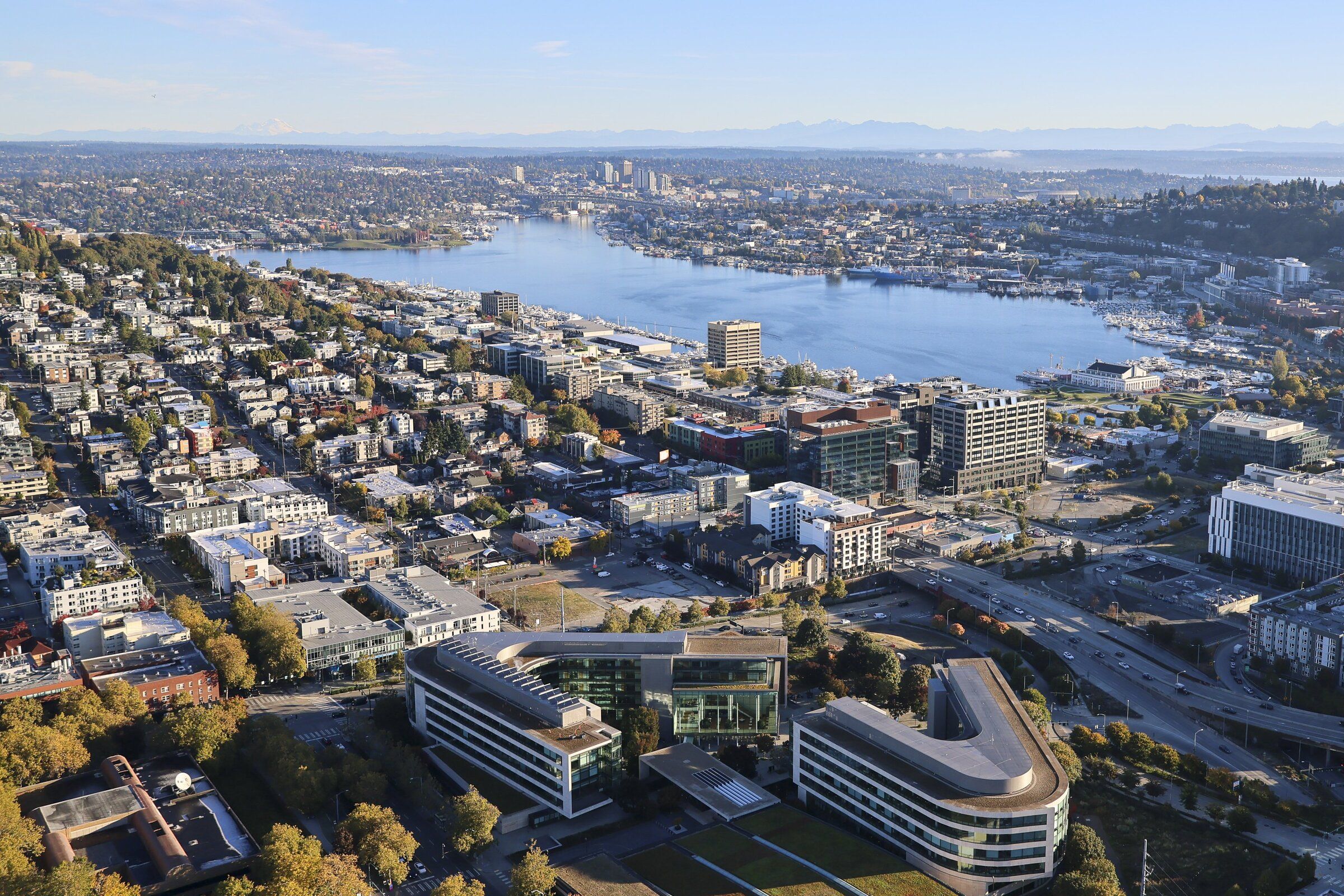
Seattle is facing a paradox: six census tracts have no children at all, reflecting profound demographic shifts. At the same time, a double homicide occurred in South Seattle, while the Seahawks received encouraging news about injuries to key players.
Seattle Without Children: How Six City Neighborhoods Were Left Without a Single Child
Over the past several decades, Seattle has experienced a genuine boom—technological, demographic and construction-related. The city has become a symbol of the new American economy, attracting young professionals from across the country and around the world. But behind this prosperity lies a paradox that strikes at the heart of urban life: almost no children remain in Seattle. According to 2024 census data, 109,500 people under the age of 18 live in the city—almost exactly the same number as in 1950, when Seattle’s population was several times smaller. Children now account for just 14% of the city’s population, and in some neighborhoods their share is not merely low—it is zero. An analysis of census-tract data by The Seattle Times identified six neighborhoods where not a single child was recorded in 2024. This is not a statistical anomaly, but a reflection of profound social and economic shifts that are reshaping American cities.
The six census tracts are located in four neighborhoods: Capitol Hill, South Lake Union, Belltown and the University District. One important caveat is that the U.S. Census Bureau uses five-year averages (2020–2024) to improve the accuracy of its estimates, so a very small number of children could theoretically have gone unrecorded. However, this does not change the overall picture. The epicenter of the trend is the southern part of Capitol Hill, around Pike/Pine. Three of the six “childless” tracts are located there, with a combined population of about 7,400 and not a single resident under 18. The median age is about 30, while the share of married residents ranges from 3% to 28%. This is the quintessential urban environment for young singles: dense development, walkability, bars, restaurants and coffee shops.
Two other tracts are in Belltown and South Lake Union, near Amazon’s campus. The Belltown tract, stretching from Bell Street to Denny Way, is home to about 5,100 people—and no children. In South Lake Union, near the flagship REI store, there are 3,700 residents and zero children. The sixth tract is in the University District, between Roosevelt Way and I-5, where student housing and apartment buildings dominate. The trend is not limited to these six locations: in neighboring parts of Capitol Hill, downtown and the University District, children account for anywhere from a fraction of a percent to 2% of the population. Of Seattle’s 177 census tracts, 29 have fewer than 100 children.
The causes are largely national, but they are especially pronounced in Seattle. U.S. birthrates have reached historic lows, while more adults are delaying—or rejecting altogether—marriage, homeownership and parenthood. Demographers link this to high housing costs, student debt and shifting priorities that favor careers and autonomy. Seattle’s technology-driven economy amplifies the effect: the city attracts young professionals who want precisely these kinds of neighborhoods—dense, well-connected places where studios and micro-apartments are popular. Developers respond accordingly: these areas offer very little housing suitable for families with children. There is not a single public elementary school downtown. And businesses catering to “dog parents” are noticeably more common than those serving human parents. Children do exist in Seattle, however: the Rainier Beach neighborhood in the south leads the city in its share of young residents. The census tract between South Henderson Street and South Norfolk Street is home to about 1,600 children—31% of its 5,200 residents.
The contrast between the “childless core” and isolated family oases points to a fragmented city. Seattle is becoming increasingly segregated not only by income and race, but also by life stage. Young professionals, students and childless couples are concentrating downtown, pushing families toward the outskirts or beyond the city limits. The consequences are wide-ranging. First, there is a demographic imbalance: the city is losing natural population growth and becoming dependent on migration. Second, there is an infrastructure imbalance: schools, day care centers and playgrounds are unnecessary where there are no children, but their absence in turn discourages families who might otherwise move there. A vicious cycle emerges. Third, there is a question of urban identity: what happens to a community with no children? What will the city look like in 20 or 30 years if today’s young residents grow older while new young, childless cohorts take their place?
This case is instructive for Russia and many other countries as well. Moscow, St. Petersburg and other major cities face similar challenges: declining birthrates, a growing share of childless adults and the concentration of young people in city centers. Seattle shows that the issue is not only economic, but also one of the urban environment. If a city offers only micro-apartments and coworking spaces, it will attract only those for whom such an environment works. Families are not simply a demographic category; they are an indicator of how ready a city is to serve everyone, rather than only the young and mobile. The question is whether officials and developers will choose to change course—or whether a “childless core” will become the new norm for megacities around the world.
Double Homicide in South Seattle: Gunfire and Crash Claim Two Lives
Early Saturday morning, South Seattle became the scene of a tragedy that once again raised questions about safety in the area. What began as a report of a traffic accident turned into a double-homicide investigation. Two people died in a shooting after their vehicle jumped the curb. Police have not made any arrests, but they are also not searching for suspects—a detail that raises more questions than it answers.
The events unfolded around 2:40 a.m., when 911 dispatchers began receiving calls about a crash at the intersection of Martin Luther King Jr. Way S. and S. Graham St. Firefighters were the first to arrive, reaching the scene before police. After finding the wrecked vehicle, they quickly realized that this was not an ordinary accident. A man and a woman inside the car had suffered gunshot wounds. Firefighters immediately called police.
According to preliminary information, the vehicle went over the curb. Medics provided first aid to both victims, but the woman died at the scene despite their efforts. The man was taken to Harborview Medical Center in critical condition, where doctors later pronounced him dead as well.
Homicide detectives arrived to determine what led to the shooting. No arrests have been made. However, police said they are not searching for any suspects who remain at large. That wording leaves an open question: Was there a single shooter who died by suicide, or was this a conflict involving people who have already been identified but not yet arrested? In any case, officials are not rushing to draw conclusions.
The Seattle Police Department has appealed to the public for help. Anyone with information about the incident is asked to contact the Violent Crimes Tip Line at (206) 233-5000.
This is not the first act of gun violence in South Seattle in recent months. The area along Martin Luther King Jr. Way S. has repeatedly been the site of high-profile crimes, and local residents have long called for increased patrols and prevention efforts. Officials have not linked this tragedy to any particular crime wave, but the statistics are unforgiving: every such story represents a life cut short in a matter of minutes.
For readers unfamiliar with the American emergency-response system, it is worth explaining that firefighters often arrive first at traffic accidents in the United States because their stations are nearby and they are trained to extricate victims from wrecked vehicles. That is why they discovered the gunshot wounds, which might have gone unnoticed during a routine inspection. It is also worth noting that police statements saying there are no wanted suspects are standard language. They may mean that the suspect is dead or has already been identified, or that investigators are considering self-defense or an accident. In any case, it is too early to draw final conclusions before the investigation is complete.
The original report provides only the bare facts, but behind them lies a human tragedy and another troubling warning for a city struggling to cope with violence.
Seahawks Stay Steady: Price Avoids Serious Injury, Darnold Could Return to Practice
The Seattle Seahawks continue their winning run this NFL season, but as is often the case in American football, a triumphant score on the board is almost always accompanied by worrying news from the injury report. On Sunday, Mike Macdonald’s team routed the Arizona Cardinals 31–7, earning its 12th consecutive victory and setting a franchise record. However, the achievement was tempered somewhat by two injuries suffered by starters.
The biggest concern for the coaching staff was the condition of rookie Jadarian Price, a first-round draft pick who has quickly become one of the key elements of Seattle’s rushing attack. Price left the game with a chest injury, but Macdonald said after the game that X-rays had revealed nothing alarming. The Ringer insider Tom Pelissero added that the running back would undergo further examinations Monday, while emphasizing that “there is optimism that he avoided any significant injury.” The statement from a respected journalist effectively eased much of Seahawks fans’ anxiety, since losing Price for an extended period could seriously complicate matters for a team whose offensive system relies heavily on the versatility of its ground game.
Before the injury, Price had rushed for 52 yards on 13 attempts. His final touch was an eight-yard reception late in the third quarter, after which he was listed as questionable to return. That was when Emanuel Wilson took center stage, finishing with a team-high 92 rushing yards on 21 attempts, including 58 in the fourth quarter, after Price was unable to return. George Holani added 13 yards on four carries, and Seattle finished the game with 162 rushing yards on 40 attempts. The statistics clearly show that even after a forced reshuffling of the depth chart, the Seahawks retained their ability to push through the opponent’s defense—an important signal for the coaching staff, no less than the victory itself.
At the same time, nose tackle Brandon Pili suffered a concussion and had to leave the game early. Injuries of this kind in the NFL always require players to go through a strict medical-evaluation protocol, so the timetable for Pili’s return remains unclear.
Public attention is focused even more closely on the situation involving Sam Darnold, the team’s starting quarterback. He injured his glute muscle during the opening series of the first game against the New England Patriots and has not appeared on the field since. In his absence, Drew Lock has taken the snaps, including in the victory over Arizona. According to Macdonald, Darnold has a “chance” to return to practice this week.
“We’re optimistic,” the head coach said. “We’ll see. I think there’s a possibility that he returns to practice at some point.” Macdonald also made clear that it was too early to discuss Darnold playing in the next game against the Washington Commanders, describing it only as “possible.” That caution is understandable: soft-tissue injuries, including a glute injury, are notoriously difficult to predict, and rushing a quarterback back could lead to a recurrence and a much longer absence.
For the Seahawks, the scenario is nearly ideal: the team is winning without its starting quarterback, backup Lock is playing at an acceptable level, and key contributors are avoiding serious injuries. The 12-game winning streak has already entered franchise history, and if Price truly escapes with only a scare while Darnold returns in the foreseeable future, Seattle could approach the decisive stretch of the season in a much stronger position than many expected just a few weeks ago. Still, as the NFL regularly demonstrates, the injury list is never empty for long. Macdonald’s main task now is to ensure that the euphoria surrounding the record streak does not overshadow the need to protect his players’ health. Updates on the Seahawks can be followed through Seattle Sports coverage, which publishes the latest information on injured players.
A few terms may be unfamiliar to readers who do not follow the NFL. A nose tackle is a defensive lineman positioned directly opposite the offensive center. His responsibilities include disrupting the opponent’s rushing attack and putting interior pressure on the quarterback. A concussion in the NFL requires players to complete a special protocol involving multiple stages and independent medical evaluations, so a player cannot return to the field simply because the coach wants him to. The glute muscle mentioned in connection with Darnold helps provide pelvic stability and power during throwing and running movements. Injuries to it can be especially troublesome for quarterbacks, who need to recover fully before resuming football activities. As for Price being selected in the first round of the draft, that means the club used one of its most valuable picks on him and therefore views him as a potential long-term leader of the offense.