Breakdown of Seattle Seahawks offensive spots ahead of the 2026 training camp
The Seattle Seahawks enter the 2026 training camp as defending Super Bowl champions, with an ambitious goal in front of them – to become the third club this century to successfully defend the title. As noted in a piece on Seattle Sports, the Seahawks approach camp with a unique continuity of personnel: they kept nearly 87% of their snaps on offense and defense from the 2025 championship season, including the playoffs. That’s the third-highest mark for a current Super Bowl champion since 2010. Because of that, there aren’t many starting jobs up for grabs, but there will be tough battles for roster spots in the final 53-man group by the August 30 deadline.
On offense, the picture is clear across nearly every position. Quarterback Sam Darnold, who has now strung together two straight Pro Bowl-level seasons and won the Super Bowl, feels more confident than ever. Even though he’s learning his ninth offensive coordinator in nine seasons, Darnold said the transition wasn’t “too difficult,” because new coordinator Brian Fleury is using a similar Shanahan-style system as his predecessor, Clint Kubiak. The Seahawks will likely go with three quarterbacks again: Drew Lock as the veteran backup and Jaylen Milroe as the long-term development project. For Milroe, this camp and the preseason will be decisive: he needs to show progress, and the team may try to use him as a tempo-change option in special packages—after a failed attempt last season, when he lost a costly fumble in Week 5.
In the backfield, Zack Charbonnet will likely start the season on the physically unable to perform list due to a torn ACL. With the departure of Kenneth Walker and Charbonnet’s injury, first-round pick Jadarian Price becomes the main candidate for the RB1 role. However, given his limited workload at Notre Dame, where he was a backup to Jeremiah Love, drafted with the No. 3 pick, the Seahawks will likely use a committee approach. George Holani and free agent Emanuel Wilson are likely rotation partners for Price. Holani showed well in the postseason after Charbonnet’s injury, and Wilson, over two seasons in Green Bay, racked up 998 rushing yards. Kenny McIntosh, recovering from his own ACL tear, has a chance, but he has a serious climb ahead of him.
The fullback role doesn’t go away under Fleury, either—and it may even grow in the passing game, as head coach Mike Macdonald hinted. At 117 kilograms, Robbie Ouths is likely to remain the starter, while Brady Russell, essentially the special teams captain, is set to return as a versatile option at fullback and tight end.
At receiver, the clear top four remain as Jackson Smith-Njigba, Cooper Kupp, Rashid Shahid and Tory Horton, assuming Horton fully recovers from a shin injury that cut short the second half of his promising rookie season. Shahid and Horton are the main camp storylines: the former is in great shape this spring and building a rapport with Darnold, while Horton, who has six touchdowns in eight games, could seriously boost the offense. Jake Bobo is also likely to make the roster, considering the Seahawks matched the Jacksonville offer and signed him to a two-year, $5.5 million contract. The question is whether the team will take the sixth receiver as a special teams specialist instead of Darrake Yng. The leading candidates here appear to be rookie sixth-round pick Emmanuel Henderson Jr., former Jets special teamer Irv Charles, Cody White and Ricky White III. Henderson is especially intriguing because of his speed, receiving potential, and proven special teams skills: he had 766 receiving yards, a kickoff return touchdown, and four special teams tackles in a season at Kansas.
Tight ends: A.J. Barner, even playing through injuries last year, still produced 519 yards and six touchdowns; if he’s healthy, his third season could be a breakout. Ilija Arroyo, selected in the second round of 2025, had a modest rookie year, but his unique blend of size and speed makes him another candidate for a sudden surge. Eric Sobert and Nick Callerup are likely to return as run-blocking specialists, but they’re not guaranteed. With Brady Russell potentially able to play tight end as well, the Seahawks could keep only three “pure” tight ends and use Russell as the fourth.
On the offensive line, all five starting spots are essentially locked in: Charles Cross, Grease Zabel, Jalen Sandell, Anthony Bradford and Abraham Lucas. After all 11 snap-earning linemen came back from last season—and after adding rookie Bo Stevens—the competition for spots became especially tight. Several players could challenge Bradford for the starting right guard spot, including Stevens, Bryce Cabell and Christian Haines. The name of Olu Olawatimi, a high-end center-forward whose path to the starting unit is blocked by Sandell, has surfaced in trade rumors. A trade would likely hinge on the development of Mason Richman as a potential backup center—Richman, nominally a tackle/guard, also worked at center this spring. Josh Jones remains the favorite to be the swing tackle, but head coach Macdonald made a few pointed comments about him after the veteran missed practices this spring. Amari Kite and veteran free agent Bobby Hart will be his competitors for the top backup tackle role. That means the Seahawks are entering camp with rare depth, and while the starting spots are mostly determined, every
Title
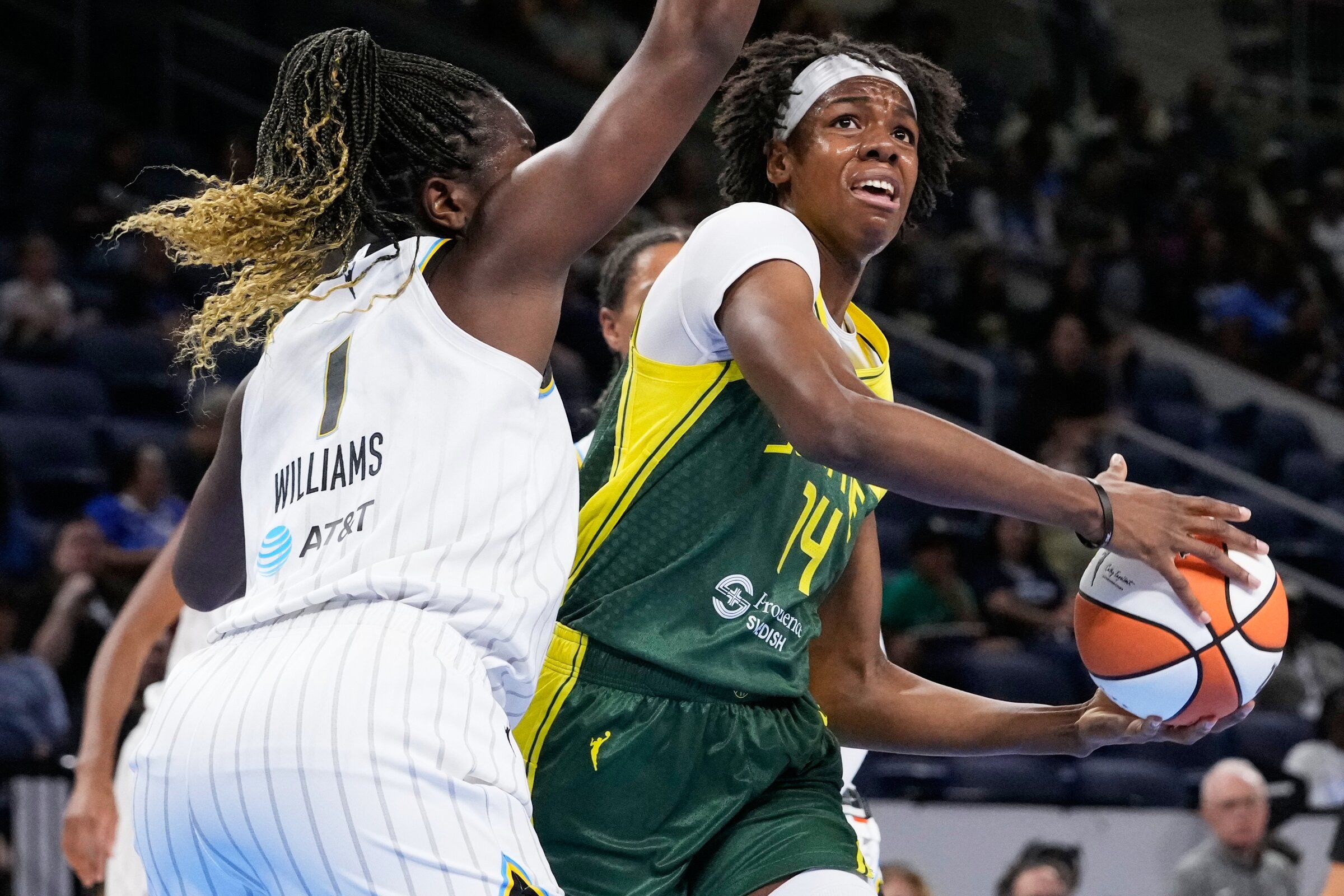
Seattle Storm isn’t panicking about struggles in the clutch: “It’s a marathon”
Article
The season for the Seattle Storm is proving difficult— the team sits last in the league with six wins and twenty-one losses. However, despite a string of heartbreaking clutch-game defeats, the coaching staff and players are staying calm. First-year coach Sonya Raman, in an interview, emphasizes that the team isn’t fixated on any one aspect of play, but is trying to improve everything as a package: defense, turnover control, and execution of the game plan. In a The Seattle Times feature, the paper goes in depth on the Storm’s problems in the decisive moments of games.
The numbers really do speak clearly: the team has won just one of ten games decided in the “clutch”—that’s what they call the final five minutes when the score is within five points. With the same 1–10 record, the Storm heads into games where the final margin does not exceed five points. At the same time, Seattle’s average scoring in the clutch is only 8.5 points per game, the 14th-best in the league, while field-goal percentage (38.6%) and three-point percentage (22.6%) lag well behind the team’s overall marks. Defense in those moments is also giving up too much: an average of 11.3 points.
That raises a natural question: who should take responsibility in the clutch? In previous years, that role belonged to legends—Lauren Jackson, Breanna Stewart, Sue Bird, or Jewell Loyd. Now the coach has the league’s youngest starting five, with an average age of 22.8. The biggest hope is 20-year-old center Dominik Malanga, who, incidentally, has recently received an invitation to the WNBA All-Star Game. In a recent game against the Indiana Fever (loss 107–110), the team trusted her with the decisive shots: Malanga scored 28 points and grabbed 14 rebounds, but her key look with the score tied 102–102 didn’t go in. “We trust Dom. She made a huge step forward this season,” the coach said.
Interestingly, by shot attempts in the decisive minutes, the leader is 29-year-old Natisha Heidemann (27 attempts), but her conversion rate is just 25.9%. Among the starting five, the best clutch percentages belong to rookie Ava Pham (55.6%) and Malanga (52.4%), while the others are still far from consistent. Point guard F’la’jay Johnson, another rookie, says, “We’re focusing too much on the little things. We just need those kinds of repetitions to understand how to play in the clutch. That’s part of growth.”
The coaching staff sees no reason to panic. The team is treating this season like a marathon, not a sprint. “We’re learning and growing. We know it’s a process,” Malanga echoes. But the statistics are unforgiving: with an overall field-goal percentage of 43.2%, the team converts just 38.6% in the clutch, and three-pointers at 22.6% versus 32.9% on average. That suggests the problem isn’t random—it’s a systemic lack of experience and psychological resilience.
Next, the Storm play the league-leading Minnesota Lynx— the team that has the best clutch numbers (9–5). The games before the All-Star break will be another test for Seattle’s young roster. For now, the Storm keeps searching for a path to wins, understanding that it takes more than skill— it also takes time.
Odyssey night screenings: why people go to a Nolan film at 3 a.m.
A new unusual record has been set by Christopher Nolan’s latest film—his adaptation of the ancient Greek myth “Odyssey” drew audiences to midnight screenings at three in the morning. Demand was so high that theaters across the country began adding extra showings at the most inconvenient times, and people really did show up. Journalists spoke with those who decided to make such a late-night trip and found out what motivates these viewers. For many, it’s not only a desire to be the first to see the film, but also the special atmosphere of a night screening—when the theater is almost empty and you can fully immerse yourself in the story. Others admit they simply couldn’t get tickets for the evening shows— they sold out within a few hours. Nolan, known for his visually complex and intellectually driven blockbusters, has sparked a buzz similar to what surrounded Interstellar or Inception. The three-hour running time of Odyssey scares some viewers, but the director’s fans are willing to make any sacrifice for full immersion.
It’s important to note that Nolan himself traditionally argues for watching his films in theaters, calling it the only correct way to experience his work. That level of viewer loyalty is the best proof that the cinema experience hasn’t died, despite the growth of streaming. In an article by CNN (the link to the original material can be found here), journalists emphasize that night screenings have become a symbol of respect for the director and his craft, as well as a way for the most devoted fans to share a unique experience. The very concept of a “night screening” in this context doesn’t mean a showing for those who stay up late—it’s more like a planned event, where people take time off from work or coordinate with their families.
For those unfamiliar with Nolan’s work, it’s worth explaining: the director is known for nonlinear storytelling and technical innovations, such as using IMAX film. Odyssey is his first adaptation of classic literature, and viewers expect him to reimagine the myth of Odysseus’s wanderings, adding modern visual solutions and philosophical depth. A three-hour runtime is characteristic of Nolan: his Oppenheimer ran for three hours, and it didn’t scare the audience—it actually attracted them. The key takeaway from this observation is that in the age of digital content consumption, going to the movies in person remains a ritual that people are willing to perform even at the most inconvenient times. Ticket sales data shows that the night screenings are filled to 70–80%, which is an incredible result for a 3 a.m. slot. The 3:00 a.m. shows were the movie chains’ answer to not being able to fit everyone into regular hours. The impact of such demand is clear: distributors are already extending theater operating hours, and studios are considering a wider IMAX-format release.
For viewers who managed to get into one of these screenings, it becomes a reason to feel proud and a part of their personal story connected to the film. Nolan has once again apparently proven that his name is synonymous with a cinematic event that can bring people together despite any inconvenience.