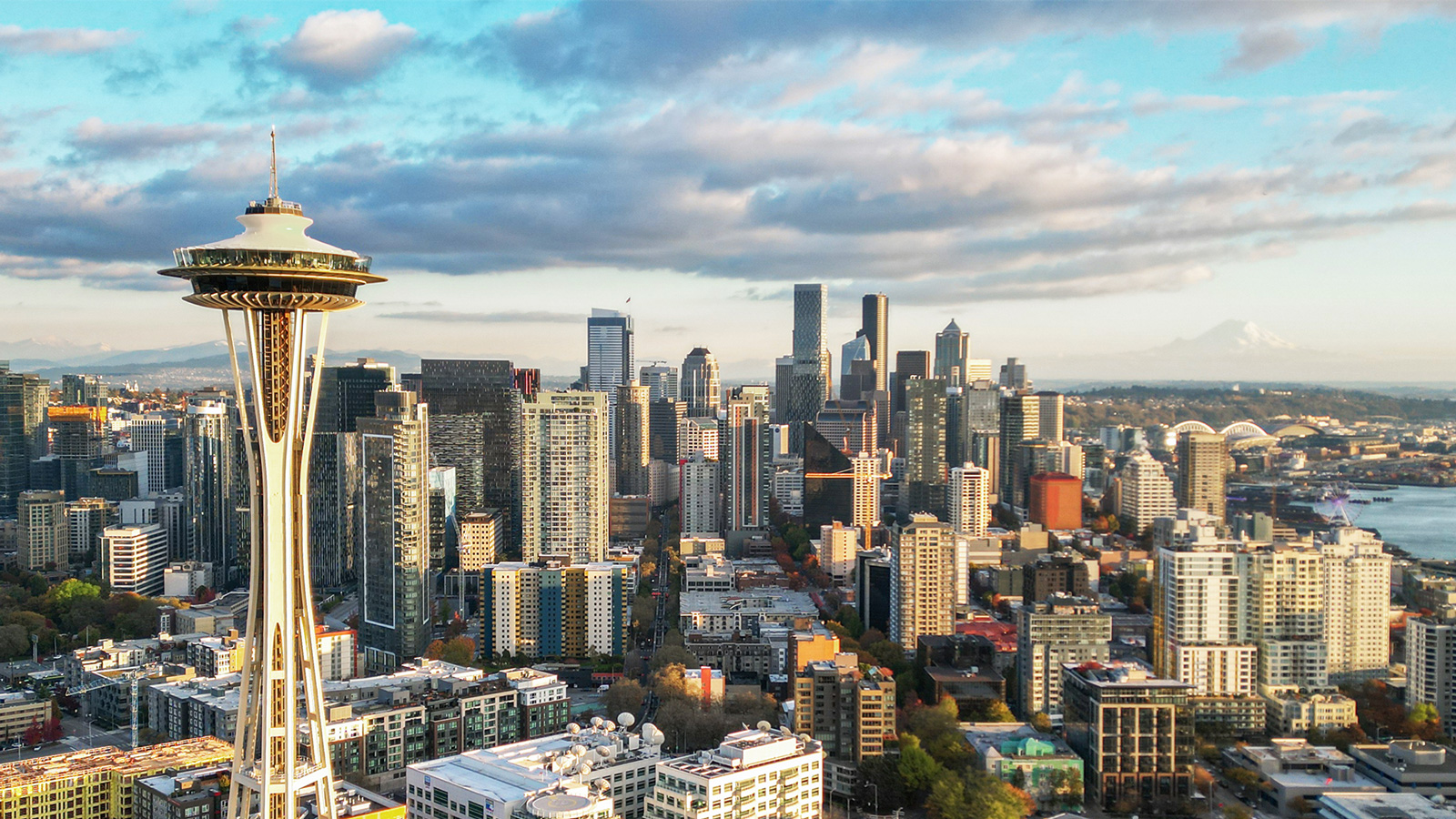
Seattle officials are delaying the publication of an audit of the city’s surveillance cameras, raising questions about transparency and the balance between security and privacy. Meanwhile, a magnitude 4.2 earthquake reminded residents of the Puget Sound region of the area’s seismic threat: the tremor was felt in Seattle, Tacoma, and Everett. No damage was reported, but the event once again drew attention to the need to prepare for more serious earthquakes.
Uncertainty Surrounds Seattle Surveillance Camera Audit: When Will City Hall Release the Results?
Seattle City Hall is once again under scrutiny because of the lack of clarity surrounding the timeline for an audit of the city’s surveillance system. According to FOX 13 Seattle, Mayor Katie Wilson had previously promised to present the results of the CCTV camera audit by late September or early October, but the timeline may now be pushed back. The news matters not only to local residents but also to anyone following the balance between public safety and privacy protection in American cities.
The story seems straightforward at first glance: city officials initiated a review of the street-camera system to assess its effectiveness, legality, and potential risks to civil liberties. The mayor publicly announced a deadline, but bureaucratic or technical difficulties apparently prevented the city from meeting it. There has been no official explanation for the delay, raising questions: did the audit turn out to be more complicated than expected, or does it reflect deeper disagreements within the administration?
What is a CCTV audit, and why is it important? CCTV stands for closed-circuit television—systems used to monitor public spaces. In this context, an audit is not merely a technical check of whether the cameras work. It is a comprehensive review of who has access to the footage, how long recordings are stored, whether notification requirements are being followed, and whether the cameras infringe on constitutional rights. For Seattle, as for many U.S. cities, this is a sensitive issue, as activists have spent years demanding greater transparency in the use of surveillance systems.
The key issue here is political accountability. Katie Wilson, who took office as mayor, has presented herself as a supporter of reform and government accountability. Her promise to release the audit results within a specific timeframe was a signal to voters and civil-rights advocates: we are not hiding problems. Now that the timeline has slipped, trust could suffer. The lack of a clear new deadline only increases the uncertainty. FOX 13 Seattle’s report did not include comments from the mayor’s office explaining the delay, leaving room for speculation.
It is worth noting that such delays are not unusual in municipal government. Auditing a camera system requires coordination among the police department, IT department, attorneys, and community organizations. If violations are uncovered—for example, unauthorized access to footage or retention of recordings longer than permitted—additional reviews and even personnel decisions may be necessary. In that case, a pause could be justified, but only if officials explain the reasons honestly.
For Seattle residents, this story is a test of transparency. Surveillance cameras are becoming an increasingly common tool, and the question is not whether they are needed but how they are regulated. If the audit is delayed indefinitely, the city risks facing growing distrust and demands for an independent investigation. For now, residents must wait for official statements and watch to see whether the mayor keeps her promise, even if belatedly.
Magnitude 4.2 Earthquake Reminds Seattle Residents They Live in a Seismic Zone
On Tuesday afternoon, Washington state’s western coast experienced an earthquake that, although it caused no damage, once again drew attention to the region’s seismic activity. The epicenter was near the boundary between Kitsap and Pierce counties, and residents of Seattle, Tacoma, and Everett felt the tremor.
According to the U.S. Geological Survey, the magnitude 4.2 earthquake occurred at approximately 2:05 p.m. local time several miles northwest of Gig Harbor. Initial magnitude estimates ranged from 4.0 to 4.3 but were later revised. The earthquake originated at a depth of about 17 miles, which is typical of crustal earthquakes in the region. As reported by The Seattle Times, the tremor felt like light shaking in Seattle, Tacoma, and Everett, while some witnesses described it as a sharp jolt. Issaquah resident Jan Kopp said she felt “one strong jolt, and the water in my glass splashed once.” Dennis Matthews of Manchester in Kitsap County compared the sensation to being hit in the back of his chair while sitting and reading.
Harold Tobin, director of the Pacific Northwest Seismic Network, said small aftershocks were possible, but the likelihood of a larger earthquake remained low. He said the event was a reminder that “we live in earthquake country” in the Pacific Northwest. “There is a possibility of a damaging earthquake, but this is not it,” the seismologist emphasized. The U.S. National Tsunami Warning Center said there was no tsunami threat in the Seattle area. Sound Transit reported that light-rail trains were forced to share one track at Angle Lake Station because of the seismic activity.
Preliminary data indicated that the tremor occurred along the Tacoma Fault, one of many faults in the Puget Sound region. The fault runs in an almost straight east-west line for about 35 miles between Kent and Union, passing through Vashon Island. Around 3 p.m., the Pierce County Department of Emergency Management said it had received no reports of damage or other impacts. On the U.S. Geological Survey scale, a magnitude 4.2 earthquake produces moderate shaking and potentially very minor damage.
The event was the fourth-strongest earthquake in Washington state over the past decade. By comparison, a magnitude 4.6 earthquake occurred near Monroe in July 2019; a magnitude 4.5 tremor was felt near the San Juan Islands in March 2025; and a magnitude 4.3 earthquake occurred near Port Townsend in October 2023. Magnitude is a logarithmic measure of the energy released by an earthquake; each one-unit increase represents roughly a 32-fold increase in released energy. A depth of 17 miles means the hypocenter was within Earth’s crust rather than at the boundary between tectonic plates, which is characteristic of many local faults. A fault is a fracture in Earth’s crust along which rocks move; the Tacoma Fault is one of several active faults in the densely populated Puget Sound region. Aftershocks are smaller tremors that follow the main earthquake and gradually diminish over time.
The key takeaway is that, despite the lack of damage, the event highlights the continuing seismic threat to the U.S. Pacific Northwest. The region lies within the Cascadia Subduction Zone, where earthquakes of magnitude 9 or greater are possible, and even moderate tremors serve as reminders of the need to be prepared. Tobin’s quote makes the point clearly: the current earthquake was not a catastrophe, but it illustrates the reality in which millions of people live. The effects on infrastructure, such as light rail, and on public perceptions of risk remain significant even when a particular incident causes no casualties or destruction.
Magnitude 4.2 Earthquake Near Port Orchard Scares Seattle Residents and Evokes Nisqually
On Tuesday afternoon, residents across the Puget Sound region felt the ground shake beneath their feet. The epicenter of the magnitude 4.2 earthquake was near the small community of Vaughn, close to Port Orchard, but the shaking was felt not only there but also in Seattle, Bremerton, Tacoma, Olympia, and Issaquah. According to the U.S. Geological Survey, the tremor occurred at about 2:05 p.m. local time roughly 10 miles north-northeast of Port Orchard, with its focus at a depth of approximately 16.7 miles. Although the event was classified as weak, it generated a notable public response: more than 6,000 people reported feeling the shaking, with most describing the intensity as “weak” or “light,” according to MyNorthwest.
Witness accounts portray an instantaneous but frightening event. Taylor Van Sise, an air-quality communications manager at the Washington State Department of Ecology, was in Lacey when she felt the tremor. “I felt it as if someone had pushed my chair, and then someone got angry in the coffee shop behind me,” she told KIRO Newsradio. “I stuck my head out of my office door and saw about 10 other people doing the same thing. All these heads started poking out and looking around. ‘Did we all feel that?’ And indeed, we did.” Van Sise also drew a comparison with a more serious event: “Many of us here probably remember what happened in 2001 with the Nisqually earthquake. This wasn’t nearly as bad, but it certainly was noticeable and interrupted the workday.” Her comments convey an important detail: for residents of a seismically active region, the event was a reminder of how fragile everyday routines can be, even though it caused no damage.
Maxine Frost, the wife of KIRO Newsradio news director Frank Lenzi, experienced the earthquake at home and described it much more dramatically. “It was a combination of massive shaking along with this sound like a deep growl; it was terrifying,” she said. “I thought a helicopter was landing on the house, or maybe a huge truck was pulling into our driveway, but the street was empty. Well, it must be an earthquake—what else could it be? Yes, it really was an earthquake. I wasn’t losing my mind.” Asked about damage, she said: “Nothing really fell, but everything was rattling above me. That’s why I thought something was landing on the roof. I could hear the ceiling fan rattling; the bed was shaking. I was sitting on the bed, and it felt like being on a ship. It lasted about seven seconds, and I was trying to figure out what I would do if the roof collapsed or something like that.” Her account vividly illustrates how even a relatively weak earthquake can feel like a threat, especially when sound and vibration intrude upon an ordinary home setting.
According to official assessments, the U.S. Geological Survey determined that the likelihood of fatalities and damage was 99% unlikely. The agency estimated that approximately 5.2 million people lived in areas that experienced “weak” shaking, with Seattle accounting for a significant share—more than 3.4 million people. The USGS also issued an aftershock forecast: a 37% chance of a magnitude 3 or greater tremor during the following week and an 8% chance of a magnitude 4 or greater event. These figures are important for understanding that seismic activity can continue after the main event and that residents should remain alert, although there is no reason for panic.
The earthquake also affected transportation infrastructure, albeit temporarily. In response to the seismic activity, Sound Transit’s Line 1 trains began using a single track at Angle Lake Station until further notice, and all trains would serve passengers on the Federal Way Downtown platform. The decision demonstrates how even moderate tremors prompt precautionary safety measures and serves as a reminder that seismic risks in the region require constant preparedness.
Overall, the event was not a catastrophe, but it highlighted several key points. First, Puget Sound residents live in an area of heightened seismic risk, and even a magnitude 4.2 earthquake can trigger a broad public response and disrupt normal routines. Second, the speed with which thousands of people reported the shaking underscores the effectiveness of modern data-collection systems and the importance of public participation in monitoring. Third, memories of the 2001 Nisqually earthquake remain vivid in the collective memory, shaping how people perceive any underground tremor. Finally, the response from transportation agencies shows that preparedness for seismic events is built into operational protocols, helping reduce risks and maintain calm. For the region, it is another reminder of the need to be ready for more serious challenges, which history shows will eventually occur.