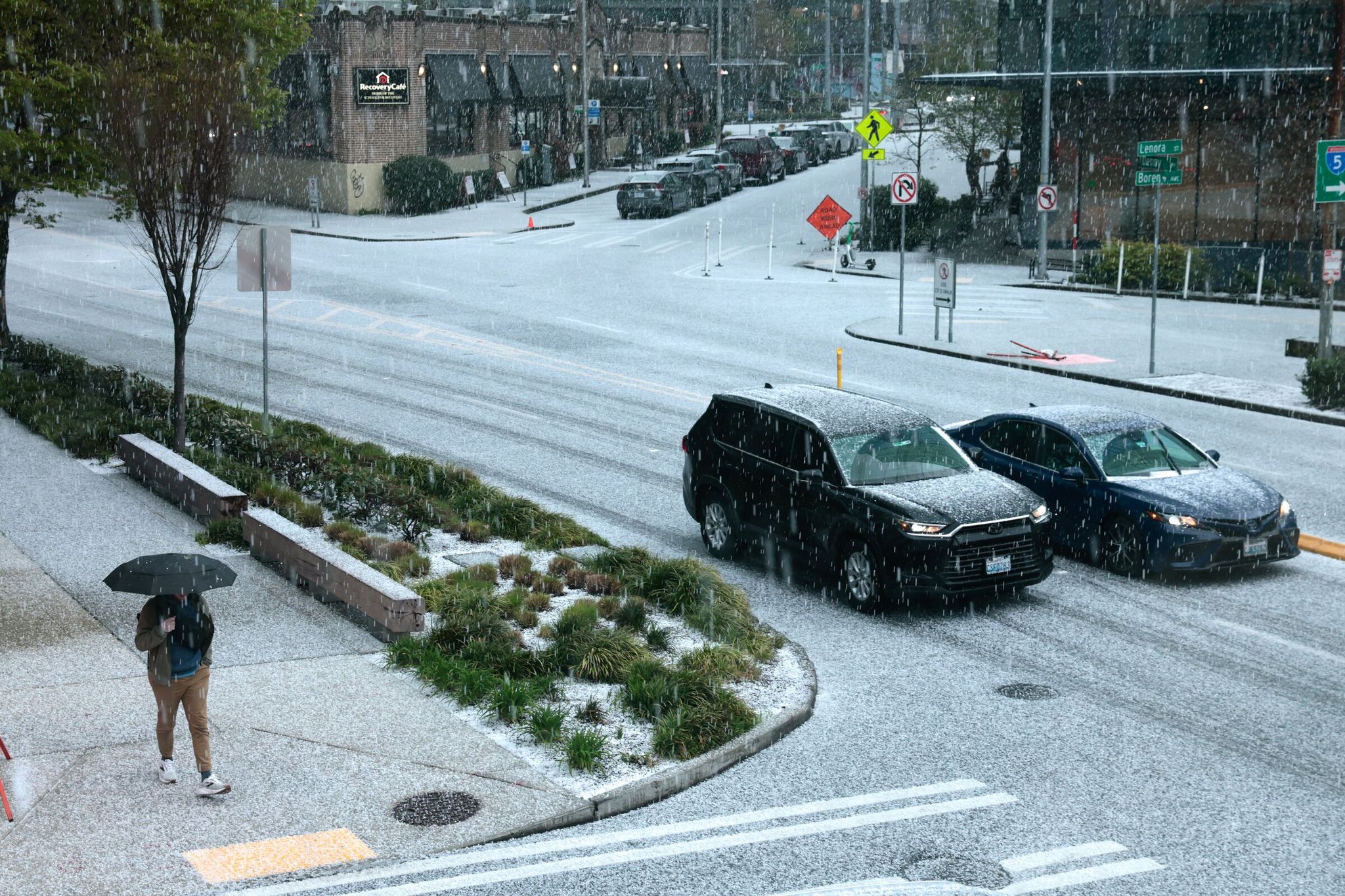
In Seattle, amid falling crime rates, companies are abandoning downtown in droves because of high taxes. The Colorado Avalanche are poised to beat the Seattle Kraken in the final game of the NHL regular season. The city also experienced a rare weather event — hail and a waterspout.
Seattle status report: crime down, but businesses fleeing
A new report from the Downtown Seattle Association (DSA) delivers mixed news. On one hand, crime is down for the first time since the pandemic, the population is growing, and tourism is booming. But behind that positive façade lies a worrying trend: companies are leaving downtown en masse, which experts warn could undermine Seattle’s economy in the long term. In its 2025 report (https://www.kiro7.com/news/local/report-shows-businesses-are-fleeing-downtown-seattle/OYOKAOQMCJHNFNAGUFFTCL4FNA/), the DSA notes that 35% of office and retail space in the central business district is vacant and that the number of jobs has not grown for three years.
DSA CEO John Scholes says that despite improvements in safety and cleanliness, the city is in a fragile position. He identifies the loss of jobs as the main problem: in 2025 alone, the Emerald City lost more than 13,000 jobs. Scholes cites high taxes and wage mandates as primary reasons businesses are leaving, saying they make operating in Seattle too costly and complicated. The business community is particularly concerned about a newly introduced 5% tax on social housing this year, levied on the portion of employee compensation that exceeds $1 million. That tax, along with other fiscal measures, Scholes says, is pushing companies to seek alternatives in other cities, such as Bellevue.
Scholes is calling on city leaders to rethink tax policy to stop the exodus. His argument is simple: rather than increasing the tax burden on the companies that remain, the city needs to create conditions that attract new businesses and grow jobs. “What we need is not more businesses paying taxes, but more businesses in the city that will pay taxes,” he says. The paradox is that improvements in quality of life and safety downtown are occurring alongside economic weakening driven by the flight of capital and jobs. The future of the city’s economy now depends on whether officials can find a balance between social programs funded by taxes and creating a business-friendly climate.
Preview and analysis: Colorado Avalanche vs. Seattle Kraken in the regular-season finale
On Wednesday, April 16, the Colorado Avalanche will close out the 2025/26 NHL regular season with a home game against the Seattle Kraken. This will be the third and final meeting between the teams this season, and the Avalanche have convincingly won the two previous matchups. For Colorado, already secured a playoff spot, this game is an opportunity to thank fans and keep a winning rhythm heading into the postseason. For Seattle, whose playoff chances are virtually nil, it’s a chance to finish the season on a high note and play spoiler.
Colorado enters the game in excellent form, having beaten the Calgary Flames 3–1. Key figures in that game were Martin Nečas, who recorded his 100th point of the season, and goalie Mackenzie Blackwood, who stopped 30 of 31 shots. Captain Gabriel Landeskog and superstar Nathan MacKinnon also made contributions. Of particular note was the return of defenseman Cale Makar, who immediately added three assists. As Avalanche assistant coach Nolan Pratt noted in a preview on NHL.com (https://www.nhl.com/avalanche/news/game-preview-04-16-26), Makar is “a dynamic player who can create opportunities out of nothing... he sees things others don’t.” Colorado’s statistics are impressive: the league’s best team save percentage (.908), the best goal differential in the first period (+35), and one of the best records for fewest goals allowed in the third period in April (only 4). Nathan MacKinnon leads the NHL in goals (53), and Martin Nečas is tied for seventh in points (100).
The Seattle Kraken, by contrast, suffered a 1–4 loss to the Vegas Golden Knights in their last game. Still, they have dangerous scorers: Jordan Eberle leads the team in points (55), and Bobby MacMillan leads in goals (29). Historically, however, the Kraken have clearly trailed Colorado: 10 Avalanche wins, 3 losses, and 1 tie in 14 regular-season meetings. Colorado’s stars have traditionally performed well against Seattle: MacKinnon has 23 points in 13 games, and Nečas has 13 points in 10. For readers unfamiliar with hockey analytics, “save percentage” (.908) is a key measure of goalie and defensive reliability, calculated as saves divided by total shots on goal — the higher, the better.
The outcome of this game will likely hinge on team motivation. Colorado, playing at home on Fan Appreciation Night, will be unlikely to dampen the celebration with a loss. Their roster depth, potent offense led by MacKinnon and Makar, and Blackwood’s steady goaltending give them a significant edge. For the Kraken, this is their last opportunity to show grit this season, but stopping Colorado’s well-oiled machine in Denver will be a very difficult task. A Colorado win would not only be a fitting end to the regular season but would also set the right tone heading into the playoffs, where every detail and every gained momentum will matter.
Hail, a waterspout and thunderstorms pound Seattle
Seattle residents on Wednesday witnessed a rare and dramatic weather event. In the afternoon, hail struck the city, and observers spotted a waterspout over Puget Sound near the Magnolia neighborhood. According to The Seattle Times (https://www.seattletimes.com/seattle-news/weather/hail-water-spouts-thunderstorms-hit-seattle/), these events were accompanied by thunderstorms that created a dramatic atmosphere in a region usually calm in terms of weather.
The National Weather Service reported coin-sized hail (about 6 mm, roughly the size of a quarter) starting to be reported around 2:45 p.m., and the waterspout was seen at approximately 3:00 p.m., about three miles west of Magnolia. Meteorologist Logan Howard explained that a strong cold front that passed through the region the previous evening was behind the active weather. A subsequent influx of cold air created instability in the upper layers of the atmosphere. Such conditions allow air masses to rise vigorously, leading to convective phenomena: thunderstorms, heavy rains and hail.
A waterspout is, in essence, a tornado that forms over a body of water. As the National Weather Service explains, tornadic waterspouts are the same as tornadoes that form over water or move from land onto water. They share all the characteristics of their land-based counterparts: they are associated with severe thunderstorms and often accompanied by squall winds, high waves, large hail and frequent dangerous lightning. For residents of the U.S. Pacific Northwest, where such events are relatively rare, the appearance of a waterspout was especially notable.
The weather service warned that rain and storms could continue in Seattle until 10:00 p.m., with a small chance of lingering until 11:00 p.m. This episode clearly demonstrates how the rapid change of air masses — the intrusion of cold air following a front — can disrupt normal conditions and lead to the development of intense, though localized, weather events. For meteorologists, such cases are important examples of atmospheric instability in the region, and for residents, a vivid reminder of the power of nature.