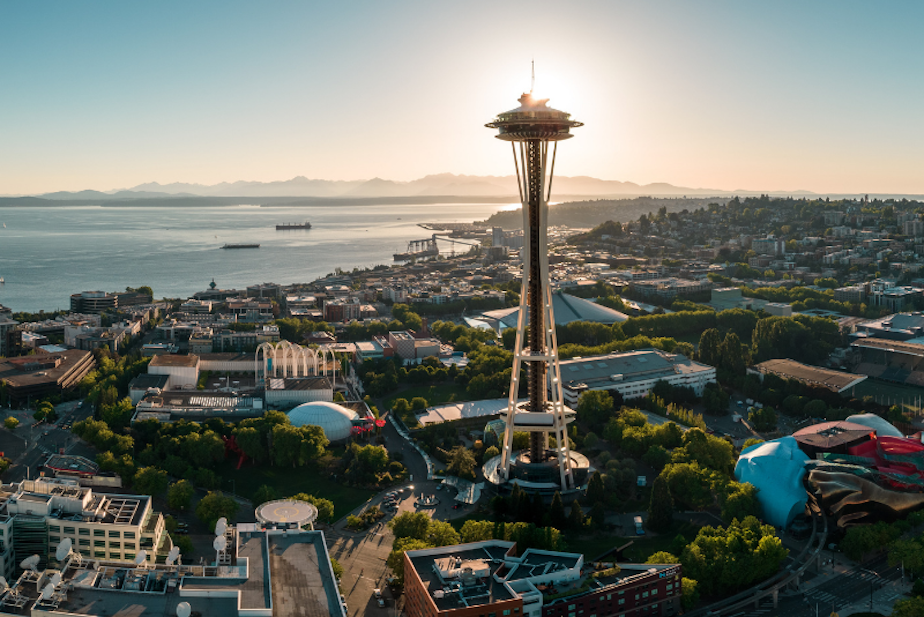
Seattle is facing high-profile incidents and challenges: a brutal attack on a man in downtown, a major fire in a historic Tacoma building, and a possible one-year moratorium on building mega data centers due to risks of rising energy rates and unprepared infrastructure.
Unknown assailant brutally beat a man in Seattle: victim in intensive care on a ventilator
Seattle police are searching for a suspect in the brutal assault of a 34-year-old man that occurred downtown. According to police, the incident took place near the Renaissance Downtown Seattle hotel. The attack, described by law enforcement as unprovoked, left the victim—identified by relatives as George Miller—on mechanical ventilation in the intensive care unit at Harborview Medical Center. He has been in critical condition since the assault last week. According to KOMO News, the victim’s relative Lisa Driscoll confirmed that his condition remains serious and doctors are continuing to fight for his life. Police are urging anyone with information about the attacker’s identity or the circumstances of the assault to contact them immediately.
This case raises troubling questions about public safety, especially in large cities like Seattle, where seemingly random acts of aggression cause major concern among residents. It’s important to understand that “unprovoked” in this context most likely means police currently have no evidence that the attack was preceded by an argument, robbery, or any other obvious conflict between the victim and the assailant. Such attacks highlight people’s vulnerability in urban environments and the difficulty facing law enforcement, which must not only investigate crimes but also search for hidden motives, if any existed at all. These incidents often occur suddenly and leave a deep impact on the victim and their family, as well as on public perceptions of safety.
Fire in a historic Tacoma building: fate of architectural heritage in question
Footage shot by witnesses shows flames engulfing one of the city’s oldest structures. The fire broke out in a neighborhood known for its Victorian architecture and required a substantial fire department response. There are no reports of injuries so far, but the damage to the historic building may be catastrophic. Local authorities have urged residents to avoid the area while firefighters battle the blaze. The event again raises questions about preserving architectural heritage amid dense urban development.
Notably, in KIRO 7 News Seattle’s newsfeed, the report about the fire is presented alongside a segment about English Championship club Southampton, which—despite a scandal surrounding a “spy story”—has reached the playoff final and is one step away from returning to the English Premier League. The juxtaposition of these stories in a single bulletin may seem coincidental, but it reflects the typical modern news flow where local emergencies are mixed with global sporting dramas.
In this context, “playoffs” refers to the knockout series at the end of the football season that determines the third club to be promoted to the Premier League—the top division of English football. The “spy story” relates to allegations aimed at Southampton’s coach, which added extra drama to the club’s sporting success. As for the Tacoma fire, the consequences are still being assessed, but the loss of any historic site is invariably a blow to a city’s cultural identity. Details of the incident, including possible causes and the extent of the damage, are still being clarified. A full report can be followed in the KIRO 7 News Seattle coverage.
Seattle hits pause: city may impose one-year moratorium on building mega data centers
Seattle finds itself at the intersection of a tech boom and municipal caution. Rapid advances in artificial intelligence have spurred frenzied demand for computing power, and tech giants are aggressively seeking land for massive server farms. That push has reached Washington’s largest city, but it has met unexpected resistance. The City Council is seriously considering a one-year ban on constructing new large data centers. As reported by KUOW, four companies initially planned to build five massive data centers in Seattle, but appetites have since shrunk: only two projects from two companies remain, and they have already contacted the municipal utility Seattle City Light to discuss power supply issues.
The city’s main fear is a sharp rise in electricity rates for ordinary residents. Each such center consumes electricity comparable to a small city, and existing infrastructure and pricing systems may not withstand that load. Councilmember Debra Juarez has openly stated that Seattle is not ready for this. She says there are currently no federal or even local standards regulating this sector, and the city doesn’t even have a clear definition of what should be considered a “data center.” This legal vacuum needs to be filled before large-scale construction is allowed.
Interestingly, the sponsor of the legislative initiative, Councilmember Eddie Lin, acknowledges the limits of this approach. He believes a local moratorium is a half-measure and that it would be more effective to develop rules at the regional or state level. If Seattle simply shuts the door, developers will move to neighboring Bellevue, which won’t solve the problem but merely shift it. Lin emphasizes a technical nuance: the region’s power grid is integrated, and Seattle City Light must buy energy on the open market. Mega data centers in Bellevue, by creating shortages and driving up wholesale prices, will still indirectly affect Seattle residents’ bills. This argument illustrates how difficult it is to isolate a local economy from global digitalization processes.
However, voices cautioning against hasty decisions are also being heard on the council. Councilmember Bob Kettle warned colleagues against “knee-jerk reactions” that could harm the business climate and cost Seattle valuable tech jobs. He is not categorically opposed to a ban but calls for measured, careful policymaking. Lobbyists from the Data Center Coalition counter that such projects bring construction jobs and tax revenue to cities. The article also cites Amazon as an example: the company already has small data centers inside office buildings in Seattle. The excess heat from their operation is used in winter to warm a nearby small building. Realtor Peter Nitze suggests not taking drastic measures but allowing compact, technology-forward solutions. He also sees an opportunity in (especially small-scale) data centers to sensibly fill vacant office floors downtown that lost tenants during the era of remote work.
The key conclusion is a dilemma faced not only by Seattle but by many tech hubs: how to balance attracting investment and innovation (including AI development) with protecting ordinary citizens’ interests. The digital economy requires physical infrastructure, and that infrastructure is voracious. Data show that even with fewer applications, the two remaining projects could pose a serious challenge for the city. Seattle’s decision to pause and study the issue seems a prudent precedent other municipalities might follow. But open questions remain: how soon will a compromise be found, and will a one-year delay cause the region to miss out on economic benefits while data centers are built elsewhere—affecting the overall power system and producing no tax revenue for the city’s budget?