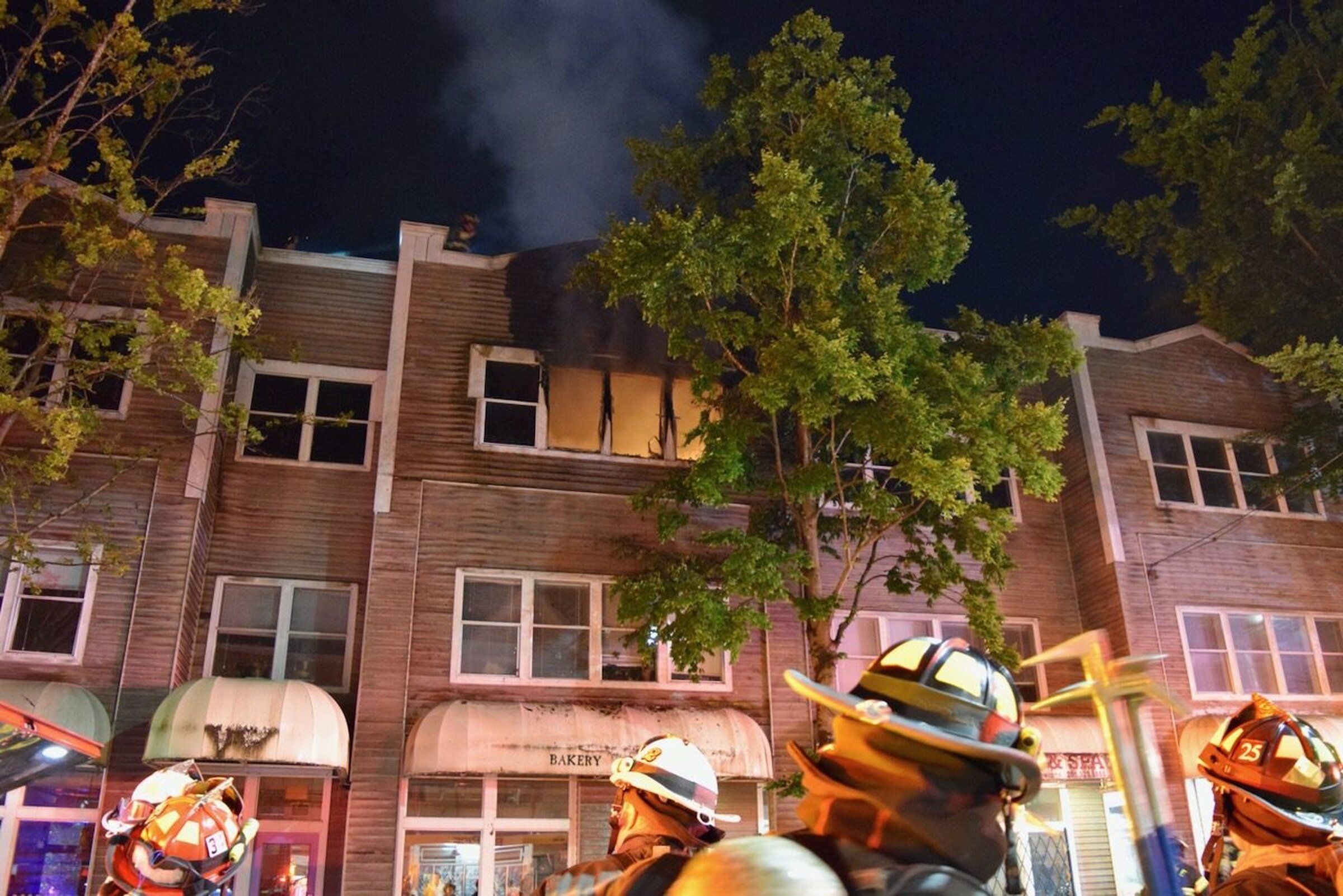
A overnight fire at a commercial building in downtown Seattle caused no injuries. The family of venture capitalist Vinod Khosla is buying the Seattle Seahawks for a record $9.6 billion. And autumn in the city promises a packed concert calendar—though the list contains some inaccuracies.
Fire at a Commercial Building Near the Washington Park Arboretum: No One Was Hurt
In downtown Seattle last night, a fire broke out in a three-story commercial building located in the 2700 block of East Madison Street, southwest of the Washington Park Arboretum. According to the Seattle Fire Department public information, the blaze started around 3:30 a.m. Calls were made by witnesses, and fire crews arrived on scene promptly. By the time they arrived, flames were already coming from the third floor. Firefighters were able to quickly contain the fire outside the building, then go inside to extinguish the flames and check rooms for people. The fire was fully extinguished by 5:30 a.m.
Speaking with Seattle Fire Department spokesperson David Kuerpo, he said the fire damaged office space on the third floor, but crews managed to prevent the flames from spreading to the lower floors. However, the first and second floors were damaged by water used to put out the fire. Gas and electricity were shut off at the scene. East Madison Street was closed from 25th to 28th Avenue and Martin Luther King Jr. Way while fire trucks remained nearby to monitor for possible flare-ups. Traffic has since been restored. On the south side of the street, debris and broken glass remained.
Fortunately, no one was inside the building, and no one was injured. The cause of the fire has not yet been determined. Authorities are investigating.
The incident once again raises the question of fire safety in older commercial buildings. While modern building codes require sprinklers and early warning systems, buildings in Seattle’s historic districts often do not meet these standards. Experts note that nighttime—when offices are empty—reduces the risk to life, but at the same time, the delay in detecting a fire can lead to more serious damage.
As reported by The Seattle Times, the building has two floors of offices above retail stores on the ground level. The entire third floor burned out, a major blow for tenants who lost workplaces, documents, and equipment.
Even though official conclusions about the cause have not yet been made, fires like this often happen because of faulty wiring or unattended heating devices. It took rescue services nearly two hours to deal with the fire—fairly quick for a three-story building, but the consequences are still significant. Water damage can be just as extensive as fire damage: furniture, equipment, and documentation on the lower floors are likely to be lost or will require expensive restoration.
This case is a reminder of how important it is to regularly check the condition of electrical wiring and follow fire-safety rules—especially at commercial sites with a lot of office equipment. No injuries are the main bit of luck in this story, but the financial losses could be substantial for business owners and tenants.
The Khosla Family: How a Silicon Valley Venture Capitalist Buys the Seattle Seahawks for $9.6 Billion
The story of how one of the most well-known families in Silicon Valley is entering the elite club of NFL owners began with news that rocked the sports world. Venture capitalist Vinod Khosla, his wife Neeru, and their son Neal will head a group of buyers that will acquire the Seattle Seahawks for $9.6 billion. The deal, which would be a record for American football, still needs approval from other NFL owners. According to a league memo, Neeru Khosla will become the controlling owner, and their son Neal will “play a significant leadership role in the ownership group.” Vinod Khosla, who is currently 71, is a legendary figure not only in the world of technology, but also in big money. He made history as one of the first investors in Google, and his firm Khosla Ventures bet on OpenAI as early as 2019, when it bought 5% of the AI developer’s shares for $50 million. According to Forbes, by March of this year, that stake was already worth $852 billion. Other notable investments by his firm include DoorDash and Instacart.
MARC BENIOFF, CEO of Salesforce, called him “a standout venture capitalist of our time,” and Patrick Collison, CEO of Stripe, whose business Khosla also supported early on, described him as someone who would seem unbelievable in a work of fiction—but is real. Born in India in 1955 to an army officer’s family, Khosla earned a bachelor’s degree in electrical engineering at the Indian Institute of Technology in Delhi, then moved to the United States, where he studied at Carnegie Mellon University and Stanford Graduate School of Business. In 1982, he became a co-founder of Sun Microsystems—the company that created the Java programming language, which became the backbone of the internet. He then spent two decades at venture firm Kleiner Perkins before founding his own fund, Khosla Ventures, in 2004, focused on artificial intelligence and “green” technologies. The fund describes itself as a structure that supports entrepreneurs building revolutionary technology companies. Its investments include Impossible Foods, the maker of plant-based meat, where Khosla invested early in 2011.
Unlike many NFL owners, Khosla is a public figure. He often gives interviews, actively uses X, and is close with OpenAI CEO Sam Altman. He criticizes Donald Trump for immigration and climate policies, but agrees with the president on the need for competition with China in AI. Khosla once told The New York Times that his life philosophy is the book Lies by Sam Harris—a treatise on the importance of truth and the destructive consequences even of small lies. On the Khosla Ventures website, the firm is explicit: “Our style is very direct and candid. We’re not here to be your friends or to control ownership; we’re here to help you build your business. We prefer brutal honesty over hypocritical politeness.”
In a 2018 conversation with the Times, he admitted that he is hurt when “billionaire” becomes almost a swear word in the country. Khosla is known for meticulousness: at his company headquarters, he designed door handles himself and selected landscaping—grass, flowers, and bamboo. He doesn’t play golf with other venture capitalists and most days fast until dinner, because, as he says, food slows him down.
Neeru Khosla, his wife, was a molecular biologist, but she left science—she put it this way in a TED talk in 2010—because “radioactivity and pregnancy are incompatible.” Today she devotes herself to philanthropy and education. In 2007, she co-founded and became executive director of the CK-12 Foundation, a nonprofit organization that promotes STEM education and reduces the cost of textbooks for schoolchildren around the world by offering them for free. Their son Neal is co-founder and CEO of Curai Health, a virtual-medicine company.
Outside Silicon Valley, Khosla is known for a years-long legal battle with the California authorities over a coastal plot of land. In 2008, he bought 89 acres on the coast and closed the road leading to the beach, prompting a lawsuit from an organization that advocates for public beach access. The case reached the U.S. Supreme Court, but it refused to hear it. Khosla, he says, regrets that episode but emphasizes that he was defending the principle of private property. Notably, Vinod Khosla already has ties to the NFL: in 2025, he acquired a little more than 3% of the San Francisco 49ers, which at the time were valued at more than $8.5 billion. Now, according to the league memo, the family must sell its stake in the 49ers to complete the Seahawks purchase. This transition from one team to another is a rare case in professional sports, highlighting the uniqueness of the situation. Experts say Khosla’s arrival in the league could change how teams use technology and artificial intelligence in management, and his wealth and connections promise new horizons for the franchise. As noted in his ESPN piece, the $9.6 billion purchase sets not only a record club valuation in the NFL, but also marks the entry into sports of a family from the high-tech world that sees it not just as entertainment, but as a new platform for innovation.
Seattle’s Hottest Concerts This Fall: From Doja Cat to Jeff Goldblum
Fall in Seattle promises to be not only rainy, but also musically packed. Local media compiled a list of the most anticipated concerts that will take place at the city’s biggest venues such as Climate Pledge Arena and Benaroya Hall. According to an article on FOX 13 Seattle, from September through December dozens of stars will perform across the city—from pop queens and rock legends to K-pop acts and the indie scene. At first glance, it seems like the organizers tried to please everyone: you’ve got the iconic group Gorillaz for Halloween, and now even the nearly never-performed classic in the form of Journey, along with experimental projects like Jeff Goldblum and The Mildred Snitzer Orchestra with the Seattle Symphony. But a closer look raises questions—some dates and album titles appear to be outright made up, which slightly undermines trust in the publication.
The lineup is indeed varied and covers nearly all genres. For example, on September 21, the legendary rock band Journey will perform at Climate Pledge Arena as part of its “The Final Frontier Tour”—an event for fans of classic ’80s rock. A little later, on September 25, the same venue will host a duet of The B-52’s and Devo, who teamed up for the “Cosmic De-Evolution Tour”—the kind of show that would interest fans of the new wave and post-punk revival. R&B and pop will be represented by Kelani (September 27), and for fans of a heavier sound later in the month, viral rap duo $uicideboy$ will come with their Grey Day Tour. The group’s name alone could confuse an unprepared listener: they’re a duo from New Orleans known for their dark aesthetic, lyrics about depression and substance abuse—and they became a phenomenon thanks to the internet.
Also expected in early October is a mysterious “SOMBR”—supposedly a “Grammy” winner with a tour called “You Are The Reason.” However, there is no information about such an artist in public sources. Most likely it’s a publisher typo, and it was about someone else—possibly British singer Sam Smith or a group—but checking doesn’t give a clear answer.
Autumn continues with concerts by country artist Tyler Childers (October 2) and the British funk group Jungle (October 3). Worth highlighting separately is a performance by K-pop group aespa on October 9—one of the most popular female groups in South Korea, whose style blends energetic pop with elements of cyberpunk and the metaverse. Another unexpected entry is a concert by Rush on October 10 and 12. Here, it’s necessary to clarify: the legendary Canadian rock trio Rush effectively ended after drummer Neil Peart died in 2020, and they are not running any “Fifty Something Tour.” It’s likely the journalists made a mistake—perhaps referring to a tribute band or a similarly named project—but in the article, it’s presented as a performance by the band itself—an obvious factual error.
The climax of the fall season will be a visit by Jeff Goldblum, the well-known actor and jazz pianist. On October 11, he will perform at Benaroya Hall with his orchestra, The Mildred Snitzer Orchestra, alongside the Seattle Symphony Orchestra. Such an event is rare and a great stroke of luck for jazz and film fans. Next on the list: young Puerto Rican rapper Young Miko (October 13), pop-rap star Doja Cat (October 15) with the mysterious Ma Vie World Tour, legendary Mexican rock band MANÁ (October 17), and indie-folk singer Phoebe Bridgers (October 23). Interestingly, her tour is named the “Lost Tour” in support of the album Lost Weekend—but in reality, Phoebe Bridgers does not have records by that name. Her most recent full-length studio album is Punisher (2020), though she has released singles. Most likely, this is an invention by the list’s author.
Country-pop star Kacey Musgraves will arrive on October 26 with the “Middle of Nowhere” tour, even though her current album is Deeper Well (2024), not some “middle of nowhere.” British alternative artist beabadoobee (written in lowercase) will perform on October 29—her music mixes indie rock, grunge, and ’90s pop. On Halloween, October 31, Gorillaz will take over Climate Pledge Arena—the virtual group created by Damon Albarn. The season ends and winter begins with a lineup of R&B and pop performers: Bryson Tiller (November 1), Teddy Swims (November 5), The Smashing Pumpkins (November 6—The Rats In A Cage tour commemorating the 30th anniversary of Mellon Collie And The Infinite Sadness), global K-pop group KATSEYE (November 17), and finally two concerts by Olivia Rodrigo on December 7 and 8 with her “Unravaveled Tour.” The article claims her third album is titled “you seem pretty sad for a girl so in love” and spent a month in the Billboard top 10—but in reality Olivia has only two studio albums: SOUR and Guts, and a third has not yet been announced.
So while Seattle this fall truly attracts a lot of artists, the list published by FOX 13 includes questionable details. It’s possible this is a draft or outdated information, but for readers it’s important to understand that some tour and album titles don’t match reality. In any case, the city is set for a rich musical season, and everyone will find a show to their taste—from classic rock acts that have stood the test of time to new names in pop culture like aespa or Teddy Swims, whose music blends R&B, soul, and hip-hop. The publication also promises further regional concert news, so it’s worth keeping an eye on updates to avoid missing truly reliable information.