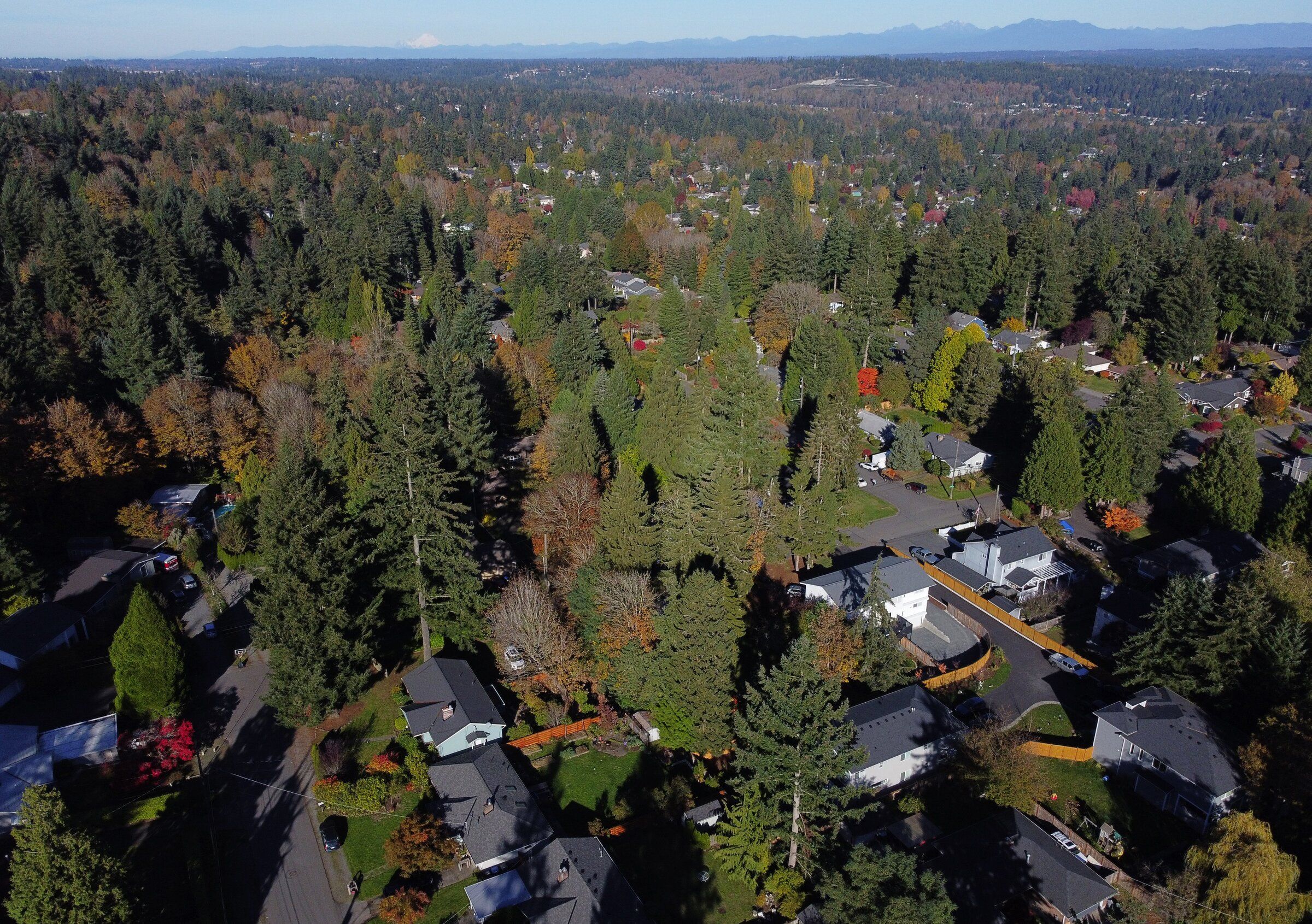
The Seattle region is facing transportation gridlock caused by bedroom communities, authorities are closing a controversial homeless encampment after a shooting, and an environmental crisis has prompted a fishing ban on the Snohomish River to protect salmon.
Seattle has become an extreme bedroom community: 98% of residents work outside their cities
When we talk about “bedroom communities,” we usually picture quiet suburbs where people leave for a major city each morning to go to work. But the Seattle metropolitan area has taken this phenomenon to an absurd extreme. According to a Seattle Times investigation, in the town of Lake Forest Park, only 88 of its 5,240 employed residents work within the city limits. The remaining 98.3% leave the city every day—some drive, others take a ferry or bus, but almost no one stays to work where they live and pay taxes.
This is not an isolated curiosity but the extreme end of a trend affecting the entire region. The problem is not commuting itself—it has always existed—but its scale. When virtually an entire city’s population leaves to earn a living, the local economy loses its tax base, small businesses lack daytime customers, and the transportation network becomes severely overloaded along a limited number of routes. Lake Forest Park is a clear example of how housing and jobs have become spatially separated. People settle where it is cheaper or more comfortable, then work where offices are concentrated—in downtown Seattle, Bellevue or Redmond.
What makes the situation unusual is that Lake Forest Park is not a faceless suburb without an identity of its own. It is a city with lakes, parks and good schools, but its economic role has been reduced almost entirely to serving as a place to sleep. Eight jobs for more than 5,000 workers is a gross imbalance, pointing to a structural problem in land use. The 98.3% figure is essentially an indicator that the city creates almost no jobs for its own residents and attracts virtually no outside workers. By comparison, in a healthy mixed economy, the share of people employed within their own community is usually measured in tens of percent, not fractions.
Several important conclusions follow. First, traffic congestion in Seattle and its surroundings is not so much the result of poor roads as of this separation. As long as jobs remain concentrated in a few hubs, millions of people will be forced to cross the region in the same direction every day. Second, cities such as Lake Forest Park lose out on business tax revenue, limiting their ability to invest in infrastructure and schools. Third, the environmental footprint of this arrangement is enormous: every commute means emissions, road wear and time taken away from families.
The term “bedroom community” takes on an almost literal and caricatured meaning here. Lake Forest Park is not merely a bedroom community; it is a bedroom from which nearly all its residents leave for the entire day. This raises an uncomfortable question for regional authorities: can a city be considered healthy when its local economy is practically nonexistent and life revolves exclusively around the cycle of “home–work–home”? Judging by the numbers, the answer is currently no. Unless land-use and zoning policies change, the number of such “extreme bedroom communities” will only grow.
Seattle clears controversial South Seattle encampment after years of complaints
Seattle authorities have finally decided to forcibly close a large informal homeless settlement in the south of the city, located near the intersection of 42nd Avenue South and Beacon Boulevard, between the Rainier Beach and Beacon Hill neighborhoods. The immediate trigger for the emergency order, signed on September 29, was a recent shooting that city officials deemed an imminent threat to public safety. The move marked the culmination of a confrontation among city agencies, private property owners and local residents who had sought government intervention for years but, they say, received no help. According to a report by KOMO News, the situation had already spiraled out of control by 2024, when the site consisted of just one vehicle and a pile of garbage. It has now become a full-fledged “city” built, in the words of landowner Jay Wampold, by “transients.”
A representative of the Seattle Department of Construction and Inspections explained that taking action on private property requires coordination among numerous city agencies, including the Unified Care Team and the police. Property owners, however, say that this very bureaucracy paralyzed earlier efforts to resolve the problem. Wampold said the landowners posted no-trespassing signs and filed paperwork, but city agencies did nothing, while police stopped responding to calls. As stated in the owners’ formal complaint, “what began as one vehicle and some garbage became an entrenched settlement with excavations, structures, stolen and burned vehicles, hazardous waste and violent crimes,” while the cost of cleaning up the site increased many times over. Notably, a shootout at the site in 2025 left one person dead, yet authorities only decided to take emergency action after the latest shooting.
The city is now offering residents housing options, requiring them either to leave the property or accept assistance. Cleanup crews are expected to spend at least several weeks clearing the debris. For local residents such as Andrew Rauch, who called the situation “a humanitarian crisis of the worst possible kind,” the move is long overdue, even if welcome. Ryan Baxter, a waste-removal contractor with Junk King, warns that the site is filled with hazardous materials and abandoned vehicles, making it dangerous simply to be there.
The story of this encampment vividly demonstrates how a lack of timely municipal action can turn a local problem into a chronic no-go zone affecting homeless people, nearby residents and landowners alike, while the cost of resolving the issue rises exponentially. The question now is whether the city’s coordinated operation can truly restore order and safety to the area—or whether the encampment will simply move elsewhere, as often happens in similar situations.
Washington state unexpectedly closes Snohomish River fishing: What is behind the decision?
The Washington Department of Fish and Wildlife’s (WDFW) decision to close the Snohomish River to fishing from October 3 through November 1, 2026, may initially appear to be a technical seasonal measure. But behind it lies a troubling ecological rationale. Officials openly acknowledge that the situation involving one of the Pacific’s most valuable salmon species—coho—is contradictory. Where anglers still see strong catches, biologists see a risk that returns will fall short and migration will be disrupted. This is a classic example of how short-term fishing success can mask a long-term problem, forcing regulators to act preemptively before it is too late.
According to the official announcement, published Sunday, the ban covers the stretch from the river’s mouth to the confluence of the Skykomish and Snoqualmie rivers—in other words, the entire lower section of the Snohomish, which is the most accessible and popular with anglers. Technically, this includes both the “terminal marine” and “freshwater” zones, and according to WDFW, the two are showing diverging trends. In simple terms, coho are running even better than forecast in the tidal section closer to the sea. Farther upstream, however, where the fish must travel to spawn, the picture is less encouraging, and the expected return will likely not be reached.
The mention of low water levels is especially concerning. This is not merely background information: during dry periods, rivers become shallower and warmer, effectively turning into barriers for spawning salmon. Fish may be physically unable to cross shallow riffles, become delayed in the estuary, and face greater exposure to predators, disease and stress. Some spawning adults may never reach their spawning grounds at all. Under such conditions, even a formally “good” fishery in the lower river means removing fish that could otherwise support population recovery. That is why the regulator is closing the fishery entirely rather than imposing partial restrictions: the biological risk outweighs the short-term recreational benefit.
For local anglers and the businesses that depend on them—including guides, tackle-rental operators, waterfront shops and cafés—the closure is a significant blow, adding to the instability that has already become typical of fishing seasons. The month-long ban covers the height of the fall coho run, which traditionally draws large numbers of people to the Snohomish. It is notable that the department announced the decision on a Sunday, leaving the community little time to plan and further increasing frustration. At the same time, WDFW is following standard practice: when return forecasts are uncertain and hydrological conditions are unfavorable, priority goes to preserving the population rather than maintaining the fishery.
The key conclusion is that the closure is not merely an administrative measure but an indicator of a deeper crisis. Coho, like other Pacific salmon, are highly sensitive to water temperature, streamflow and the condition of spawning grounds. Climate change and water use are making these conditions increasingly unpredictable. The phrase “returns may not meet expectations” sounds cautious, but essentially means that even with successful fishing in the estuary, the system may receive too few spawning adults, making the following season even weaker. Thus, closing the Snohomish through November 1 is not a final endpoint but an early warning that managing fisheries in the region will require increasingly strict measures and more frequent intervention.
For readers unfamiliar with fisheries terminology, several concepts are worth explaining. The “terminal marine zone” is the tidal section of a river closest to the sea, where the water is still somewhat salty and salmon gather before entering freshwater. The “freshwater zone” is the section farther upstream, where the water is fully riverine and the fish travel to spawn. Coho, or silver salmon, return to Washington’s rivers in the fall and are an important target for both commercial and recreational fishing. Finally, a “return” is an estimate of the number of adult fish that have returned to a river to reproduce. It determines whether fishing can be opened and at what level. When returns fall below forecast, regulators almost always choose closure, because rebuilding a depleted population is far more difficult than sacrificing one season.