The Seattle Seahawks defeated the Los Angeles Chargers 30–23 in a chaotic game featuring a franchise-record number of penalties and interceptions on the opening possessions. The analysis shows why offensive depth and personnel decisions matter more than the final score.
Seahawks Beat Chargers Despite Chaos and Record Penalties
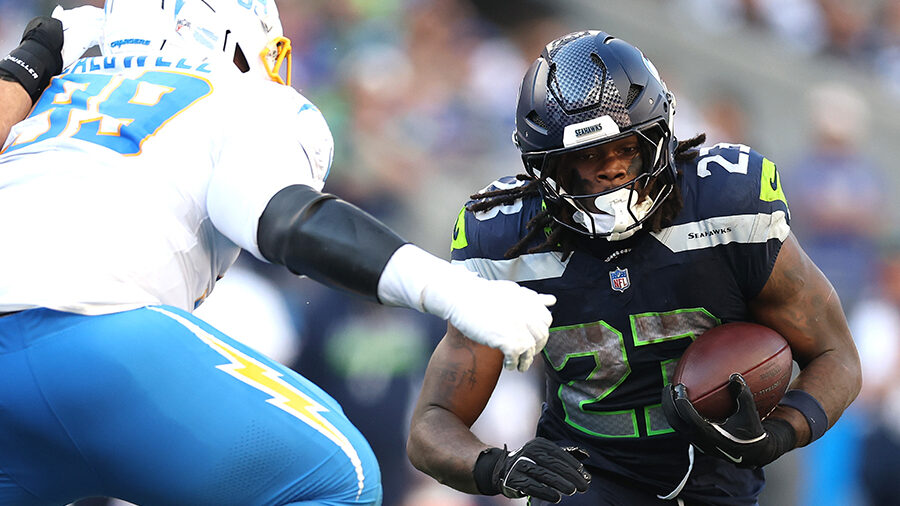
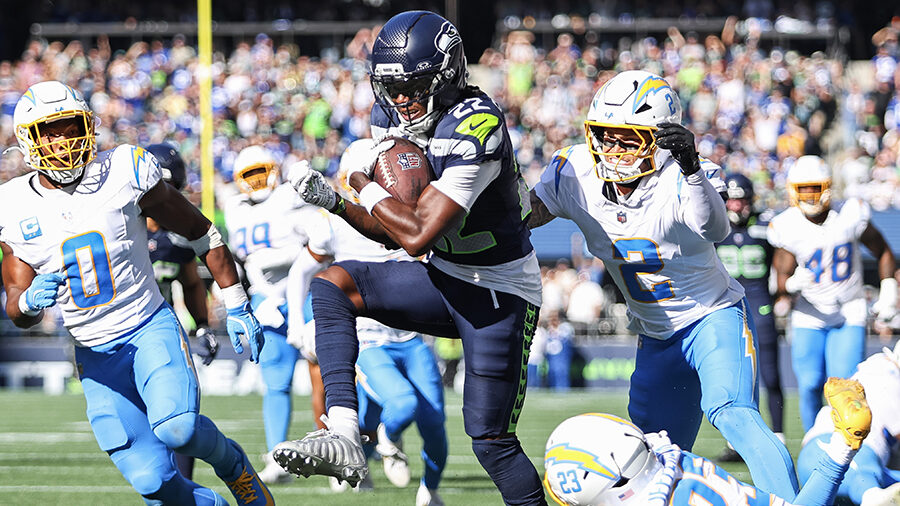
In Sunday’s National Football League game, the Seattle Seahawks defeated the Los Angeles Chargers 30–23, sending the Californians to their fourth consecutive loss to open the season. The game’s standout player was backup running back Emanuel Wilson, who both caught a touchdown pass and scored a rushing touchdown. His role grew sharply after rookie Jadairian Price was placed on injured reserve Saturday because of an aggravated chest injury. Wilson rushed for 81 yards on 21 carries and added three receptions for 39 yards, becoming a key figure in the reigning Super Bowl champions’ offense.
Seahawks quarterback Sam Darnold threw for 168 yards and two touchdowns, helping his team improve to 3–1 after a painful 33–31 loss to the Washington Commanders the previous week. As noted in a recap on Seattle Sports, this was one of the season’s most chaotic games. On the Chargers’ very first scrimmage play, Justin Herbert was intercepted by Drake Thomas. Seattle immediately answered in kind: Darnold’s first pass, intended for Wilson, was intercepted by Tuli Tuipulotu. According to Sportradar, this was the first instance since at least 1991 in which both teams threw an interception on their very first scrimmage play. The statistic highlights not so much quarterback weakness as the nervousness and unpredictability of the game’s opening stretch.
Herbert finished with 189 passing yards, one touchdown and two interceptions. He now has six interceptions and 12 sacks taken this season, including four sacks in this game that cost the team 35 yards. The Chargers became only the second team in history to start a season 0–4 while still retaining theoretical playoff hopes. The only club to reach the postseason after starting 0–4 remains the 1992 San Diego Chargers. That team defeated Seattle 17–6 on October 4, finished 11–5 and won the AFC West.
Interestingly, the Seahawks won despite committing 14 penalties for a franchise-record 150 yards. That many penalties would usually sink a team, but Seattle offset them with aggressive defense and timely big plays. After the opening exchange of interceptions, the Chargers took a 3–0 lead on Cameron Dicker’s 40-yard field goal. Then Derius Davis muffed a punt return, and Seattle recovered through Connor O’Toole. On the very next play, Darnold found Wilson for a 23-yard touchdown to make it 7–3. In the second quarter, Rashid Shaheed scored on a 28-yard touchdown run to extend the lead to 13–3, but Jason Myers missed the extra point wide right, ending a streak of 80 consecutive successful PATs dating back to 2024. Ernest Jones intercepted Herbert again and returned the ball 20 yards, and Wilson finished the ensuing drive with an 8-yard touchdown run. At halftime, the Chargers had just 92 total yards of offense.
In the second half, Darnold threw a 6-yard touchdown pass to Tory Horton to make it 27–6. The Chargers answered with a Herbert touchdown pass to Kimani Vidal. After a Seattle field goal, Omarion Hampton scored from 2 yards out, and Dicker added a 36-yard field goal to cut the deficit to 30–23 with 2:14 remaining. Los Angeles had another chance with 1:42 left, but Herbert was sacked and fumbled. Seattle recovered, bringing the game to an end.
Among the injuries, Chargers cornerback Donte Jackson left in the first quarter with a hamstring injury, tackle Joe Alt exited in the second quarter with a neck injury, and wide receiver Ladd McConkey aggravated a foot injury at halftime. Seahawks defensive tackle Leonard Williams limped to the medical tent in the third quarter with an ankle injury and did not return. In the next round, the Chargers will host Denver, while the Seahawks will face San Francisco at home.
Thus, despite the chaos, penalties and turnovers, Seattle demonstrated roster depth and the ability to win “ugly” games, while the Chargers continue searching for their identity and are already on the brink of a historic collapse. For Herbert, the season is becoming a serious test of maturity; for Wilson, it is an opportunity to establish himself as a starter.
Seahawks Find a Second Option: Why the Win Over the Chargers Matters
In modern American football, some teams rely on a single genius, while others learn how to live without one. In Sunday’s game against the Los Angeles Chargers, the Seattle Seahawks showed that they belong in the second category. At first glance, there was nothing sensational: Seattle won, and the team’s biggest star, Jaxon Smith-Njigba, was once again at the center of attention. But a closer look suggests that this game could be the turning point that separates an ordinary successful regular season from a genuine championship run. In Stacy Rost’s analysis for Seattle Sports, she explains in detail why distributing the offensive workload is not a one-game tactic but a survival strategy for a long season.
Smith-Njigba is, without exaggeration, half of Seattle’s passing offense. He received a league-high 36 percent of all targets last season, and that share has risen to 39 percent this year. He is the reigning Offensive Player of the Year, recorded more than 1,700 yards and led the team to a Super Bowl victory. He also leads the team in receiving yards through the first four weeks. This would be a very different story if quarterback Sam Darnold stubbornly kept forcing the ball to his favorite target while the offense stalled. But that is not what is happening: Smith-Njigba is almost always, inexplicably to defenders, open. By Week 4, he had accounted for six of the team’s nine touchdowns. And yet, against the Chargers, Seattle took a different approach.
Three different players reached the end zone for the first time this season. Running back Emanuel Wilson did it twice, while receivers Rashid Shaheed and Tory Horton each scored once. That matters for two reasons. The first is purely practical. Wilson started in place of injured rookie Jadairian Price, who will miss at least four weeks after being placed on injured reserve, and took on most of the rushing workload in an area where Seattle has lagged well behind its passing efficiency. It is worth recalling a telling statistic from ESPN’s Bill Barnwell: leaguewide, running backs convert about 50 percent of attempts from the 2-yard line into touchdowns. The Seahawks, by contrast, had converted none of six such attempts. Against that backdrop, Wilson’s two touchdowns—including the short rushing score before halftime—look not merely like a pleasant bonus, but like an answer to a longstanding problem.
Shaheed scored his first offensive touchdown for Seattle, which is surprising in itself given his huge contribution on special teams last season. The team struggled to find a role for him on offense for a long time: after being traded to Seattle, he finished the regular season with a modest 188 yards on 15 receptions. His first offensive touchdown since Week 5, when he was still with New Orleans, coincided with a new approach—this time, his speed was used from the backfield, producing a 28-yard run. Horton, meanwhile, scored for the first time since Week 9 of last season, which turned out to be his final game before he was placed on injured reserve. Seattle Sports host and analyst Michael Bumpus praised Horton’s route running in a preseason review and predicted a major second season for him—provided he stayed healthy.
But the second reason this matters is much more interesting. As electric and elite as Smith-Njigba is, Seattle’s passing game faltered during the final third of last regular season, forcing the team to find other ways to win. If the Seahawks surpassed 100 rushing yards in only half of their first eight games last season, they did so in 10 of their final 12 games, including the playoffs. It is not that they stopped winning through Darnold and Smith-Njigba; rather, the offense became multidimensional precisely when the passing game encountered problems. Darnold was sacked at least twice in five of his final six regular-season starts. It is important to understand what a sack is: a quarterback is tackled while holding the ball behind the line of scrimmage before he can throw a pass. Each such play kills a drive and pushes the team backward. When an opposing defense knows the ball will almost always go to one target, it becomes easier to pressure the quarterback.
That is why developing the rest of the offensive weapons is not a luxury but insurance. The Seahawks do not have to copy last year’s formula, and Smith-Njigba shows no signs of slowing down. But every Super Bowl winner has reached the top by finding ways to evolve as new challenges arise. In that sense, the win over the Chargers is valuable not because of the score, but because Seattle demonstrated that it has a Plan B, Plan C and perhaps even Plan D. Wilson proved he can fill the gap in the running game. Shaheed reminded everyone that his speed can be used for more than returns. Horton showed that he is ready for a bigger role if his health allows. That, in turn, means that even if an opposing defense manages to neutralize the team’s biggest star, Seattle will still have the tools to punish it. In a league where a 17-game season and the playoffs become a marathon of survival, such roster depth is worth more than individual yards and statistical records. And that—not another spectacular Smith-Njigba reception—is what makes the Seahawks truly dangerous.
Chargers Lose James but Get McConkey: Personnel Decisions Before Seahawks Game
Ahead of their Week 4 road game against the Seattle Seahawks at Lumen Field, the Los Angeles Chargers coaching staff released its list of inactive players. The biggest news was the absence of one of the team’s key defenders, safety Derwin James. According to the team’s official website, James, who was listed as questionable Friday because of a hamstring injury, ultimately will not play. This is a significant blow to the Bolts’ secondary, given James’ versatility: he is equally effective covering receivers, supporting the run defense and even blitzing. His absence will force the defensive coordinator to adjust the scheme, likely placing more responsibility on Elijah Molden, who fortunately recovered from his own hamstring injury. Molden had also been listed as questionable but was ultimately cleared to play.
There was good news on offense: wide receiver Ladd McConkey, who had also been listed as questionable because of a foot injury, will play. For a rookie who quickly became an important option in the passing game, this is critical, especially with other injured players unavailable. In addition to Molden and McConkey, cornerback Donte Jackson, who was dealing with a concussion, and quarterback Trey Lance, who had a groin injury, will also play after being listed as questionable. Lance will probably remain in a backup role, but his availability is important for roster depth in case of an emergency.
The list of players who definitely would not play had been known since Friday and included four players: defensive tackle Dalvin Tomlinson (hamstring), offensive lineman K योde Awooshika (fibula), wide receiver Brenden Thompson (quadriceps) and tight end Charlie Kolar (forearm). Tomlinson was an especially significant loss for a defensive line that had to contain Seattle’s rushing attack. The other two inactive players were Alex Harkey and D.J. Uiagalelei, who was designated as the emergency third quarterback—a rule allowing a team to keep a third passer outside the active roster without penalty, provided he does not enter the game except in an emergency.
The game will begin at 1:25 p.m. Pacific time, and according to the betting lines, the Chargers are considered underdogs. Losing James and Tomlinson on defense unquestionably makes the task more difficult against a team capable of attacking both through the air and on the ground. However, McConkey’s return gives the offense a chance to maintain its versatility. The question is whether a defense without its leader in the middle of the field can prevent Seattle from making big plays. We will find out on Sunday.