
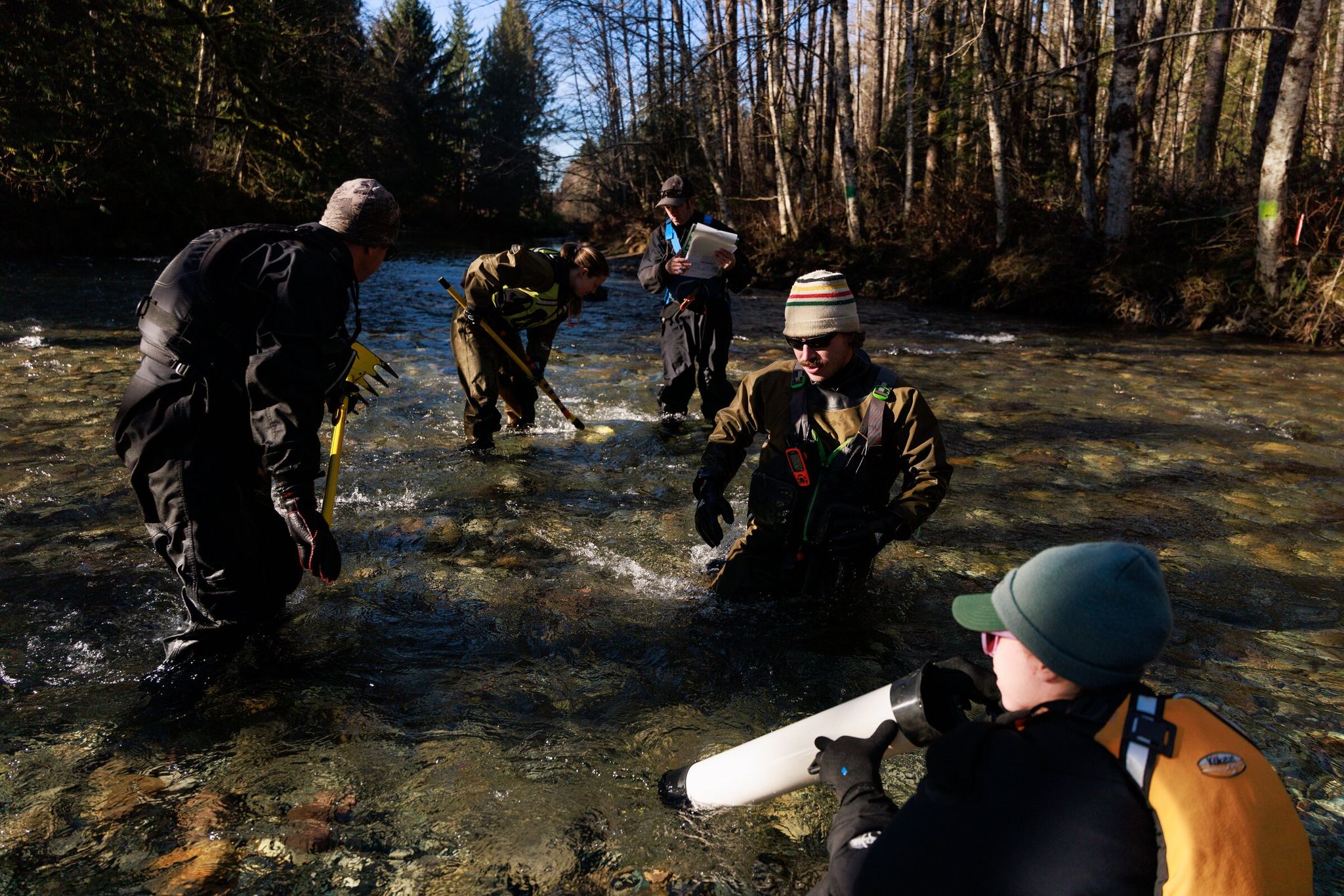
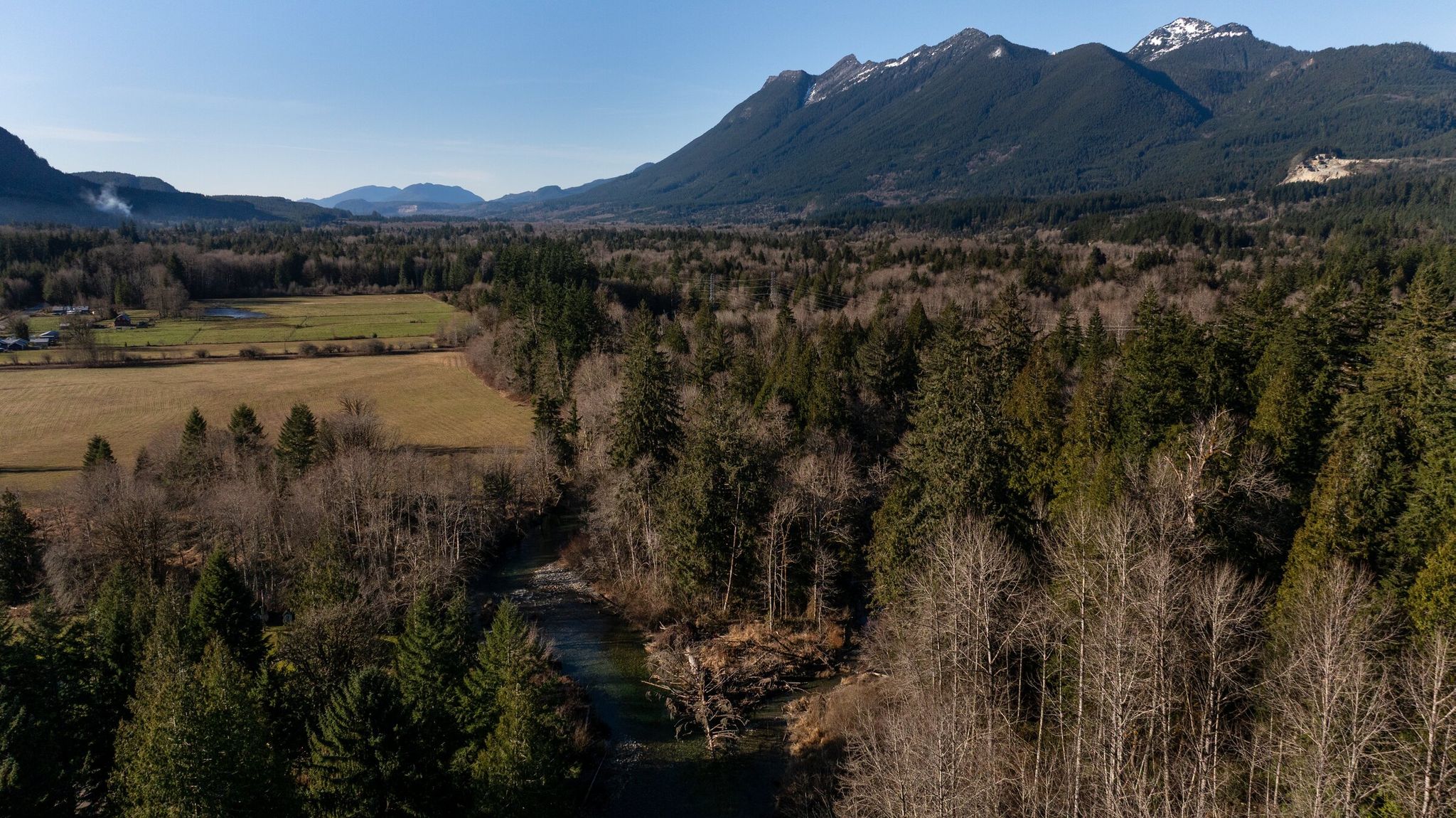
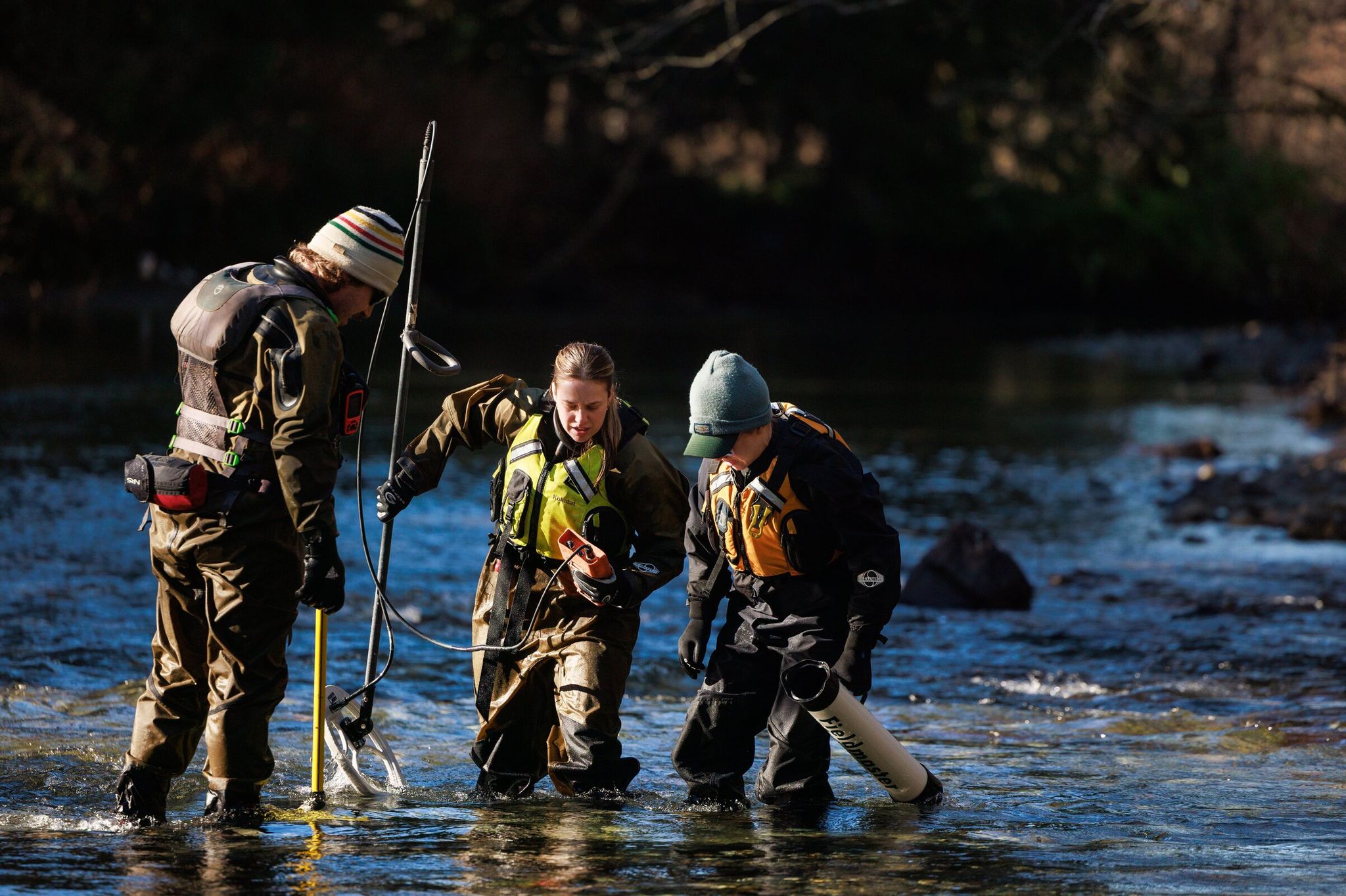
In Squire Creek near Darrington, Washington, Washington Department of Fish and Wildlife research scientist Michaela Low, wearing a wetsuit and life vest, swept an antenna along the streambed searching for signals from sensors buried under the gravel. Suddenly, above the rush of water, a pulsing beep sounded—the equipment had detected what the system identified as salmon eggs. In fact, they weren’t real eggs but part of a large experiment designed to understand how increasingly variable river conditions affect Stillaguamish Chinook at the most vulnerable stage of their lives. Chinook—the largest species of Pacific salmon, reaching up to 50 kilograms—plays a key role in the Puget Sound ecosystem: their decomposing carcasses bring ocean-derived nitrogen into forest streams, fertilizing coastal trees, and their eggs and juveniles feed 137 species of animals, including bears and southern resident orcas that rely on this salmon.
To simulate gravel nests (redds) where salmon lay their eggs, Low’s team last fall buried plastic boxes filled with beads and anchored chains with tags on the streambed at 20 sites across the Stillaguamish River watershed. The boxes were buried about 30 centimeters deep—roughly the depth Chinook typically bury eggs—and the chains were driven a few meters downstream, with the final bead left just below the gravel surface. Each box and chain was fitted with tags commonly used to track fish, allowing researchers to locate them with high precision months later. But soon after the gear was installed, the region was hit by torrential rains and record floods—a pattern of ever-more-extreme storms expected as the climate warms.
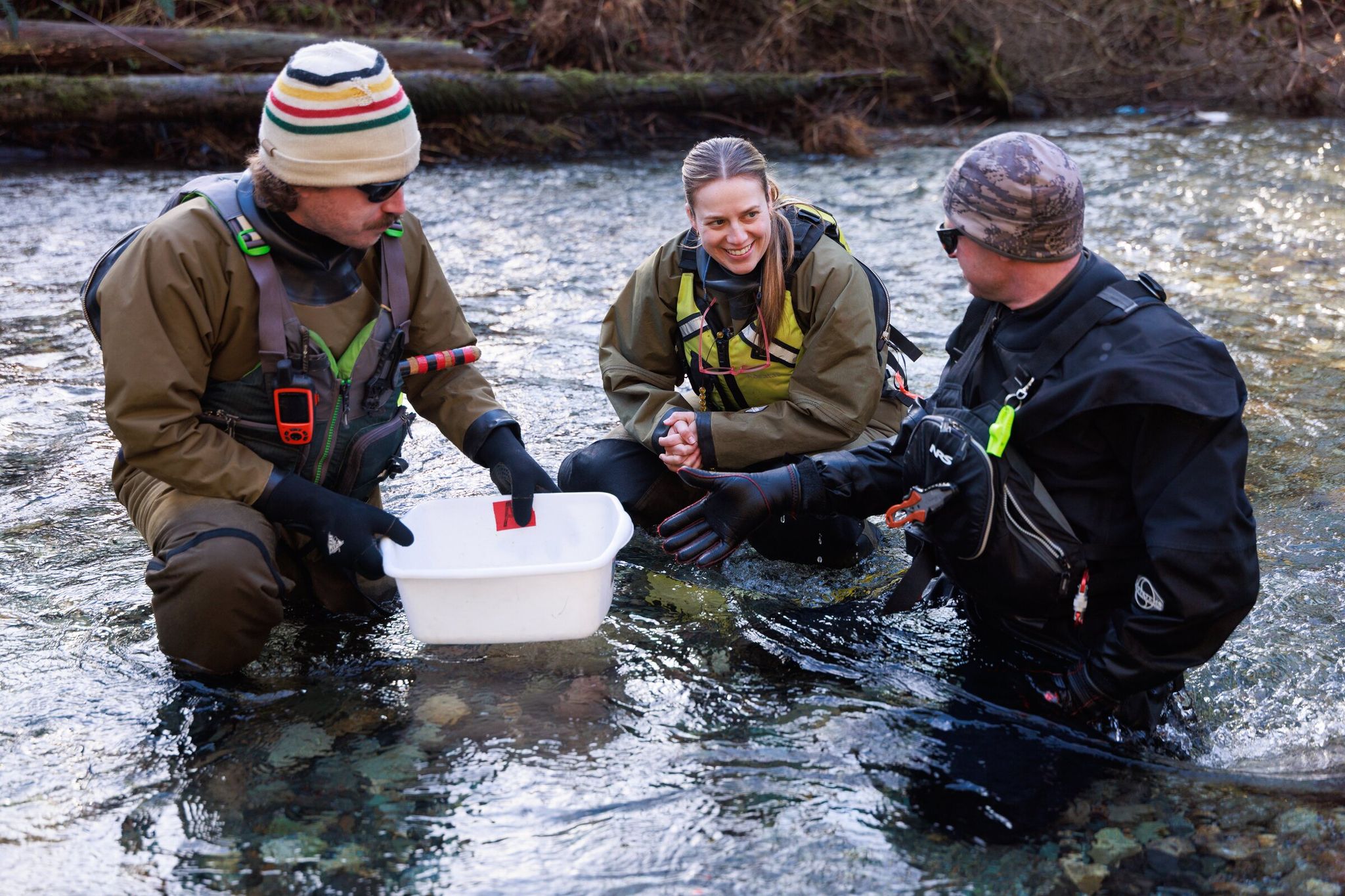
The experiment is meant to show how developing salmon eggs survive under those conditions by measuring two critical factors: scour (when flow washes eggs out of the gravel) and smothering (when eggs are buried under fine sediment and suffocate). A box filled with fine sediment indicates that real eggs in a similar spot could have been buried and deprived of oxygen, while an exposed chain signals that gravel was washed away and eggs were likely carried downstream. Researchers probed each box through the streambed, carefully retrieved it into a container, then drove the samples to a lab in Ellensburg for analysis.
The stakes for Stillaguamish Chinook are exceptionally high because this population is one of the most vulnerable in Puget Sound. While Chinook numbers are declining across the region, on average only about 1,200 adults have returned to the Stillaguamish to spawn over the past decade—roughly 10% of historical numbers a century ago. Chinook runs have dropped 90% from 19th-century levels due to European settlement: settlers logged forests along the river, straightened channels for log drives and agriculture, built dams and drained floodplain wetlands, leading to the loss of shaded areas, faster flows and the disappearance of spawning and juvenile refuge habitat. Commercial Chinook fishing has been closed here for decades, and tribal and recreational fishing opportunities are highly restricted. “In the short term, we’re just trying to keep them from disappearing,” says Jason Griffith, a biologist for the Stillaguamish Tribe.
The Stillaguamish Tribe is working to preserve the unique genetics of its Chinook: wild adults are captured, and their offspring are reared in captivity until habitat recovery is underway. According to fishery director Kadi Bizyaeva, that broodstock-in-culture approach is intended to maintain the salmon’s connection to the river while long-term restoration unfolds. “I’ve never been able to exercise my treaty fishing rights,” she admits. “For me, the only way to realize those rights is to serve the work that will return them to future generations.” The tribe’s treaty rights, secured in 1850s-era agreements (for example, the Point Elliott Treaty), guarantee them the right to fish at “usual and accustomed places.” Interaction with state agencies like the Department of Fish and Wildlife is governed by a 1974 court decision (the Boldt decision), which affirmed tribal rights to 50% of Washington’s salmon harvest. Each year they jointly conduct fish counts, set quotas and make season-closure decisions — a co-management model in which the tribe is an equal partner.
Historically, a healthy river in this region would spread wide, slow-moving flows across an extensive floodplain during heavy rains, dispersing across a landscape dotted with log jams, oxbows, side channels and meandering runs. Floods would carry large wood and sediment downstream, depositing them across the valley as waters receded and creating rich habitats for fish. But European settlement largely “evicted” rivers like the Stillaguamish from their wetlands and side channels, confining them to simplified, reinforced corridors lined with levees, more akin to aqueducts. In such highly altered systems much of the flood’s energy is funneled downstream “like through a firehose,” which can be catastrophic for both people and fish.
The Stillaguamish Tribe is leading efforts to “decolonize” the river: removing or setting back levees, returning large wood, and reconnecting the Stillaguamish to parts of its historic mouth and floodplain. The term “decolonization” means abandoning settlement-era practices (channel straightening, levees, logging) and returning to land-management methods used by Indigenous people before colonization — it’s not just ecology but the restoration of Indigenous sovereignty over natural resources. At a restored floodplain site, Griffith shows how floodwaters now spread sediment across the land rather than funneling it straight into the channel where it can smother salmon nests. The tribe also integrates cultural practices into science programs: elders teach youth traditional fishing methods (for example, use of basket traps and
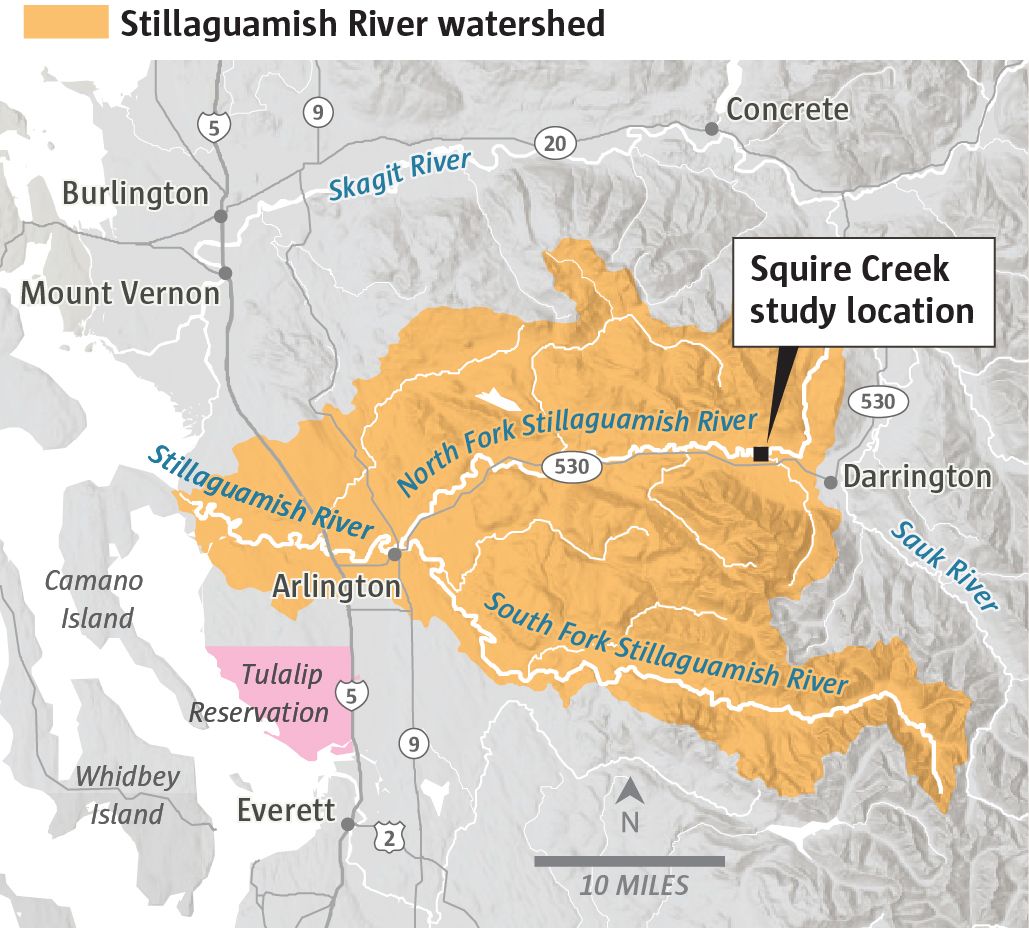
Based on: Scientists buried these tools in a WA river. Then the atmospheric rivers hit