This roundup covers three high-profile stories: the detention of a father and daughter by ICE agents at Seattle-Tacoma International Airport, which sparked protests and drew criticism from officials, and Pittsburgh receiver DK Metcalf’s third career ejection, in a game against Philadelphia.
“They’re taking my dad”: How an ICE arrest at Seattle airport divided America
Saturday morning at Seattle-Tacoma International Airport was supposed to be routine: Alaska Airlines Flight 1306 to Los Angeles, passengers with suitcases, the rush to board. Instead, the jet bridge became the setting for what witnesses later called “theatrical violence.” Two men in masks and plain clothes detained a father and daughter as they were boarding the plane. The girl’s scream—“Please, I’m begging you, please, no! They’re taking my dad!”—spread across social media within hours, instantly turning what seemed like an ordinary immigration operation into a national political scandal. The incident shook not only passengers but also the state governor, airport leadership, the airline and labor unions. It became another flashpoint in a long-running dispute over where law enforcement ends and brutality begins.
According to the U.S. Department of Homeland Security’s official account, the target was Ricardo Larrondo Mendoza, a Mexican citizen who had overstayed his visa. The department says that during the arrest his daughter, Sofia Hernandez Mejia, who officials say had also violated her visa terms, threw hot coffee at officers and will face a charge of assaulting a federal officer. In footage circulating online, one of the men does appear to have a stain on his jacket. But passengers effectively dispute that version: in the recording, one witness can be heard telling an agent, “She didn’t throw coffee at you, man.” That gap between the official account and what people see with their own eyes became the emotional core of the story.
One passenger, John Gadecki, told the Los Angeles Times that the plane was half full when he noticed two men cutting past the line. “Are we doing this? There he is, let’s go,” he heard them whisper. A moment later, they tackled a man to the floor, and, according to the witness, “everything turned into chaos.” A woman standing nearby with her young son turned around to shield him. “The immediate grief of the family, those screams, sobbing and wailing—it’s still right in front of my eyes,” Gadecki said. In the caption to his Instagram video, he called what happened “the most horrible thing I’ve personally seen in this country.”
Officials’ reaction was almost immediate. Washington Governor Bob Ferguson blasted ICE on X, saying the agency was “completely and utterly out of control,” and condemned “masked agents who don’t identify themselves dragging people off jet bridges as they board planes.” At a news conference, he called the video “horrifying” and “bloodcurdling,” describing the incident as “another example of the violence ICE is inflicting on our communities” and urging airlines to demand that the agency “get out of our airports.” Ferguson went further, saying ICE “cannot be reformed” and calling to “abolish Donald Trump’s ICE.” The Port of Seattle, which operates the airport, also expressed “outrage,” stressing that the federal operation was carried out “without the Port’s involvement or knowledge.” Officials are now asking the Department of Homeland Security whether protocols were violated. Alaska Airlines said it had received no advance notice of the arrests, was “concerned” by what happened and was looking into whether proper procedures had been followed.
The labor unions’ response gives the story particular weight. Cathy Garrow, executive secretary-treasurer of MLK Labor, which represents thousands of airport union workers, said flight attendants were the first to raise the alarm, arguing that “the escalation violated protocol and crossed a red line.” The incident shook the crew so badly that four of the six members assigned to Flight 1306 “refused to fly” that morning, she said. That detail shifts the discussion from abstract politics to everyday safety: if a crew openly refuses to operate a flight, what happened is seen not as distant news but as a direct threat.
Alongside the official statements, a human story is unfolding. By Sunday morning, more than $40,000 had been raised on a GoFundMe campaign launched for the father and daughter. The organizer, a close family friend named Yareli Farias, wrote that the family was “very grateful for all the love and support.” The money will go toward legal expenses, she said, because “the legal process and everything that follows could take a long time and cost a lot.” The fundraiser is a telling sign: public sympathy has landed with the detainees, not the agency.
To understand why what might seem like an ordinary arrest caused such an uproar, it helps to clarify a few things. ICE, or U.S. Immigration and Customs Enforcement, is a federal agency that, among other duties, deports foreign nationals who violate immigration law. Over the past year, it has significantly stepped up arrests at airports, including of people whose visas have expired. A visa overstay occurs when someone remains in the country beyond the time they are authorized to stay. It is technically a violation, but common in practice and by no means always grounds for immediate arrest—much less a public one. That is where the central tension lies: hard-line supporters see the incident as routine enforcement of the law; critics see it as a deliberately public show of force staged in a place where people are especially vulnerable. The agents’ masks and failure to identify themselves matter, too: to some, they are a safety measure; to others, a symbol of unchecked power. That is the divide on which the governor, the Port, the airline and the unions have found themselves on one side, and the Department of Homeland Security on the other.
The main takeaway from the incident is simple and troubling at once. The conflict is no longer just about whether something is “legal or illegal”; it has shifted to how it is done and whom it affects. An arrest on a jet bridge, in front of children, followed by a crew refusing to fly and a public fundraiser for legal fees, shows that even actions with a formal legal basis can be perceived as violence if they appear humiliating and opaque. Ferguson’s statement that ICE “cannot be reformed” is also telling: this is no longer a dispute about procedures, but a call to abolish the agency, taking the debate to a fundamentally different level. While some count the tens of thousands raised on GoFundMe and others calculate the political dividends, one thing is clear: the damage this episode has done to trust between the federal government and local communities is far greater than the organizers of Saturday’s operation could have foreseen.
Protest at Seattle airport: How the arrest of a father and daughter reignited debate over ICE’s powers
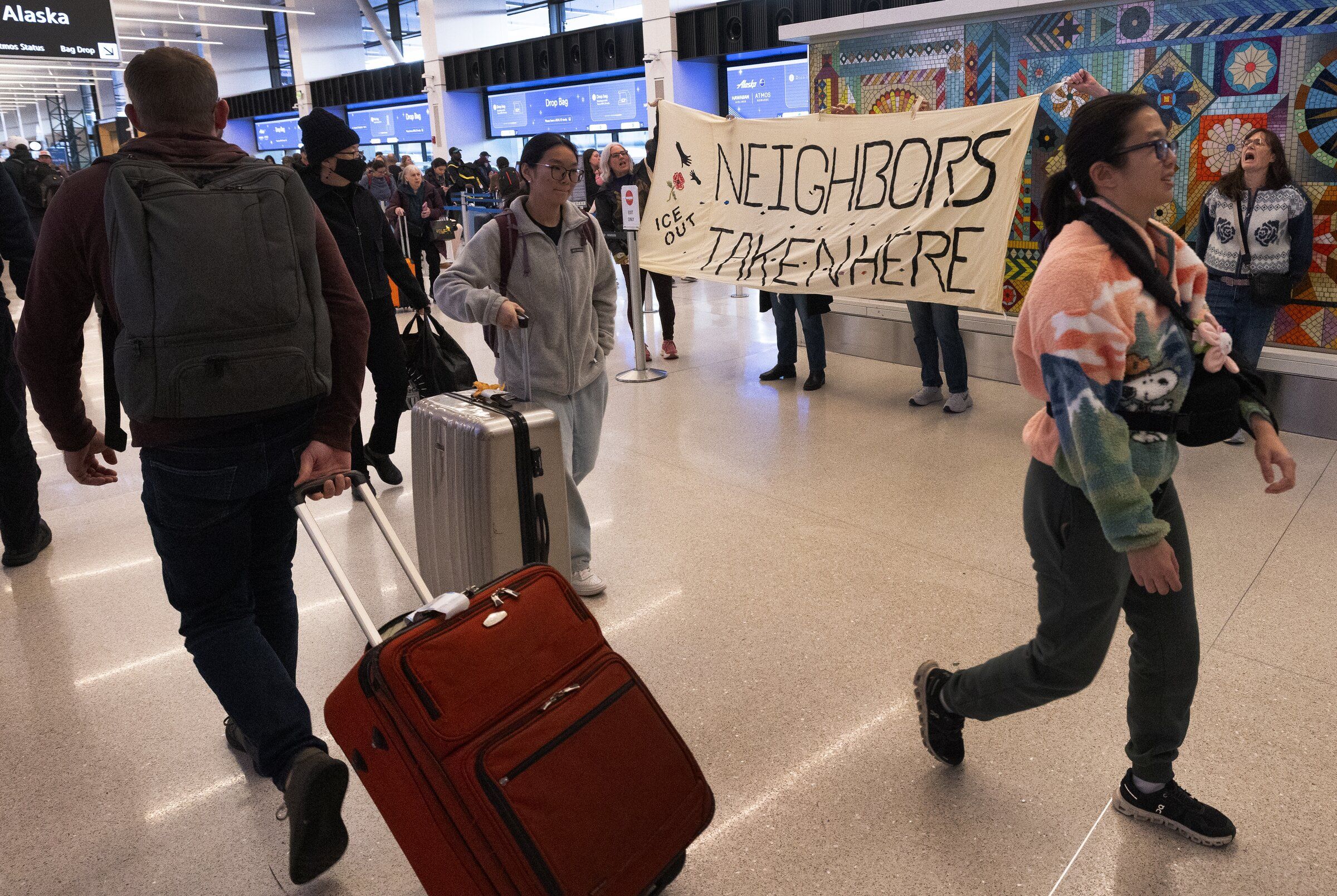
Last Sunday, a small but visible group of demonstrators marched through Seattle-Tacoma International Airport, demanding that U.S. Immigration and Customs Enforcement be removed from public spaces. The protest was prompted by footage of Saturday’s arrest of a man and his daughter as they waited to board an Alaska Airlines flight to Los Angeles. The video, in which a woman cries and begs officers to release her father before she, too, is detained, spread across social media within hours, drawing sharp responses from the state governor, the attorney general, members of Congress and Port of Seattle officials, who operate the airport.
According to ICE’s official account, both detainees had violated their visa terms, and the woman had also allegedly thrown hot coffee at a federal officer. The agency says those circumstances justified its forceful actions. But for many witnesses and commentators, the scene itself mattered more: armed, masked people operating in a narrow, crowded boarding corridor, separating a father from his daughter in front of dozens of passengers. That visual detail, rather than the legal background, became the emotional core of the scandal.
The organizer of Sunday’s protest, Palmira Figueroa, said that none of those gathered represented an organized group; they were simply people who had long helped and defended immigrants. In an interview after the protest, she said the video made her angry, but not surprised. “I’m not surprised, unfortunately. But when I watched this video, I was deeply affected by their inhumanity, by the way people are being separated from their families,” she said. Demonstrators unfurled a banner reading “Neighbors are being taken here” and chanted “ICE out!” They also gave a gift basket to the Alaska Airlines crew that had refused to fly to Los Angeles after the incident. In addition, they circulated an open letter calling on airline CEO Ben Minicucci to publicly condemn Saturday’s arrests.
Notably, Port Police not only allowed the protest to proceed but escorted the march, even though the demonstrators had no permit. Airport spokesperson Perry Cooper, who watched from the sidelines, summed up the administration’s mixed position: “We’re just as upset as they are, to be honest.” He added, however, that during the middle of a workday, at the start of the busy holiday travel season, the airport is a commercial space and “this isn’t the place to protest.” Cooper, who has worked at the airport for 19 years, said he could not recall such an aggressive immigration operation there—especially in a narrow boarding corridor. Federal agents, he said, are entitled to pass through entry points and many post-screening areas. With clearance, they can even drive onto the airfield, without notifying Port Police.
It is important to understand how this arrangement works. U.S. airports have a dual structure of authority: local governments such as the Port of Seattle handle day-to-day operations, but federal agencies retain broad powers throughout the transportation hub. Cooper explained that if the airport tried to obstruct ICE, the federal government could threaten to withhold previously awarded grants or even demand that they be repaid. That financial dependence makes local authorities’ formal autonomy highly conditional. Cooper also said he had previously seen black ICE vehicles pull up to aircraft boarding bridges on surveillance cameras and take passengers away, “but never as dramatically as this time.”
The incident brings several tensions in contemporary American politics into focus. First, there is a conflict between federal immigration priorities and local communities’ views of how much law-enforcement presence is acceptable in public spaces. Second, it raises the question of where lawful enforcement of immigration-status orders ends and a public show of force begins—a display that is perceived as intimidation and undermines trust in government. Third, it highlights the fragility of commercial operators’ reputations: airlines and airport authorities find themselves in the awkward position of mediating between loyalty to the federal government and the expectations of their own passengers and employees. Finally, the scale of the protest is striking: just about 20 people, without a permit and without a single breach of the peace, managed to attract national media attention and a response from the state’s top officials. The original video’s emotional impact was that strong.
The key lesson is simple: in an era when every minute in public can be captured on camera, the tactics of immigration authorities have become a political factor in their own right. Even when formal legal grounds exist for an arrest—a visa overstay and an alleged assault on an officer—the way it is carried out can matter more than the letter of the law. Statements by Governor Bob Ferguson, Attorney General Nick Brown and members of Congress, along with the demonstrators’ open letter to Alaska Airlines, show that the dispute has moved from the realm of law to that of morality and the social contract. While ICE insists it acted properly, Seattle-Tacoma International Airport remains the stage on which federal agencies’ limits—and local communities’ willingness to push back—are being tested.
DK Metcalf in the spotlight again: Third career ejection raises unanswered questions
DK Metcalf’s move from the Seattle Seahawks to the Pittsburgh Steelers in the spring of 2025 was supposed to give the receiver a chance to reset his career and prove he could lead an offense in a new system. The reality, however, has been far more complicated. In Sunday’s game against the Philadelphia Eagles, Metcalf was once again at the center of an altercation and was ejected for unsportsmanlike conduct—his third such ejection as a professional. The incident happened in the third quarter, after the receiver got into two confrontations with opposing defenders, and vividly illustrated a problem that has dogged a talented but highly volatile athlete.
The sequence of events makes for ugly reading. In the first half, Metcalf was flagged for unnecessary roughness after charging at cornerback Cooper DeJean. Then, during a second altercation, he apparently poked an opponent in the eyes. That earned him an unsportsmanlike-conduct penalty and an ejection. Metcalf’s final stat line for the game seems almost taunting: one catch for two yards, two personal fouls and an ejection. For a player who was recently considered one of the league’s most dangerous deep threats, it was a humiliating result.
The context matters because this was not an isolated incident. Last season, the NFL suspended Metcalf for two games after an altercation with a fan during a win over Detroit. Now a third ejection has been added to the record—and that is a warning sign for both the Steelers and the player himself. A Seattle Sports report notes that Metcalf was selected by the Seahawks in the second round of the 2019 draft and recorded 6,324 receiving yards and 48 touchdowns over his first six seasons—numbers that speak to his exceptional talent. But talent without discipline does not count for much in the NFL.
It is worth recalling how Seattle parted ways with Metcalf. In March 2025, the club traded him to Pittsburgh in exchange for the 52nd pick in that year’s draft. The Seahawks used that pick in a draft-day trade to move up 17 spots and select safety Nick Emmanwori at No. 35. In other words, Seattle turned a productive but volatile receiver into a promising defensive back—and, so far, the trade looks increasingly far-sighted. In 15 games for Pittsburgh last season, Metcalf recorded 850 receiving yards and six touchdowns. Before Sunday’s game, he had 432 yards and two touchdowns in nine games this season. Those are respectable numbers, but not outstanding, and they pale beside his disciplinary troubles.
For clarity, “unsportsmanlike conduct” is an NFL penalty that covers aggressive actions, insults, fights and deliberate attempts to hurt an opponent. An “unnecessary roughness” penalty is called for excessive contact outside the normal course of play. Ejection is the most severe measure, used by officials when violations are egregious or repeated. “Personal foul” is a general term for this type of disciplinary penalty. Three career ejections is a lot, even for a player with a reputation as a “tough guy.”
The main takeaway is simple: Metcalf remains an exceptionally gifted athlete, but his career is increasingly being held back by his inability to control his emotions. Pittsburgh has a player who can win a game—or let the team down at the worst possible moment, as happened in Philadelphia. For Seattle, this episode is further confirmation that trading him was a sound decision. The question now is how many more chances Metcalf will get before the league and its teams stop seeing him as a star receiver and start treating him as a chronic offender whose talent no longer justifies the risk.