A dispute is heating up in Seattle over road safety and the preservation of historic districts, the Mariners are considering Joe Espada for manager, and the Reign are turning Jess Fishlock’s farewell into a celebration with a merchandise collection bearing her name.
A dispute is heating up in Seattle over who should decide how to make historic districts safer
What began as a routine amendment to city law has turned into one of Seattle’s most revealing conflicts: a clash between the push for traffic safety and the desire to preserve the character of historic neighborhoods. At the center is a bill that would allow the city traffic engineer to make certain changes to street infrastructure in historic districts without approval from the district boards. At first glance, this may seem like a technical detail. But it raises a much broader question: who gets the final say when pedestrian lives are at stake on streets the city itself has pledged to protect?
On Monday, the Seattle City Council unanimously approved two bills in the “SAFER Streets Act” package proposed by Transportation Committee Chair Rob Saka. But a third measure—Council Bill 121296—was left in limbo. It became the crux of the dispute after Councilmember Alexis Mercedes Rinck introduced Amendment 16, which the committee approved by a 3–2 vote. The amendment would allow the city traffic engineer to install traffic-control devices and make targeted design changes in historic districts without a certificate of approval, which can currently be appealed. In other words, safety improvements would no longer have to pass through the review boards. Road-safety advocates supported the amendment, while historic-preservation advocates—including the board members themselves—saw it as an encroachment on their authority, as The Urbanist reports.
It is important to understand why the bill has stalled. The issue is not a lack of votes. Because the amendments were considered on a tight timeline before the committee vote, Amendment 16 required further review under the State Environmental Policy Act (SEPA), given its scope. That review is expected to take several months. Some councilmembers reportedly pushed for an earlier vote accompanied by a different amendment that would have removed Amendment 16 entirely, but that has not happened yet. Saka told reporters the process had run into legal complications: “We’re working on it. There are some legal issues, some legal concerns. We’re hoping to work through that with the third bill, so we’re not ready to vote on it today.” He mentioned a possible vote on November 10, but the final decision rests with Council President Joy Hollingsworth.
To understand the dispute, it helps to clarify a few terms. Seattle’s “historic districts” are eight designated areas where any changes to public space go through review boards, which issue certificates of approval to protect the area’s architectural and cultural character. A “certificate of approval” is a permit that can be appealed, and that appeal process gives the boards leverage to delay or stop projects. Amendment 16 would remove the need for such a certificate for “traffic-control devices and targeted design changes.” Its supporters stress, however, that it would not give the Seattle Department of Transportation (SDOT) carte blanche: installing bollards, for example—posts that prevent vehicles from entering an area—would not be covered by the amendment. The proposal is specifically about targeted safety measures that could be implemented more quickly.
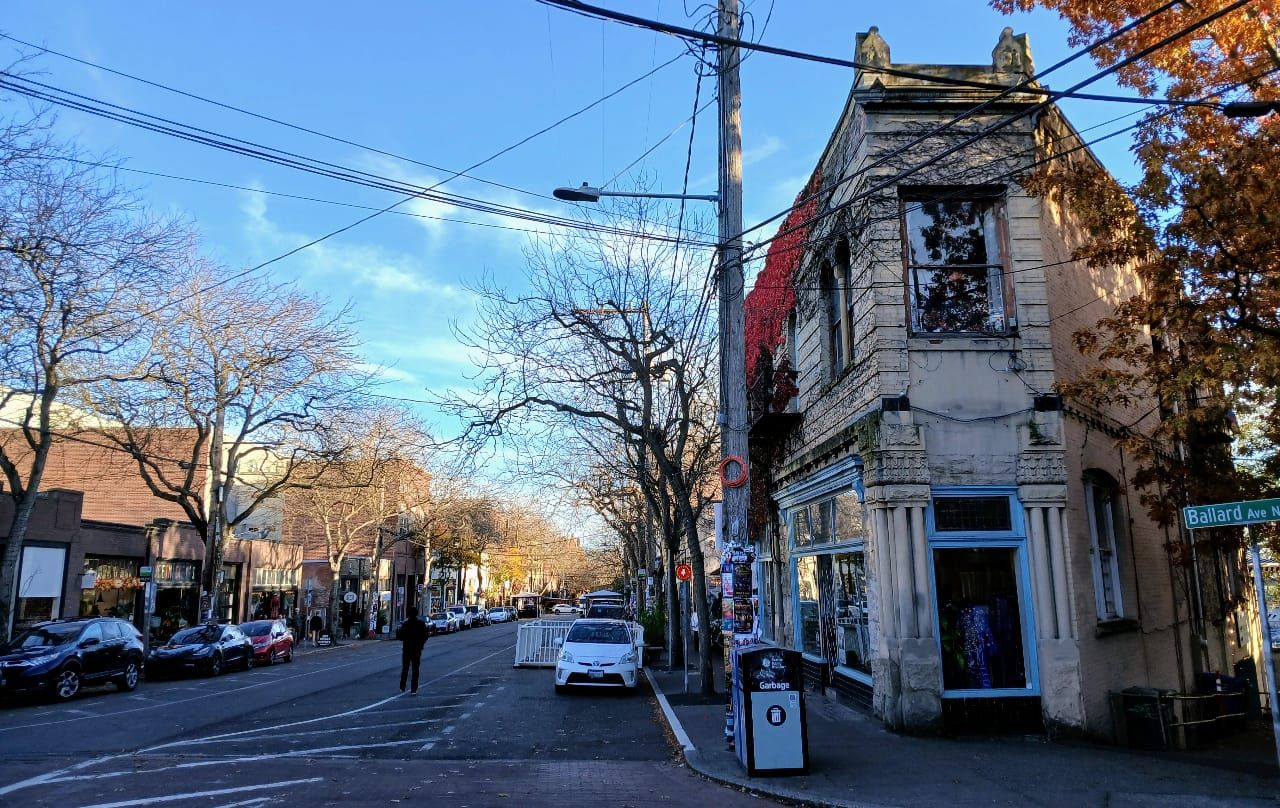
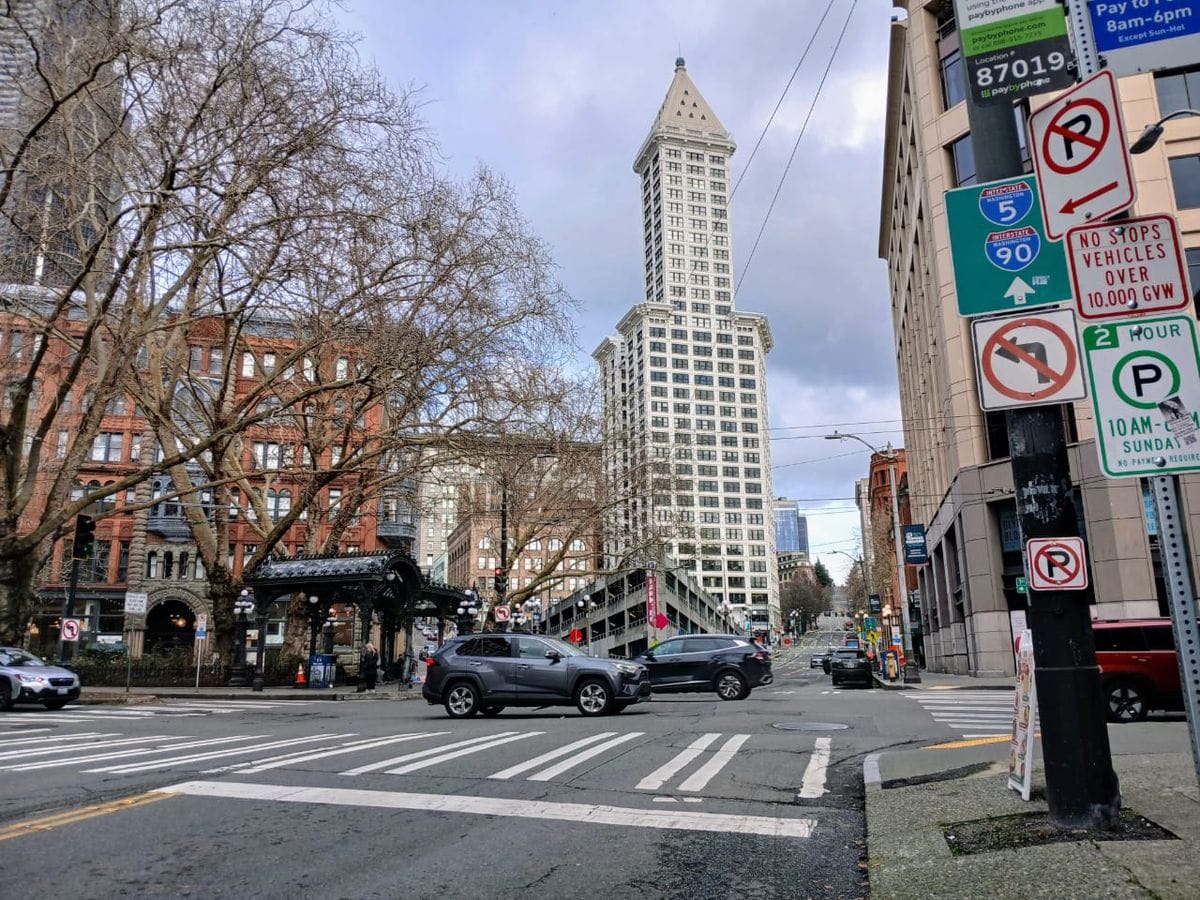
A telling example, central to the debate, is the dispute over bike parking in Pioneer Square. Earlier this year, SDOT proposed installing on-street bike and scooter parking at 21 intersections in the district, to get them off sidewalks and improve visibility at intersections. Along with seven more sidewalk parking areas, the project would provide space for about 300 bikes and scooters while taking up just one or two legal parking spaces. But business owners objected, and the Alliance for Pioneer Square said the proposed design was “fundamentally incompatible with the character and spirit of the district.” The group called for more expensive vintage-style racks and questioned whether additional parking was needed at all. Several months later, with the possibility of installing the racks before the World Cup approaching, SDOT returned with a proposal for just three on-street parking areas. On October 14, the Pioneer Square Preservation Board approved sending an official letter opposing the amendment. Board member Henry Watson, a development manager at Urban Villages, which owns the RailSpur complex, described the process as a success: “When everyone was concerned about 30 parking spaces going into the district, I think we wanted to slow SDOT down and ask them to gather community feedback, and that process was great. A lot of business owners came. A lot of concerned people, and I think we got much better results.”
But it is precisely this idea of “slowing things down” that most frustrates supporters of the amendment. Gordon Padelford, executive director of Seattle Streets Alliance, put the problem plainly when addressing councilmembers: “If you’re walking south on First Avenue, the person ultimately responsible for whether you’re safe or not is City Traffic Engineer Venu Nemani until you get to Columbia, and then suddenly it becomes the preservation board. And that’s not quite right when we talk about public accountability and public safety. There needs to be someone with the authority to ensure our streets are safe.” On the other side, Maureen Elenga, an architectural historian and chair of the Pioneer Square board, believes the amendment’s supporters are misinformed: “This is a group of people who complained to a councilmember that the special review districts don’t care about pedestrian safety, and they responded with this—which I don’t think is an appropriate way to conduct city policy. We all know that’s not what happened. What happened is what the process was designed to do. And if they want to come to us and talk about specific things that could be done administratively, of course we can discuss that. But simply trying to take away our entire scope of oversight over the right-of-way is not appropriate.”
Across downtown, the Pike Place Market Historical Commission is expected to formally weigh in on Amendment 16 at a meeting later this week. Friends of the Market, founded in 1964 to prevent the market’s demolition, has already come out against it. Board member Christine Vaughn put the group’s position this way: “The defining question around Amendment 16 is not safety, which everyone can support. It’s how to make decisions that promote safety while preserving the protections provided by the careful judgment of the boards and commissions tasked with overseeing changes to the public spaces they know best. Preservation and safety concerns can go hand in hand when commissioners and SDOT work together to find solutions suited to each neighborhood while also meeting traffic-safety needs.”
The key takeaway is this: even if CB 121296 ultimately passes with Amendment 16, the tension between the preservation boards’ goals and citywide efforts to improve safety and mobility will not go away. As things stand, the process for approving street improvements in the eight historic districts gives officials leverage to delay or block changes that they do not have in other neighborhoods. The amendment would not eliminate that leverage entirely, but it would speed up some safety projects. Both sides have valid arguments: preserving the distinctive character of Pioneer Square and Pike Place is not a whim, but a commitment the city has made to its own history. But pedestrian safety cannot depend on which street people happen to be on. Watson himself acknowledged the heart of the debate bluntly: “One of the things everyone loves about Pioneer Square is how walkable it is. It feels safe. That’s great. This board isn’t against any of that. I think that’s why everyone loves Pioneer Square. But I think the purpose of these discussions is to slow these things down.” The question is how long the city is prepared to wait when people’s safety is at stake—and who will be held responsible if the delay goes on too long.
Joe Espada and the Mariners: Why the Astros’ former manager could be Seattle’s answer
When Joe Espada’s name first appeared on the list of candidates to manage the Seattle Mariners, it may have seemed strange: the club was looking for a new skipper, and was considering someone just let go by its main division rival. But what began as an almost comical possibility has become a real one. Espada and Jason Kanzler, the Chicago Cubs’ director of player development, are the two leading finalists, and they are due for in-person interviews this week. It is a sign that the search for a replacement for Dan Wilson is entering its final stretch.
Espada has one significant advantage on paper: President of Baseball Operations Jerry Dipoto has said outright that the club would prefer a manager with experience in the role. Espada’s résumé speaks for itself: three seasons at the helm of the Houston Astros, two division titles, and before that, six years as bench coach under A.J. Hinch and Dusty Baker, including three World Series appearances and one championship. So why would the Mariners hire a manager their main rival has just let go? MLB Network insider Jon Morosi explained it simply on Wyman and Bob on Seattle Sports: the issue is not Espada, but what is happening inside Houston. The club is undergoing a major overhaul and looking for a new general manager after firing Dana Brown in the middle of the season. And, Morosi says, owner Jim Crane is difficult to work with—just look at how James Click took the team to the World Series and was still fired. So the Astros’ decision may say more about organizational turmoil than about Espada’s coaching abilities.
But there is another side to the story that deserves an honest look. Houston won its second division title in a historically weak American League West: the Astros became the first team in MLB history to win a division over a full season with a record below .500. The team’s main weakness was obvious: pitching. Houston let its ace, Framber Valdez, leave in free agency, then suffered a string of injuries, while major offseason acquisition Tatsuya Imai never managed to adjust to the move from Japan’s NPB to MLB.
This is where Morosi sees a key difference for Seattle. The Mariners’ starting rotation is the team’s greatest strength, and that changes the equation. “Believe me, if Joe Espada gets the Seattle Mariners’ managerial job, he’s going to look at that rotation and say, ‘Oh my gosh, where were you last year?’ And the answer is, they were on a different team,” he said, according to the outlet. In Morosi’s view, Espada would be far more effective in Seattle because he would have what he critically lacked in Houston. In addition to his coaching experience—including time in the New York Yankees’ system—Morosi particularly highlighted Espada’s communication skills, which are highly valued, and said he has always enjoyed being around him.
For the Mariners, this decision could shape the club for years to come. A team with a strong rotation and ambitions of reaching the playoffs has a chance to hire a manager with a record of winning, but also the burden of an unsuccessful finish in Houston—a result that, in Morosi’s view, was largely due to circumstances rather than the quality of Espada’s work. If Espada does end up in Seattle, he will have to prove that the Astros’ struggles were the result of organizational dysfunction, not his own shortcomings as a manager. And judging by Morosi’s reasoning, Espada would have the resources to do that—the Mariners’ pitching staff—as well as the reputation of a strong communicator, a quality in today’s MLB that may be valued almost more highly than tactical schemes.
A few terms that may be unfamiliar to readers are worth explaining. A bench coach assists the manager and is responsible for preparing the team’s bench players and coordinating operations. Pitching refers to a team’s performance on defense—in other words, the quality of its pitchers, which determines how many runs an opponent can score. NPB is the Japanese professional baseball league, and the transition to MLB can be difficult for pitchers because of differences in season length, the ball, and the intensity of play. Finally, a record below .500 means a team lost more games than it won. Winning a division with such a record is a genuine historical anomaly that underscores the weakness of the competition.
Jess Fishlock: The Reign turn a legend’s farewell into a celebration—and a business opportunity
On Sunday, Seattle Reign will play what may be the season’s most emotional game: Decision Day, which the club has chosen to turn into a tribute to Jess Fishlock, one of the most recognizable figures in women’s soccer. The club has also launched a clothing collection dedicated to the Welsh star, ranging from T-shirts to a scarf and a baseball cap. As the club’s press release says, Fishlock is the longest-serving player in Reign history, and her impact on the club is hard to overstate. The merchandise is intended to let fans wear her name not just now, but for years after she retires.
The news is simple but symbolic. The Reign have released a five-piece capsule collection: two T-shirt designs, a hoodie, a scarf and a trucker cap. On its own, the collection is standard club merchandise, but the context makes it much more significant. Decision Day in American women’s soccer is the final match of the NWSL regular season, when the playoff teams are determined. Combining such a game with a tribute to Fishlock serves sporting, emotional and commercial purposes at once. Fans come for a decisive match but leave with a sense of having been part of an era. The club, in turn, monetizes nostalgia at a time when attention on the player is at its peak.
The phrase “club original” in the text refers to a player who has been with a team since its founding or its earliest seasons. Fishlock was indeed there at the beginning of the Reign and remains the club’s all-time appearance leader. “Indelible legacy” is common language in press releases, but in the Welsh midfielder’s case it is more than a marketing cliché: for years, she has been the team’s face, its captain and its most prominent symbol. That is why launching the merchandise now makes sense: while fans are emotionally invested, demand for items bearing her name will be higher than at any other point in the season.
The key insight here is how modern women’s soccer clubs have learned to build on their players’ legacies. A few years ago, the departure of a star was more likely to feel like a loss than a reason to celebrate. Now the Reign are turning a farewell into an event: a special match, a special collection and a special story. This reflects a broader trend in the NWSL, where the commercialization of women’s sports is growing rapidly and clubs are investing more actively in players’ brands. For Fishlock, it is also a way to establish her name beyond the field. The Welsh midfielder has long been an ambassador for women’s soccer in Europe and the United States, and merchandise bearing her name promotes her personal brand as much as the club’s.
One detail is easy to miss: the article does not say whether Fishlock is ending her career right now. The phrase “long after her retirement” leaves room for interpretation. Perhaps she is about to say goodbye to the club; perhaps she is retiring from the game altogether; or perhaps the club is simply looking to the future. This kind of caution is typical of teams that want to preserve the suspense and avoid turning a celebration into a premature farewell. For fans, it is another reason to attend the match and see for themselves.
Ultimately, the merchandise announcement is only the tip of the iceberg. Behind it is a more important story about how women’s soccer is learning to celebrate its legends while they are still playing, rather than only after they leave. The Reign are showing that a player’s farewell need not be a sad ending; it can be a carefully planned event where sporting results, fan emotions and commercial interests all work in the same direction. And if Jess Fishlock really is about to say goodbye to the field, she can leave the way true icons do—with people all around her wearing shirts bearing her name.