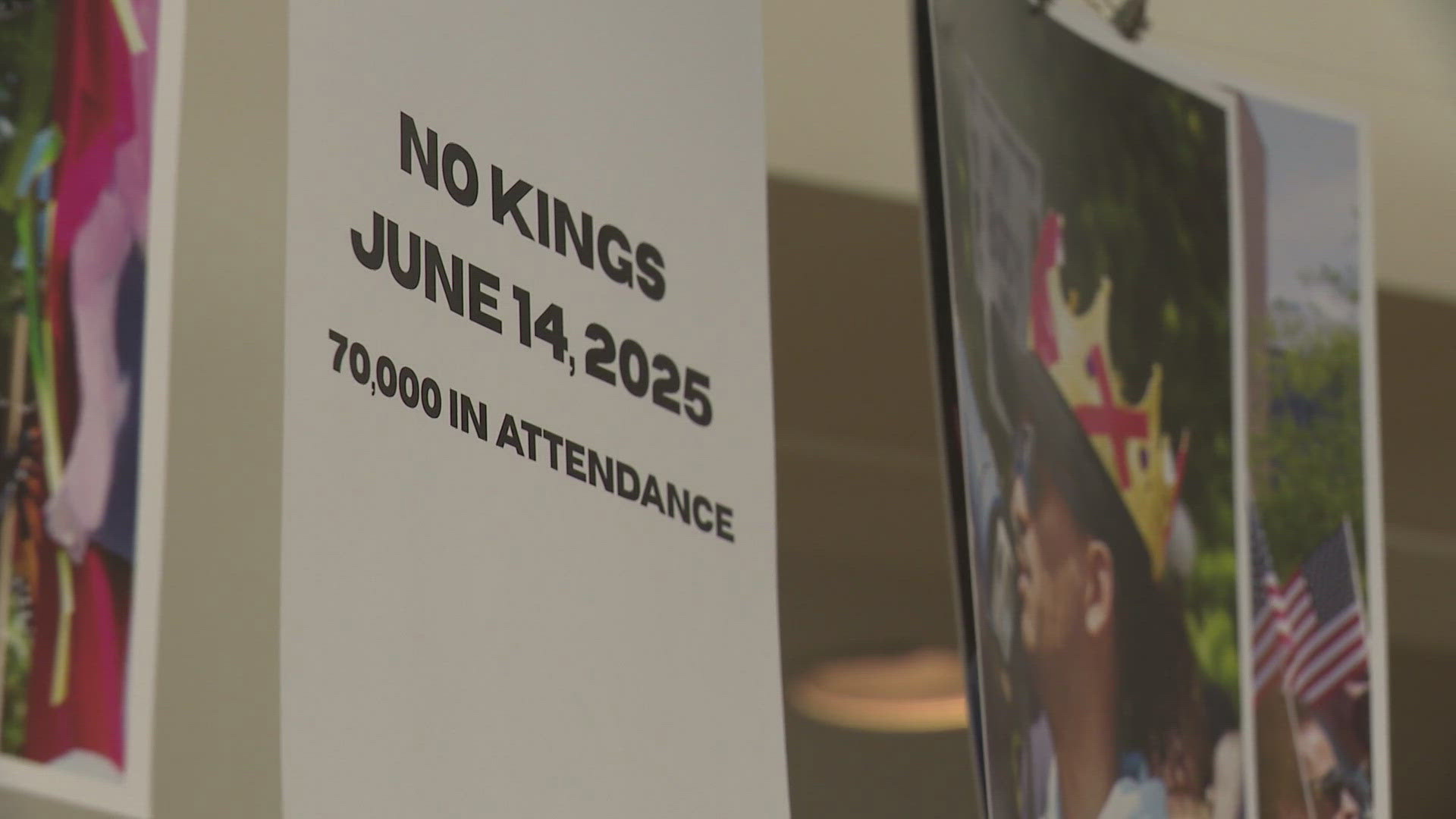
Mass protests by the "No Kings" movement will take place in Washington. In Seattle, a man is charged with attempting to push a person in front of a train, raising renewed questions about psychiatric care and public safety.
"No Kings" protests: large demonstrations across western Washington this weekend
This weekend, western Washington will become the epicenter of large public demonstrations. The "No Kings" movement, presenting itself as a peaceful protest against the policies of President Donald Trump's administration, plans to hold dozens of rallies and marches in cities such as Seattle, Tacoma, Everett, Olympia and Bellingham. Organizers expect record turnout, especially in Seattle, where more than 100,000 people could gather at Cal Anderson Park and then march to Seattle Center. Details on locations and times are available on the movement's official website: https://www.king5.com/article/news/local/where-no-kings-protests-are-happening-this-weekend-western-washington/281-7c1c6f6a-0367-43b5-8538-abf637568c88.
Events are scheduled for Saturday, March 28, and will cover many locations. In Bellevue the rally will be at 14801 NE Bel Red Rd. from 11 a.m. to 1 p.m.; in Bremerton — at the Manette Bridge from noon to 2 p.m.; in Everett — on the Snohomish County campus square from 12 to 3 p.m. In Federal Way the event will be at the intersection of South 320th Street and Pacific Highway South, and in Issaquah organizers, recalling the success of an October rally that drew 7,000 people, hope for even larger turnout from 12:30 to 2:30 p.m. In Kirkland the action will begin at the Ala Locke Pavilion in Marina Park at 1 p.m., with a rally at 2 p.m. and a march at 3 p.m.; police warn of possible congestion and road closures, and participants are asked to bring food donations for Hopelink. In Olympia the march will start at 11:30 a.m. from Percival Landing Park to the State Capitol, where a midday rally with speeches, music and community groups will follow. In Seattle, in addition to the main event, Washington Attorney General Bob Ferguson is expected to speak. The Tacoma event will take place in the Wright Park area. For participants' convenience, NoKings.org offers an interactive map to find the nearest event by ZIP code, and an additional map is available at mobilize.us/nokings/map/.
These demonstrations mark the third nationwide day of action by the "No Kings" movement, which organizers say has been steadily growing since last June, when initial actions drew more than 5 million people nationwide. This year more than 3,000 nonviolent protests are expected across the U.S., potentially making this mobilization one of the largest single-day protest actions in the country's recent history. The events come amid an expected Senate vote on ending a partial government shutdown, adding political intensity. Civil-rights groups such as Indivisible and 50501, along with a number of labor and civic organizations, have joined the movement, emphasizing that the marches aim to draw attention to immigration policy, voting rights, economic issues and other topics while defending free speech and the First Amendment. As stated on No Kings' official site, "as President Trump increases attempts to control us, it is up to us, the people, to show we will fight to protect each other and our country." For those who want to follow events, KING 5 offers coverage in its app to stay updated in real time.
Attempted murder charge at Seattle light-rail station
A troubling incident in Seattle has rekindled concerns about public transit safety and the challenges the justice system faces when dealing with people with severe mental illness. A man has been charged with attempting to push a stranger onto the tracks in front of an approaching train.
26-year-old Elisio Melendez was charged with second-degree attempted murder after a March 19 incident at the Northgate light-rail station in north Seattle. According to court documents, Melendez allegedly approached the victim from behind as a train arrived and twice tried to shove him onto the tracks. By a stroke of luck the victim managed to keep his balance and avoid falling. Prosecutors note that surveillance footage shows the suspect timed the attack with the arrival of a train, which they say clearly indicates an intent to cause maximum harm. Melendez fled the scene after the incident but was later identified from video and arrested on March 24 at a nearby residential facility. During questioning he denied involvement, telling investigators, "Maybe it was my twin, which I don't have," according to KOMO News: https://komonews.com/news/local/man-charged-after-allegedly-trying-to-push-stranger-in-front-of-train-at-northgate-station-link-public-transit-safety-victim-passenger-attack-assault-treatment-facility-seattle.
The attack comes amid rising ridership and growing concerns about safety on Seattle's public transit. But Melendez's case exposes deeper systemic issues. Court records indicate he has been diagnosed with schizophrenia and has a documented history of mental-health treatment. Earlier, in 2019, he faced a domestic violence charge after his sister was stabbed in the abdomen, but that case was dismissed in 2021 after Melendez was found incompetent to stand trial. "Incompetence to stand trial" is a legal finding that, due to severe mental illness, the defendant does not understand the court process and cannot participate in their defense, making a fair trial impossible. After that case was dismissed, Melendez was involuntarily committed to Western State Hospital.
By January 2022 the state's Department of Social and Health Services (DSHS) determined Melendez had progressed in treatment to the point where he could be moved to a less restrictive setting. DSHS explained that discharge planning for such patients is complex: social workers focus on housing, finances and follow-up care, and treatment is planned by a team of specialists to help the patient reintegrate into the community. Because of privacy laws like HIPAA, details of the specific case cannot be disclosed. Prosecutors express frustration with the system. As Casey McNerthney of the King County Prosecutor's Office noted, even if Melendez had been convicted in the 2019 case, the sentencing guidelines would have capped the maximum at 21 months, and he would have received credit for time already served. "Sometimes people point to that at prosecutors, but when you look at the file, you realize prosecutors had no other lawful options," he said. The prosecution is now asking for bail to be set at $750,000, deeming Melendez dangerous to the public.
The case raises difficult questions about balancing public safety, justice for victims and treatment for people with serious mental illness. It highlights gaps in the system where someone found incompetent and treated can still pose a threat, while the legal system is limited in its ability to prevent a tragedy. The Northgate incident is not only a story of a victim who escaped harm by chance but also a warning about the need for more effective coordination between the courts and psychiatric services.
Man charged with attempted murder after incident at Seattle station
A disturbing incident in Seattle again raises complex issues about mental health, public safety and the justice system. A man is charged with attempting to shove a stranger into the path of an oncoming train at Northgate station. This case, detailed by KING5.com: https://www.king5.com/article/news/crime/attempted-murder-charge-for-man-allegedly-trying-to-shove-rider-into-arriving-northgate-train/281-24d2e21c-a8c4-488a-88f8-eae9eda50f61, goes beyond an ordinary criminal matter and exposes long-standing systemic problems.
Court documents say the attack occurred March 19 at Northgate station. The victim was waiting for the northbound train when an unknown man approached from behind and tried to push him onto the tracks as the train arrived. The victim miraculously kept his balance, but video footage shows the assailant made a second attempt, again pushing the person toward the train before fleeing the scene. Investigators used the footage to identify the suspect as Elisio Melendez. He was arrested March 24 at a mental-health facility near a bus stop toward which he fled. Clothing matching what the attacker wore in the video was found in his room.
Melendez was charged with attempted murder, and bail was set at $750,000 at his first court appearance. But his story did not begin with this incident. According to the King County Prosecutor's Office, the only prior case on his record was a 2019 second-degree assault domestic-violence charge. During that process, the defense questioned his competency to stand trial. Melendez underwent several court-ordered competency restoration periods — the maximum allowed under state law. Ultimately the court found him incompetent and unable to be restored, and on February 10, 2021, the case was dismissed. The court ordered him committed for involuntary treatment at Western State Hospital. "Competency restoration" refers to the legal process aimed at treating a defendant to the point where they can understand the nature of the proceedings against them and participate in their defense — a prerequisite for continuing criminal prosecution. Prosecutors say Melendez remained at Western State until January 2022, when state officials determined he had improved enough to be transferred to a "less restrictive alternative," such as a specialized group home or outpatient treatment program.
The case raises acute questions. On one hand, there is an obvious threat to public safety and the need to protect citizens from violent acts. On the other, it is a tragic example of how a system designed to treat and rehabilitate people with serious mental illness can fail, potentially releasing individuals who still pose a danger. Melendez's story is that of a person the system found incompetent and not subject to criminal punishment, yet whose subsequent treatment and risk assessment left him free at the time of the incident. The attempted-murder charge now brings him back before the courts, and his competency will undoubtedly be a central issue. The incident is likely to spur public debate over the effectiveness of psychiatric care programs, criteria for moving patients to less restrictive settings, and how the legal system balances the rights of people with mental illness with the need to protect the public. The near-tragedy on the Northgate platform is not only a crime story but a stark reminder of the deep problems at the intersection of law, medicine and public welfare.