
Today is primary election day in the state of Washington. Voters will determine who advances to the general election on November 3, as well as decide local ballot measures. Under state rules, the top two candidates who receive the most votes move forward—even if they are from the same party.
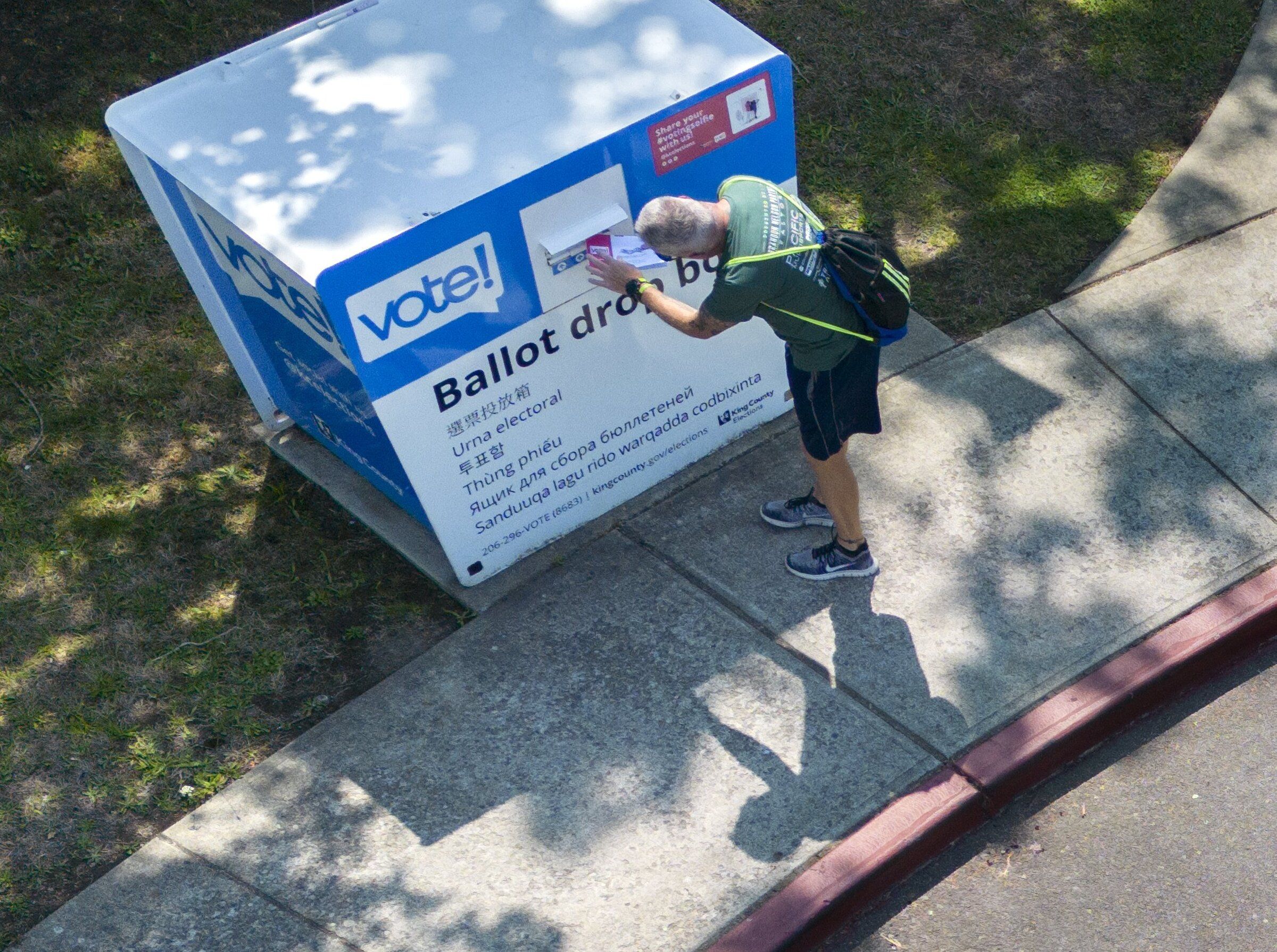
Washington is one of the pioneers of vote-by-mail in the United States. Many counties in the state have used that format for years, and in 2011 lawmakers required all counties to conduct elections entirely by mail; the system was fully in place beginning with the 2012 elections. This approach has become the norm because it is convenient for residents, helps boost turnout, reduces costs, and is accessible. Every registered voter automatically receives a ballot about two weeks before Election Day. Voters can mail it back through the regular postal service—most counties include an already postage-paid return envelope—but for those for whom mail is inconvenient, such as people who are traveling, have disabilities, or worry about delays, alternatives are available: official secure drop boxes, voting centers where you can return your ballot in person, and special voting machines for people with disabilities. For a ballot to be counted, it must be postmarked no later than August 4 or dropped into an official ballot box by 8:00 p.m. that day. Officials advise against waiting until the last moment to rely on the mail—dropping your ballot in person at the box is safer.
If you aren’t registered yet, you can register in person on Election Day. In King County, voting centers are open from 8:30 a.m. to 8:00 p.m.—for example at Bellevue College, at the City Hall in Kenmore, at the Lumen Field Event Center, or at the King County Elections office. King County is an administrative unit in the state that includes Seattle and dozens of other cities and towns: Bellevue, Redmond, Renton, and Kent. It is the most populous county in Washington: about 2.3 million residents, or roughly one-third of the entire state’s population. With so many voters, the county effectively helps determine statewide outcomes—from governor and state legislators to referendums—and has a major influence on how the United States president is chosen. Politically, it is a stronghold of Democrats. In addition, the county government provides regional services that affect everyone in the Seattle area: public transportation (King County Metro buses), public health, roads and bridges, parks, courts, jails, and emergency services. So, “Seattle politics” is, in practice, largely King County politics. Voting centers also offer audio ballots, large print, and assistive tools, as well as materials in Chinese, Korean, Russian, Somali, Spanish, and Vietnamese.
After you submit your ballot, you can track its status online at voter.votewa.gov. If you lose your ballot, don’t worry: you can vote in person or print a replacement. Replacement-printing instructions are available on the King County website, and residents of other counties can contact their county elections office.
This year, more than 600 offices are up for election in Washington. That includes all 10 U.S. House seats—including the districts represented by Pramila Jayapal and Adam Smith—as well as numerous seats in the Washington State Legislature. Voters will also select five of the nine justices on the Washington State Supreme Court, members of the King County Council, and one member of the Seattle City Council. Washington is among U.S. states where judges are chosen in elections rather than appointed. The tradition dates back to the 19th century and the era of “Jacksonian democracy,” when people in the western United States believed judges should be accountable to the public—not appointed by governors or lawmakers. The nine justices of the state Supreme Court serve six-year terms and are elected in nonpartisan elections: candidates are placed on the ballot without party labels. That aligns with Washington’s nonpartisan primary system. If more than two candidates run for a seat, a “top-two” primary takes place in August, with all candidates on a single ballot; then only the two who receive the most votes advance to the November general election. If there are only two candidates, they go directly to November. In this way, the system stays nonpartisan at every stage. At the same time, elected judges still have to raise campaign funds, run campaigns, and defend their decisions to voters: critics see this as a threat to judicial independence, while supporters argue that elections make the judiciary more democratic and transparent.
Separately, voters are asked to weigh in on Prop. 1, a property tax— a seven-year measure raising $480 million to fund Seattle’s public libraries. Supporters say the money is needed to repair libraries and expand their services. Opponents argue it is an additional burden on residents and would make the city less accessible.
For detailed information about candidates at the national, county, and city levels, see The Seattle Times voter guide. It includes information on all candidates to help you make an informed choice before polls close.
Based on: It’s primary Election Day in WA. Here’s what to know