
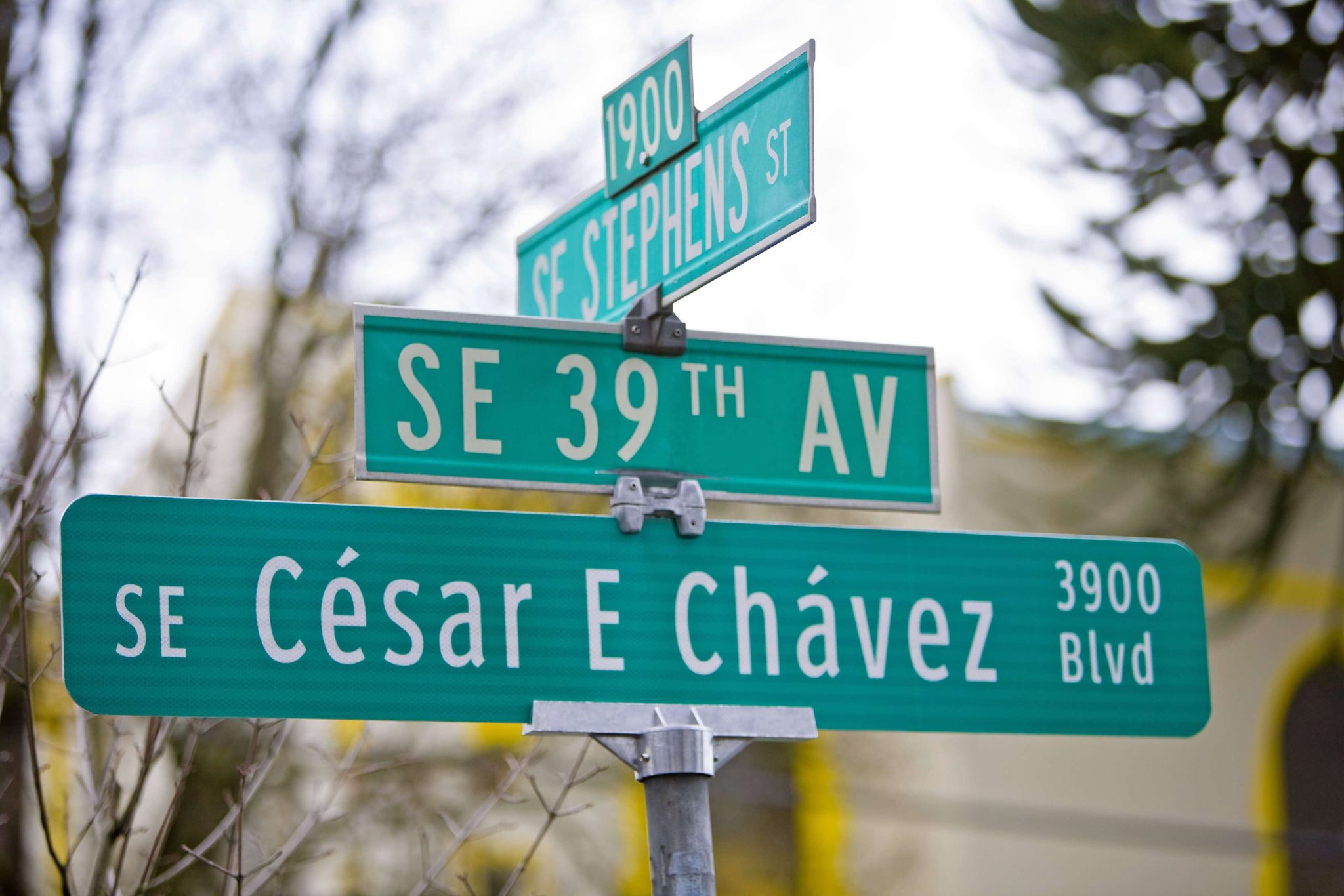
Members of the Portland City Council this week took the first step to swiftly rename César E. Chávez Boulevard after sexual scandals tied to the once-revered labor leader. The City Council’s public works committee unanimously approved a proposal that bypasses the city’s strict street-renaming rules to change the name of the eastside thoroughfare to Campesinos Boulevard — honoring the role of Latino farmworkers in the labor-rights movement.
The 5-0 vote sends the initiative to the full City Council for consideration, which is expected to decide in the coming weeks. If approved, it would be the first time Portland authorities remove a person’s name from a city street. “This ordinance is about a fuller truth and choosing values that are more important than any one symbol,” said Martha Gembas, a chief backer of the measure, at Tuesday’s hearing.
Gembas, who also heads the recently formed Por La Causa committee, played a key role in Portland’s decision nearly two decades ago to honor Chávez and the Latino community with the street name. But the movement to remove the name began after a New York Times investigation detailed statements from several women alleging Chávez sexually abused them in the 1970s, when he was at the height of his power as leader of the United Farm Workers union.
According to the report, two of the alleged victims were 13 and 15 years old at the time of the purported abuse. Chávez died in 1993. In 2009, the Portland City Council unanimously voted to rename 39th Avenue as César E. Chávez Boulevard after a yearslong campaign by Gembas, who faced xenophobia and intimidation. The thoroughfare, more than 11 miles long, runs through the city’s northeast and southeast neighborhoods.
Supporters asked the council to waive standard requirements, such as collecting 2,500 signatures or gaining the consent of 75% of property owners, citing inconsistent application of rules in the past and a desire to avoid a protracted process that could reopen old wounds. Portland, they noted, has already faced criticism for uneven approaches to renaming: some streets were renamed for prominent figures without adequate public discussion, while initiatives tied to recognizing marginalized communities languished in bureaucracy for years. For example, requests from Indigenous peoples were rejected due to complex voting requirements, while commercial naming requests were approved more quickly. This time the council chose to bypass those obstacles and focus on the symbolic significance of the new name.
“This is about choosing values that are more important than any symbol,” Gembas emphasized.
The new name — Campesinos Boulevard — was chosen deliberately. The term “campesinos,” meaning “peasants” or “farmworkers,” has deep roots in Latin American labor movements, especially in the work of César Chávez and the United Farm Workers in the 1960s and 1970s. The word symbolizes dignity, struggle and solidarity among migrant and Indigenous agricultural workers who have faced exploitation and low pay. In the context of the Pacific Northwest region, the name reflects the historical contributions of Latino and Mexican workers who played a crucial role in developing agriculture. It also serves as a reminder of the ongoing fight for fair labor conditions, linking the local community to broader social movements.
But the proposal has already prompted criticism. Some residents are calling to revert the street to 39th Avenue, and others are outraged at the city’s decision to bypass its own rules. “This is unfair, inappropriate and not in keeping with best practices for street renaming. You talk about inclusivity but you are not including us. We live on this street,” resident Kyle Warner, who lives on Chávez Boulevard, told councilors.
Based on: Portland launches fast-track renaming of César E. Chávez Boulevard