
On Wednesday, September 30, Pinehurst Station will begin service in north Seattle—the first station in Sound Transit’s history to be inserted into an already operating light-rail line. It will shorten the trip downtown for residents of neighborhoods around Northeast 130th Street, but its opening comes as the network’s further expansion faces a multibillion-dollar funding gap and increasingly distant timelines.
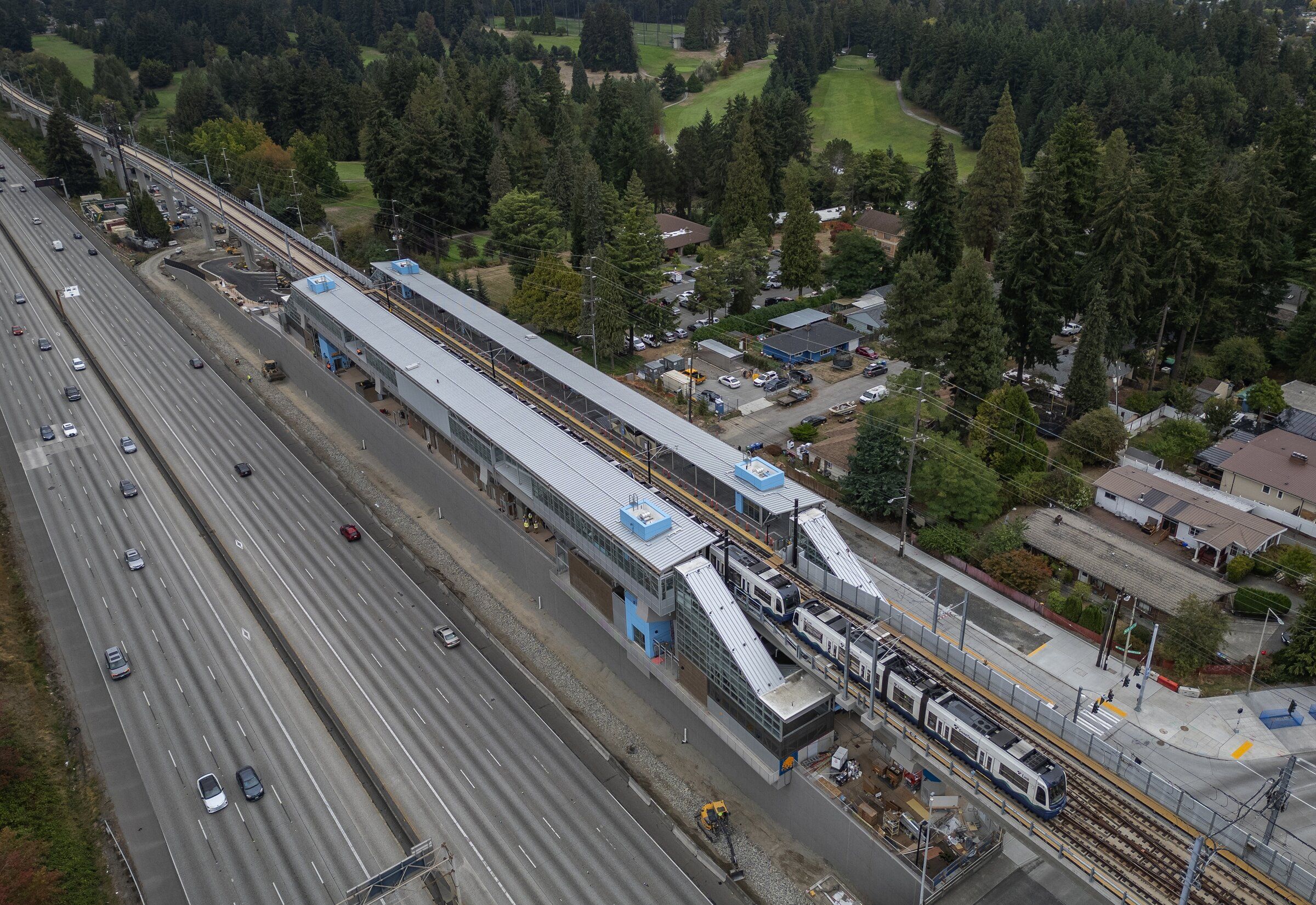
The Pinehurst platform hangs above 5th Avenue Northeast at Northeast 130th Street, between Northgate and Shoreline South/148th, near the I-5 interchange, residential neighborhoods and the Jackson Park Golf Course fields. This is neither a new branch nor a new route: the station was carefully inserted into the Lynnwood Link elevated structure, where trains had already been passing this spot. Trains on Lines 1 and 2 will now stop here, with peak-hour intervals of approximately four to six minutes, according to Sound Transit.
For passengers, the change is simple and almost personal. The trip from Pinehurst to Westlake in downtown Seattle is expected to take about 15 minutes, while the ride to the station at Sea-Tac Airport will take 53 minutes. Sound Transit expects between 2,600 and 4,200 boardings per day. The area had long been a gap between two stations—not empty, but not close enough to rail for it to become part of everyday life. Now that gap has its own staircase to the platform.
The station officially became part of the ST3 program approved by voters in 2016. At the time, it was scheduled to open in 2031. In 2020, the Sound Transit Board decided to accelerate the design process, and in 2022 it approved additional budget and contract measures. This made it possible to begin work before the entire Lynnwood Link Extension opened, avoiding the particularly disruptive prospect of construction in the middle of a fully operating line. The opening was nevertheless pushed back from the originally planned second quarter of 2026 to late September—but compared with the old schedule, the station is arriving five years early.
Pinehurst is not designed as a major transfer hub with a multistory garage, but as a station for nearby neighborhoods and buses. The street level includes a plaza, bus stops, passenger drop-off areas, stairs, elevators and bicycle infrastructure. The city is also improving the approaches to the station, building protected bike lanes and upgrading crossings and bus stops on Northeast 130th Street, Roosevelt Way Northeast and Northeast 125th Street. Officials’ expectation is that nine out of 10 passengers will walk, bike or transfer from a bus.
The bus connections have already begun to change. In late August, King County Metro launched Route 77, connecting Bitter Lake, Pinehurst, Lake City, Roosevelt Station and the University District. For an area divided by a freeway and streets designed primarily for cars, the route may prove to be just as important a part of the new station as the elevated tracks themselves. Rail provides speed from north to south; the bus is meant to gather riders from the east and west.
Visually, Pinehurst does not try to pretend it is already a dense urban center of the future—there are still plenty of quiet streets, detached homes and greenery around it. But the city views the area around 130th Street as a future urban center, with denser residential and mixed-use development on both sides of I-5. The station’s design attempts to connect the infrastructure with that future, which has yet to take shape: local artist Romson Bustillo created colorful panels and a 100-meter ceramic mural, while the landscaping incorporates native plants, boulders and motifs from nearby Thornton Creek.
And yet the celebratory day will carry a hint of a pause. In May, the Sound Transit Board revised the ST3 program in an attempt to close a projected $34.5 billion funding gap over the next two decades. The extension to West Seattle remains funded, though without an Avalon station; construction of the Ballard Link is currently funded only as far as Seattle Center. The segment from Seattle Center to Market Street in Ballard is still being designed, but the current plan contains no money to build it.
Sound Transit says the full route to Ballard could still open in 2042 if the region finds new sources of funding and achieves further savings. Without them, trains to Smith Cove, Interbay and Market Street may not arrive until around 2060. Pinehurst is therefore both a small victory and an accurate portrait of Seattle today: the city managed to place a stop where trains were already passing, but the question of how much farther those trains will go remains open.
Based on: Seattle gets a new light rail station, and then a long wait