
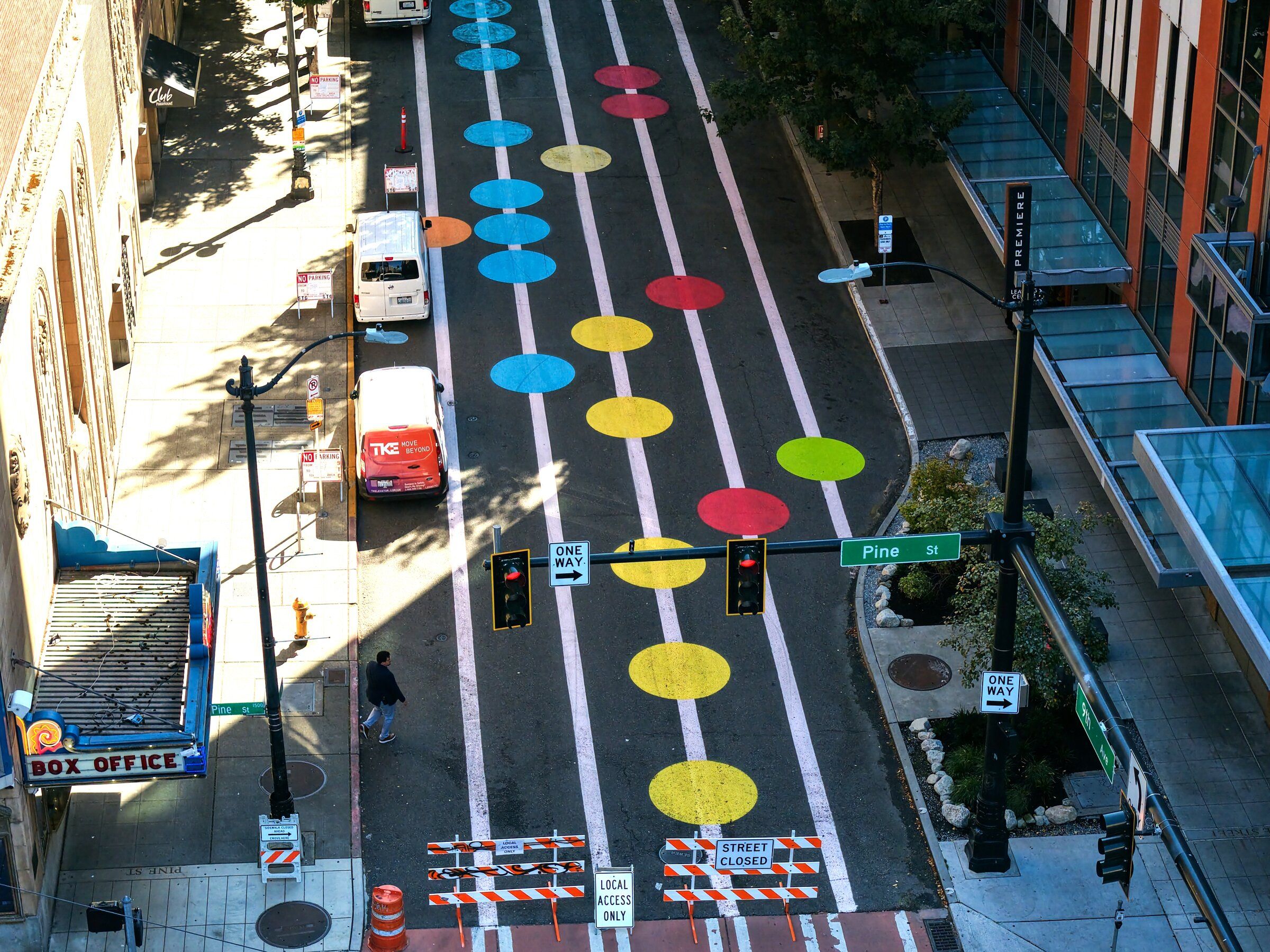
Bright circles and white stripes left on Ninth Avenue after the August Market at the Marquee turned one downtown Seattle block into an unexpected traffic problem. Attempts to remove the paint with solvents and power washing damaged the asphalt, and the street between Pike Street and Pine Street remained closed far longer than planned. But by the evening of Sept. 19, Seattle Convention Center and the Seattle Department of Transportation, or SDOT, had agreed not merely to paint over the design, but to create an updated version with clear road markings. The work is expected to be completed within two weeks at the convention center’s expense.
On an ordinary day, the short block near the Paramount Theatre could easily be mistaken for one of downtown’s many service arteries. Its importance becomes clear when it is closed: Ninth Avenue leads to the entrance for the Interstate 5 express lanes. Drivers are now being advised to detour via Seventh Avenue and Pike Street, while local transportation officials say the delay adds 10 to 15 minutes to some daily trips.
The story began with a thoroughly urban, almost idyllic idea. Seattle Convention Center closed the street in late July, hoping to extend the downtown revitalization that emerged during the FIFA World Cup matches. On Thursdays—Aug. 6, 13, 20 and 27—the area hosted the evening Market at the Marquee, featuring local vendors, food, music and a pedestrian market from 5 to 8 p.m.
The asphalt was meant to become part of the backdrop. About 40 large red, yellow, green and blue circles appeared on it, along with five thick white lines extending nearly the full length of the block. For organizers, it was a practical experiment: Could the space between the convention center buildings and the surrounding neighborhood be made more welcoming, safer and more useful for small businesses?
The street-closure permit called for the road to reopen Sept. 4. But after the market ended, it became clear that the temporary artwork had remarkable staying power. The convention center tried Taginator graffiti remover and high-pressure hot-water washing. The paint proved difficult to remove, and in some places the road surface itself began peeling away during the process.
According to the convention center, that became the main obstacle to reopening the street. The issue is no longer simply whether people like the colorful circles: Blurred white stripes on the roadway could be mistaken for traffic instructions, while the damaged asphalt requires repairs. Under SDOT rules, street murals must receive departmental approval and be painted with slip-resistant paint. But any artwork on an active roadway must ultimately give way to clear traffic movement.
On Sept. 18, SDOT initially said the design would likely have to be covered with paint in the near term, followed by standard road markings, with the remaining material later ground down and the pavement restored. The next day, the outlook became somewhat less bleak: The parties agreed to modify the design so it could preserve the spirit of public art while adding clear centerlines and other markings needed by drivers.
The convention center said it would pay for the redesigned mural, its installation and the new road markings—with no cost to the city budget or residents. The compromise reflects a distinctly Seattle logic: Rather than dismissing an unsuccessful street experiment as a mistake, officials are trying to reshape it into something more viable. But before Ninth Avenue can once again be both a gathering place and a roadway, it will have to learn how to be a roadway again.
Based on: Colorful art won’t come off a Seattle street, so dull paint will cover it