
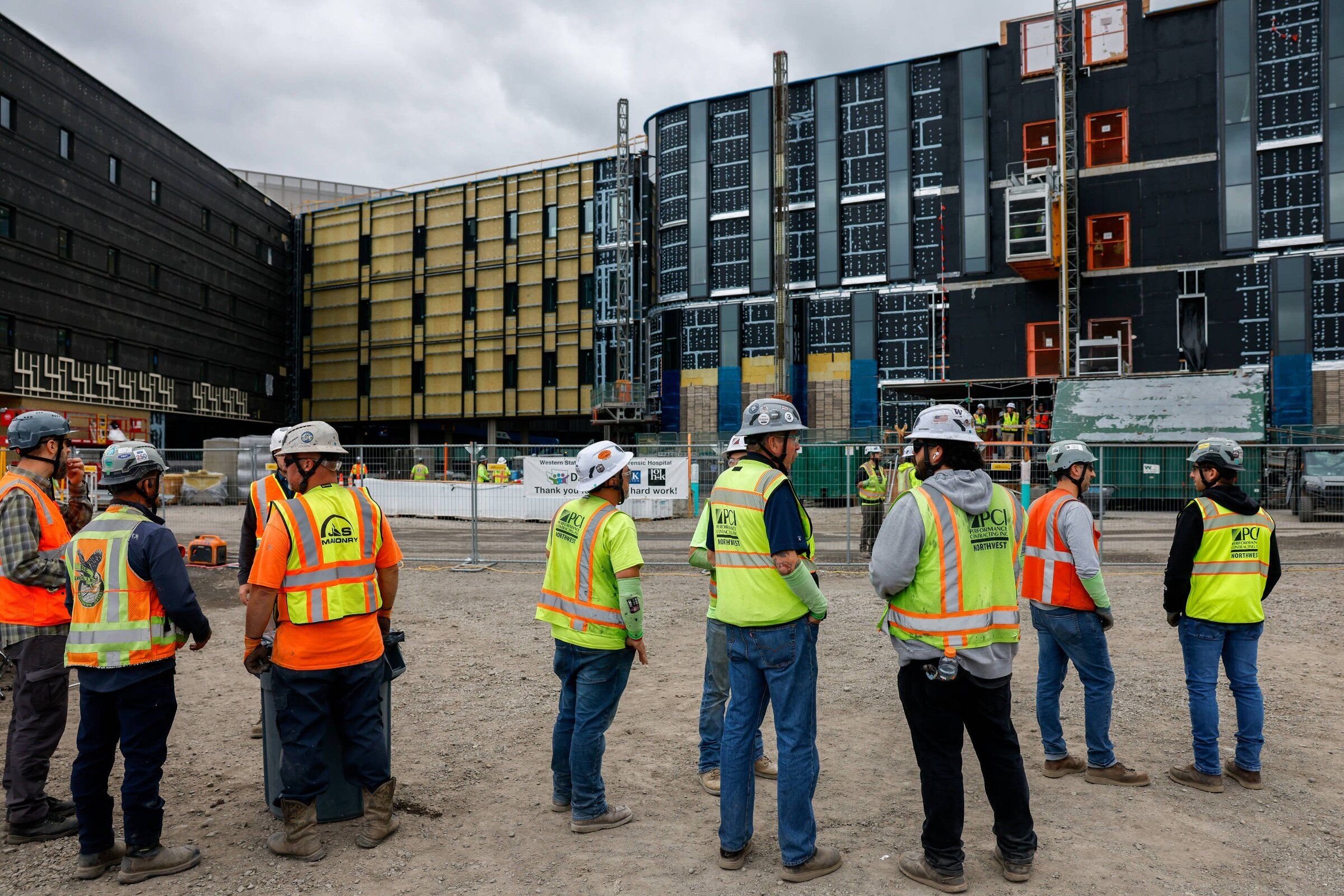
In Lakewood, Pierce County, officials held a ceremony to install the final structural beam atop the main building of the new facility at Western State Hospital. The $947 million project is considered the largest capital investment in Washington state history.
The hospital is located in Lakewood for a reason. It was founded in the 19th century as a large rural psychiatric complex, which required extensive land and relative isolation. The existing campus near Tacoma allows the state to expand the institution without purchasing expensive property and building an entirely new complex in Seattle or Tacoma—projects that would also require addressing security, transportation and coordination with local authorities.
At the ceremony, Gov. Bob Ferguson and other state leaders spoke about the future facility’s importance to Washington residents. Nearby, however, hospital employees were protesting, calling for a fair labor agreement, higher wages and safer working conditions.
The “topping out” ceremony symbolizes the completion of the building’s main structural frame. About two more years of work remain, including outfitting the rooms, completing mechanical and electrical systems, and preparing to transfer patients. Occupancy is scheduled to begin in fall 2028.
The new building will be able to house 350 forensic psychiatric patients. These are people accused of crimes who have been found unable to understand the charges against them or work with their attorneys and therefore need treatment before criminal proceedings can continue. The hospital treats these patients and assesses their progress, but it does not determine guilt; courts make subsequent decisions. The corrections system primarily oversees convicted people serving sentences and does not replace specialized forensic psychiatric treatment.
This patient category is currently the largest among those needing treatment in the state. Over the next six years, Washington is projected to need 1,157 beds for forensic psychiatric patients, not including beds for people ordered into treatment by civil courts.
The project could also help Washington regain federal funding. In 2018, the hospital lost its certification from the Centers for Medicare and Medicaid Services, or CMS, the federal agency that oversees health care facilities’ participation in the programs. The state subsequently lost about $53 million in annual support, while state hospitals faced increased oversight and greater reliance on temporary state funding.
Angela Ramirez, secretary of the Department of Social and Health Services, said regaining CMS certification could potentially reduce the state’s costs. To do so, the hospital will have to demonstrate compliance with federal standards for safe care, adequate staffing and training, proper medication administration, record-keeping, emergency management, infection control and protection of patients’ rights. Once deficiencies are corrected, CMS must confirm compliance, and federal inspectors may conduct unannounced inspections.
Officials emphasize that construction is on schedule and under budget. Even so, the new building will not solve the problem completely. Once it opens, the campus will have about 1,190 beds, but Lakewood’s permit allows only 867 beds to be occupied at one time. This municipal limit applies to the maximum number of occupied beds across the entire campus. Therefore, the physical availability of additional rooms does not mean the hospital can legally fill them without modifying the permit and possibly taking additional measures involving security, transportation, water supply and other infrastructure.
Some older buildings will be preserved, but it will probably not be possible to use all of them. Patients will be transferred in small groups because moving everyone at once is not feasible given safety requirements and the need to prepare staff. The new beds will become genuinely available only when trained employees, stable shift schedules, medical and security infrastructure, the necessary permits and CMS compliance are all in place.
About a dozen hospital workers who belong to the Washington Federation of State Workers union said the celebratory atmosphere did not reflect their reality. Negotiations over a new contract have been underway since April; employees are seeking higher pay to retain specialists and fill vacant positions.
According to the union, understaffing increases the risk of assaults on workers, leads to overburdened shifts and can delay treatment. It could also complicate patient transfers and prevent the safe use of new beds after construction is complete. Employees say state officials are talking about transforming the system while refusing to invest in the people who will work in the new building every day.
Labor disputes could lead to strikes, increased turnover and limits on transfers between hospital units. After similar disagreements in 2024, employees went on strike and are planning another walkout next week.
Based on: Final beam marks construction milestone for Western State Hospital