
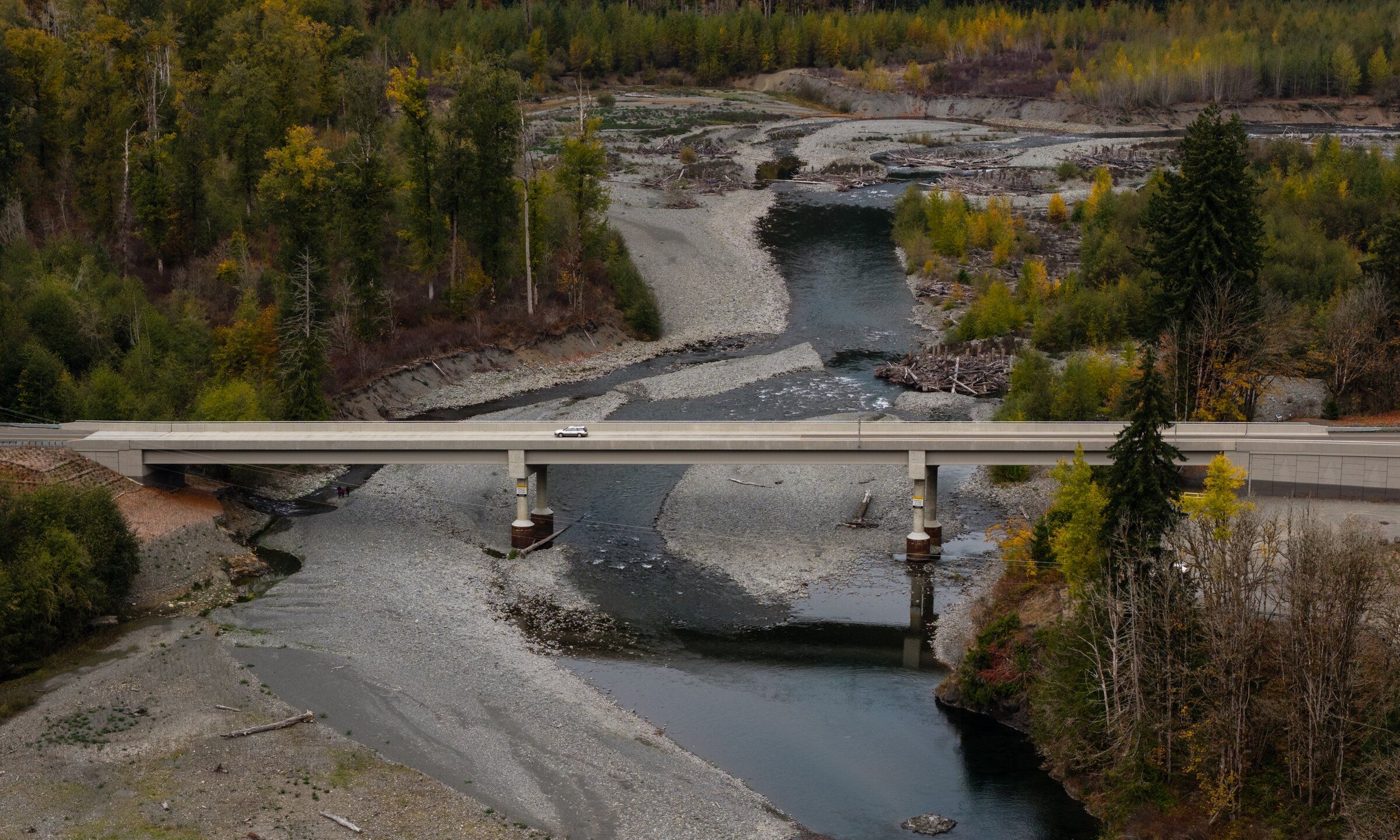
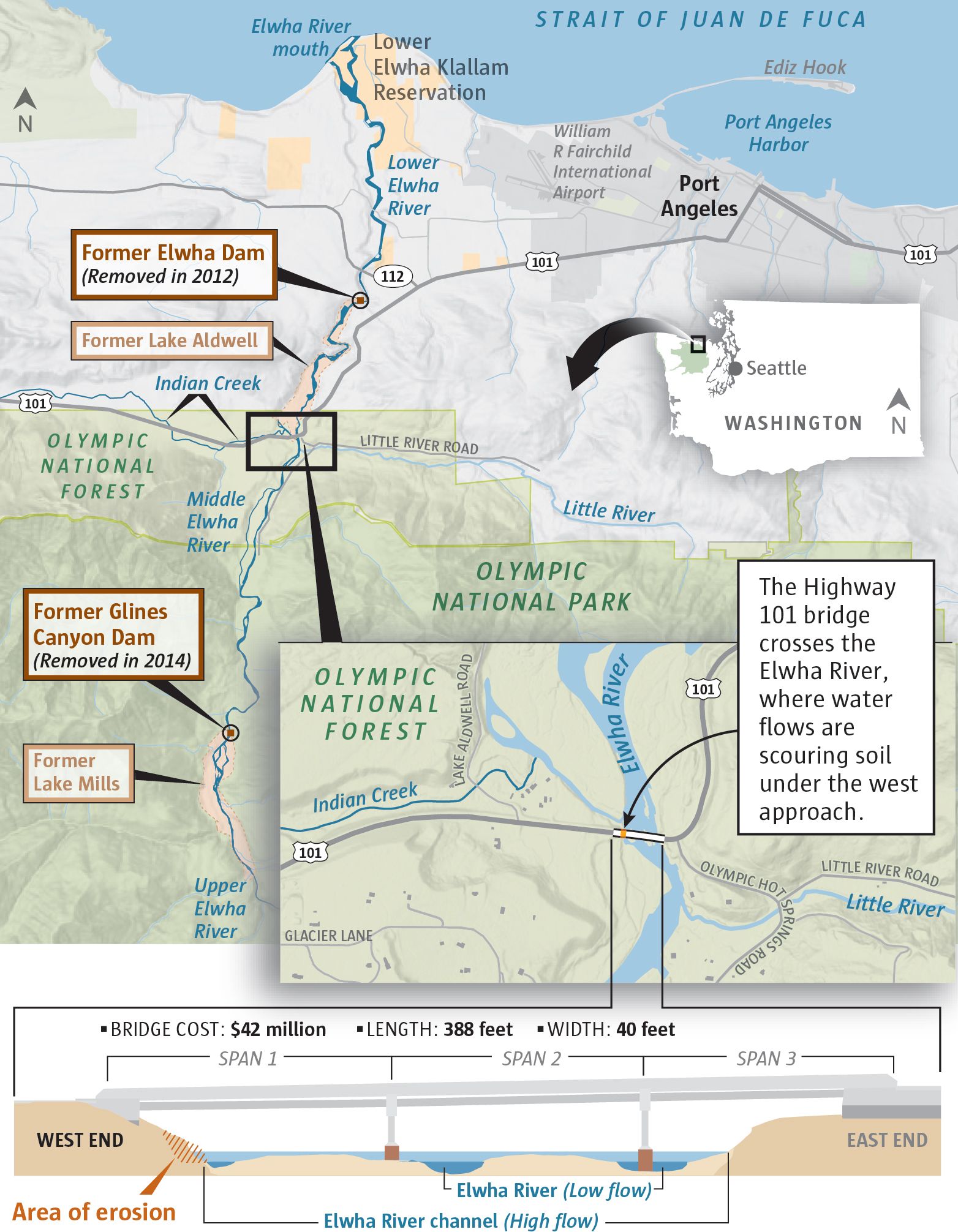
After heavy rain a year ago, the Elwha’s swift current washed away soil on the west side of the new bridge on Highway 101. The $42 million bridge opened just two years ago. The bridge itself remains safe, but further erosion could eventually weaken the road leading to the crossing.
Washington state is developing an emergency plan to protect the bank, likely using rocks and other materials to reinforce the soil. But representatives of the Lower Elwha Klallam Tribe warn that a poorly designed embankment could damage spawning grounds and impede fish passage. The tribe is calling for an environmental impact assessment and consideration of alternatives, including extending the span or using specialized structures to reinforce the bank.
Officials say the bridge’s supports are firmly anchored in bedrock. But during the flood, the water came within just a few feet of a retaining wall, and the road surface before the bridge rests on an earthen embankment. If erosion continues, the walls holding it in place could weaken. About 4,200 people use the bridge daily, including local residents and visitors to Olympic National Park, the coast and other parts of the peninsula.
Erosion from river currents is one of the most common causes of bridge collapses. Changes on the Elwha have been especially noticeable since two dams were removed: they once trapped sand, gravel and woody debris and regulated the flow. Now, accumulated sediment is moving downstream, the river channel is changing, and the river responds more freely to heavy rain and snowmelt. That is why bridge design must account not only for water levels, but also for potential scour around supports, shifts in the river channel and impacts from floating logs.
The old bridge’s supports had been severely scoured; investigators found they were set in gravel, not bedrock. The new bridge was designed to allow the river to flow freely and to account for historical flood data. State and federal officials estimate it should withstand the largest flood expected once every 100 years. But in December last year, the water washed away another 35 feet of bank, showing that the river’s actual behavior can differ from projections. Warmer winters and more precipitation falling as rain instead of snow are an additional concern: they could make peak floods on the Elwha more severe.
The area where the Elwha meets Indian Creek is particularly sensitive. Since the dams were removed, fish habitat has recovered there: about 400 spawning Chinook were counted this year, coho are moving upstream, and lamprey live in the creek. The tribe fears a rock embankment could harm this area, which is recovering from a July 2025 fuel spill that killed thousands of fish. A traditional Klallam village site is nearby.
The Lower Elwha Klallam Tribe is taking part in consultations with officials and insists that its treaty fishing rights be respected. Those rights are protected by the 1855 Treaty of Point Elliott, which preserves the tribe’s ability to fish at its usual and accustomed fishing places. The tribe says decisions about work along the river must take into account not only the condition of spawning grounds, but also access to fish resources.
After negotiations and joint visits to the bridge, the tribe acknowledged that temporary reinforcement is necessary to avoid more destructive work during a flood. The state is considering not only large rocks, but also crushed stone, gravel, clay, sand and specialized fabrics to hold the soil in place. Soft sand is to be removed down to bedrock.
Before work begins, the project must undergo environmental review and obtain the necessary approvals. Depending on the location and scale, it may require a federal permit for work in U.S. waters, a state permit for work in the river channel and consultation with the tribe. Specialists must assess possible effects on spawning gravel, water quality and turbidity, fish shelter and passage through the river. To reduce harm, work may be restricted to periods outside spawning and migration seasons, with erosion-control measures and habitat restoration also included.
The tribe plans to submit formal comments and is demanding that any rocks washed downstream be removed. Both sides are seeking to maintain reliable transportation while protecting the river, fish resources and the tribe’s treaty rights.
Based on: Elwha River’s free flow undermines ground below new $42M bridge