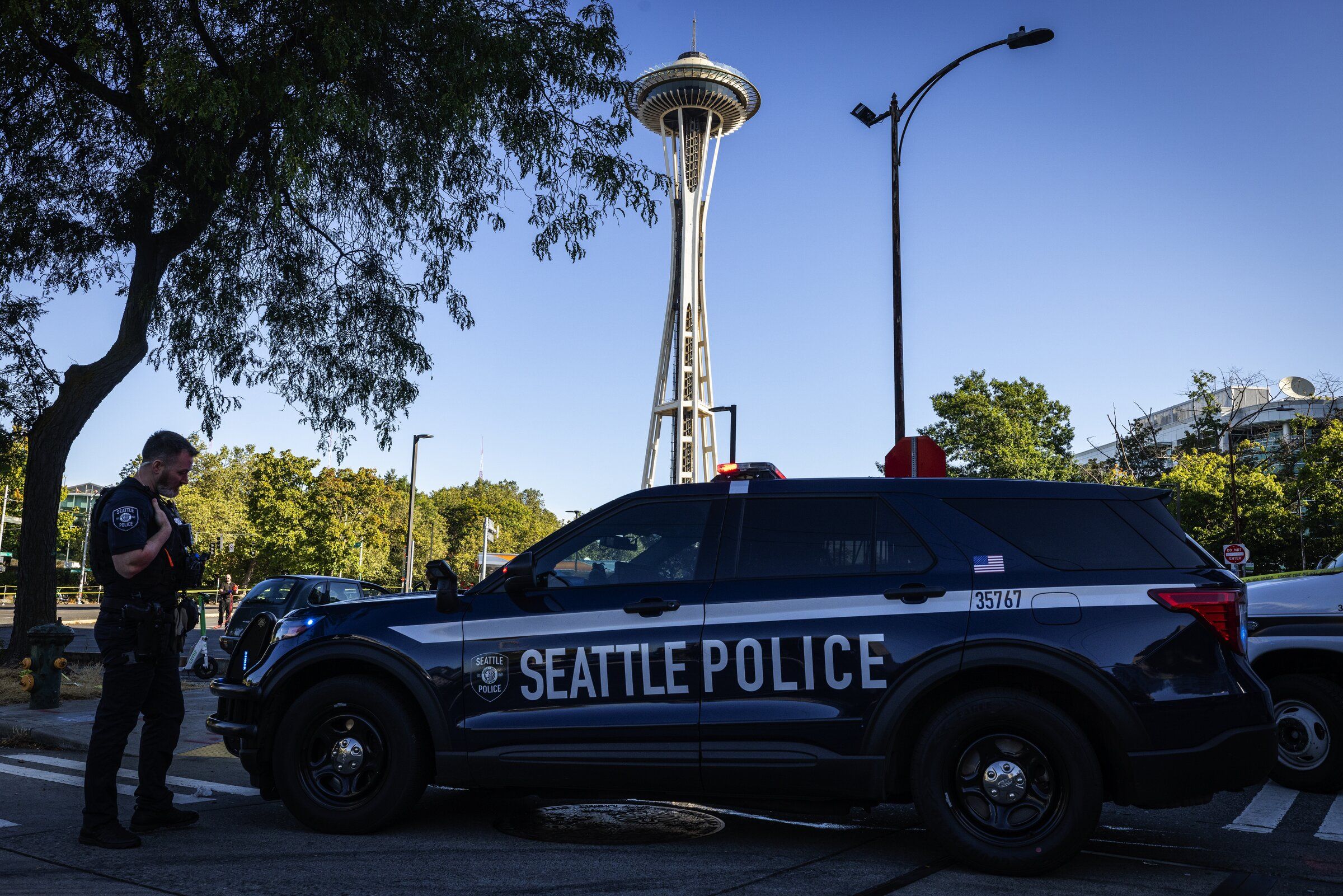
Sports setbacks and financial blunders: a Seahawks running back’s injury and the Seattle Police Department’s $13 million overpayment.
Seahawks Lose First-Round Pick: Jadarian Price to Miss Week 4
The Seattle Seahawks will be without their starting running back for a crucial divisional game against the Los Angeles Chargers—and this is one of those cases where losing a starter feels more like an unfortunate inevitability than a reason to panic. The player in question is rookie Jadarian Price, whom the club selected in the first round of the most recent draft. He had appeared in just three games of his professional career before a chest injury sidelined him. Head coach Mike Macdonald said Price sustained the injury in Week 2 and aggravated it during Wednesday’s practice to the point that he did not take the field Thursday or Friday. The coach declined to provide a timetable for his return—and that alone is a troubling sign, because in the NFL such wording usually means that even the medical staff lacks clarity.
Interestingly, when Macdonald discussed the situation, he spoke about Price not as an injured asset but almost in personal terms, clearly wanting to remove any sense of blame from the player. “This is in no way JD’s fault,” the coach emphasized, adding that injuries are part of football, that a rookie cannot control them, and that Price had “done everything we’ve asked him to do since he got here,” remaining an excellent teammate with a bright future. The rhetoric is telling: the Seahawks clearly do not want a young running back who is still adjusting to the league to put additional pressure on himself because of the injury. After all, his statistics are modest so far—119 yards on 28 carries and 21 yards on four receptions—but in the third game against Washington, he was briefly benched after his second fumble in two weeks, so the psychological burden on him was already significant even before the injury.
Now the entire burden of the ground game falls on Emanuel Wilson and George Holani. Wilson has 109 yards on 32 touches, while Holani has 102 yards on 21 touches, and both are expected to receive considerably more work than they anticipated at the start of the season. In practice, Velus Jones Jr. could be elevated to the active roster—the club has already done so twice this season. Macdonald remains optimistic: “I’m excited to see how these guys play. It’s unfortunate with JD, but hopefully this allows him to get healthy, and we’ve got guys that are ready to go and are working their tails off.” Essentially, this is a classic coaching attempt to turn a personnel problem into an opportunity to test the roster’s depth—and to see which reserves can withstand the pressure of a divisional matchup.
There is also good news for Seattle: safety Julian Love, who missed the previous game with a calf injury, returned to full practice Friday and is expected to play Sunday. Ty Okada and reserve linebacker Chazz Surratt, however, are listed as questionable. Okada is dealing with a hamstring injury that has kept him out of all three games so far, even though he was expected to start alongside Love before the season. Another important storyline is the return of Zach Charbonnet, who was cleared to practice Thursday. He remains on the physically unable-to-perform list following February surgery to repair a torn ACL and must miss at least one more game. According to Macdonald, Charbonnet “looks fantastic,” but the club intends to take no chances and bring him back gradually so that he feels confident. The irony is that Charbonnet, who shared the starting role with Price in 2025, could now provide insurance for the depleted backfield—but instead, the Seahawks are waiting on both him and Price at the same time, relying on players who until recently were considered depth.
This situation clearly shows how, in the NFL, a single practice incident can rearrange an entire team’s logic: Price’s injury, which initially appeared minor, now determines the game plan against the Chargers, affects the distribution of touches and forces the coaching staff to adjust the rotation. If Wilson and Holani perform well, Seattle will face a welcome dilemma when all its running backs return. If they do not, questions about the roster’s depth—and about whether it was wise to build the offense around two injury-prone players—will become much louder. For now, the Seahawks are simply trying to win their next game with the players available—and it is precisely in moments like these that a club’s depth at every level is tested, as ESPN reports in detail.
Seattle Police Union Wants Underpayments Resolved Before Overpayments Are Repaid
The story of the multimillion-dollar payroll error involving Seattle police officers is gaining new details. At first glance, it may seem like a routine bureaucratic mishap: the city accidentally paid more than 900 officers too much and is now trying to recover the excess. But behind that lies a far more complicated tangle of problems—from distrust of the city’s payroll system to tax complications and a staffing crisis within the police department.
Kent Laux, president of the Seattle Police Officers Guild (SPOG), outlined a position on the Gee and Ursula show on KIRO Newsradio that sounds simple but creates a serious headache for city officials: officers do not intend to keep money they were not owed, but they want the city to first put its own calculations in order. The error resulted in overpayments totaling $13.1 million. The city confirmed that the mistake occurred because 2020 base rates were used instead of 2024 rates when calculating retroactive contractual raises. As a result, the payments exceeded the six-percent increase that employees were supposed to receive. The money was paid to employees on June 12, and officials emphasized that the current Workday payroll system was not to blame.
It might seem simple enough to return the excess. But Laux insists that the city must first resolve underpayments and other inaccuracies that have accumulated over two years. “We’ve had two years of inaccuracies, issues with pay stubs and paychecks,” he said. According to Laux, employees simply cannot see how the amounts are calculated and therefore cannot understand the city’s logic. “We don’t see behind the curtain,” Laux said. “I don’t know how any of this is calculated.” Host Ursula Reutin asked whether officers had not noticed the error when they received the money. The answer is revealing: without access to the calculations, it is practically impossible to know.
Host Gee Scott asked directly whether the union’s position meant that police officers should not repay the overpayment. Laux rejected that interpretation: “That’s not our position. Our position is that if we’re claiming an overpayment, we need to first reconcile the underpayments. We need to go back and correct the inaccuracies from the last two years.” He added: “We don’t want money that we’re not entitled to.” According to Laux, the union is still finding new small errors that have accumulated, and it remains unclear how everything adds up over a two-year period.
The situation is made worse by the fact that not every employee can easily return the money. Ursula described an officer who will have to repay nearly $20,000. Although he still has the money, some colleagues no longer do. Laux added another complication: some employees directed the payments into investment accounts, meaning they simply do not have the cash on hand. There are also tax consequences associated with repayment—the city is already consulting specialists on deferred compensation and federal taxes. “There are a lot of tax consequences and a lot of things that will have to be untangled,” Laux said.
Formally, the city is required to negotiate with the union over how the money will be repaid, but no specific timeline has been announced. Laux would like the underpayments and other inaccuracies to be resolved first, followed by a determination of the correct amounts and then an agreed repayment plan.
Another separate and painful issue is the revolving door in police leadership. Laux says officers are tired of constant changes at the top and have grown accustomed to chiefs lasting only a year or two. “I would really like to see someone come in for the long term and be able to maintain a course,” he said. Laux spoke warmly about interim Chief André Sales, praising his ability to communicate with rank-and-file officers and his willingness to listen to the union, but stopped short of directly endorsing him for the permanent position, noting that other qualified candidates may emerge.
Speaking about the staffing shortage, Laux explained that graduating from the state academy is only the first step. Recruits undergo additional training within the department and work with field training officers, and it is at this stage that a bottleneck emerges. “You get to the field training officers, you get out on the streets and really start learning the job, so there’s a bottleneck there that we’re trying to solve,” he said. He added that he is working on the issue with the interim chief.
Finally, the conversation turned to disagreements with Seattle Mayor Katie Wilson over public safety. Laux supports having more officers respond to calls and work in communities, as well as a justice system capable of supporting arrests, charges and accountability. “My view is that we need to protect the most productive and the most vulnerable,” he said. Discussing sex trafficking and violence along Aurora Avenue, he argued that enforcing existing laws could help identify and rescue victims. “I would like to use the laws that are in place to actually save them—to create that intervention,” Laux said. At the same time, he emphasized that an arrest does not necessarily mean prosecution: “That doesn’t mean that you necessarily have to prosecute, but it does mean that you can intervene and potentially save people.”
Understanding several key concepts helps make sense of this story. A retroactive pay raise is one in which a new contract takes effect retroactively, with employees receiving the difference for time they have already worked; that is where the error involving the base rates occurred. Workday is a cloud-based platform for human resources and financial management used by the city; officials emphasize that the mistake did not originate there. Deferred compensation is a program that allows employees to set aside part of their salary for the future, often with tax advantages; recovering funds mistakenly deposited into such accounts creates complications because the money may have been invested. A field training officer (FTO) is an experienced officer who trains recruits on the streets, and a shortage of FTOs slows new employees’ transition to independent duty. Finally, “accountability” in the context of justice means real responsibility for crimes, not merely documenting violations.
The key insight from this story is that a technical payroll error has become a question of trust between the city and the police union. Laux is essentially saying: we are prepared to return the excess, but first prove that you know how to calculate things correctly. This creates the risk of a protracted negotiation, because the city must agree with the union on how the money will be recovered, meaning the process could stretch on for months. Tax and investment complications turn what appears to be a simple repayment procedure into a genuine legal maze. Laux’s statement that “we don’t want money that we’re not entitled to” sounds conciliatory, but it is followed by a firm condition: first correct the underpayments from the past two years. This is no longer just about $13 million; it is about a systemic payroll problem that could cost the city additional millions and reputational damage.
Another important layer is staffing. Discussions about the chief, the bottleneck involving field training officers and officers’ frustration with constant leadership changes show that the Seattle Police Department is experiencing a persistent management crisis. Against that backdrop, the overpayment is not merely a bookkeeping nuisance but a litmus test of the city’s ability to manage its obligations to those responsible for public safety. And while some officials calculate how to recover the money, other officers are wondering who will remain in the department if leadership turnover and bureaucratic errors continue.
$13 Million Mistake: How Seattle Overpaid Police and Hit a Legal Dead End
Seattle’s June payroll cycle became one of the most embarrassing financial errors in the city in recent years: more than 900 police employees received payments that collectively exceeded the amounts owed by $13.1 million. The error was not discovered immediately, and once it was, officials found that there was no mechanism for quickly recovering the money. Now city officials, police leadership and unions are caught in a situation where a simple arithmetic mistake has turned into a question of labor law, budget planning and political accountability. The Seattle Times reported what happened, and the details are worth examining.
Here is the essence of what happened. Under the terms of the current contract, the city was supposed to pay police officers and sergeants retroactive amounts reflecting a six-percent raise for hours worked in 2024. Instead of using 2024 rates, however, an unidentified employee in the city’s finance department entered 2020 rates into the system. That is a fundamental difference: in 2020, officers and sergeants earned at least 30 percent less than they did in 2024. It might seem that a lower rate should produce a smaller payment, but the logic of the retroactive-pay calculation works in the opposite direction: when an understated rate is used as the baseline, the difference between the amount paid and the amount owed is calculated incorrectly, causing the final payments to be inflated. As a result, more than 900 people received unusually large paychecks on June 12. If the total were divided equally among everyone, each employee would have received more than $14,000 above the proper amount—a figure equivalent to several months of pay for a rank-and-file officer.
The next part of the story concerns the speed of the response, which raises at least as many questions as the error itself. The overpayment was not discovered immediately: police officers noticed the discrepancy and contacted the city’s budget office only in mid-July, roughly a month after the payments were issued. By mid-July, other city officials were aware of the problem, but the City Council was not notified until early August. In other words, roughly two more weeks passed between the first warning and notification of the legislative body. City Hall spokesman Alex Hudson confirmed this timeline but did not disclose how much each individual employee received or how much they should have received. It also remains unknown whether any recipients of the inflated checks independently reported the mistake—the city apparently did not investigate that question.
The financial consequences are already tangible. According to Hudson, the overpayment was a “one-time event,” but it increased projected police spending for 2026 by the same $13.1 million. That means the city will probably have to cover the difference through a supplemental budget at the end of the year. Hudson said the error would not affect the city’s long-term finances, but the situation still leaves a bad impression: the money has already gone to employees, and it may not be possible to recover all of it. For context, Mayor Katie Wilson’s proposed 2027 budget totals $9.1 billion, with $556 million allocated to the police department—$68 million more than the previous year and the largest share of the city’s general fund. At the same time, crime in Seattle and Washington state is declining significantly, making questions about how efficiently police funds are being spent even more sensitive.
The most interesting part of this story is not the amount but the legal trap in which the city has found itself. Those affected by the error include a small group of employees who belong to no union, as well as members of the Seattle Police Management Association and Teamsters Local 117. State law establishes a repayment procedure for nonunion employees. The contracts of the two unions mentioned above contain their own mechanisms for resolving payroll errors. But most of those affected are members of the Seattle Police Officers Guild, and this is where things become most complicated: state law requires the city to negotiate with union leadership over how to address the overpayments, using the grievance procedure set out in the collective bargaining agreement. The union has already filed a grievance on behalf of employees, and city officials expect negotiations to begin “promptly.” In other words, the city cannot simply ask for the money back—it will have to negotiate with the union, a process that could take months and could end in a compromise under which some of the overpayment remains with employees.
The question of who will repay the money and how deserves separate attention. For nonunion employees, Washington state law provides a procedure for recovering overpayments, but even that process has conditions: notice, an opportunity to contest the claim and compliance with labor protections are generally required. For union employees, everything depends on the collective bargaining agreement, which may provide for various scenarios—from gradual deductions from future paychecks to forgiveness of the debt if it is shown that the mistake was the employer’s fault and the employee acted in good faith. None of these scenarios has been publicly confirmed.
While the city deals with the consequences, Seattle’s budget and finance departments are already working on new payroll-control standards. Under the new system, retroactive payments will have to be approved by both departments as well as by the department where the recipient works. The Finance Department is adding this requirement to the city’s payroll manual. This is certainly a step forward, but it comes too late: the error has already occurred, the money has been paid and the question of repayment remains stuck in legal uncertainty.
What should readers unfamiliar with the specifics of American budgeting and labor law understand? Payroll in U.S. government agencies is not simply accounting; it is a complex system in which pay rates, union contracts, retroactive payments and budget projections are intertwined. A retroactive payment compensates employees for a past period when a contract had not yet been ratified but a raise later took effect retroactively. If the wrong base rate is entered into the system, the final amount can be distorted in either direction, and that is what happened in Seattle. In the United States, the mechanism for recovering an overpayment depends heavily on whether the employee belongs to a union: nonunion employees are governed by state labor law, while union employees are governed by a collective bargaining agreement, and the city cannot unilaterally change those rules.
The key insight from this story is that even a one-time error involving $13 million does not automatically become “solvable”—it runs into procedures that can delay repayment indefinitely. The city has become hostage to its own system: it cannot quickly recover the money because it must negotiate with the union, and the union has already filed a grievance, moving the matter into the realm of labor arbitration. While the parties negotiate, $13 million will remain in employees’ pockets, and the 2026 budget will be short that amount.
There is also a political dimension. Mayor Katie Wilson is proposing a $68 million increase in police funding, and against that backdrop, news that the city accidentally overpaid police officers $13 million does not sound good. Especially since crime in Seattle and Washington state is declining, making the argument for a larger police budget more vulnerable. A payroll error is not corruption or malicious intent, but it undermines confidence in how the city manages taxpayers’ money. It remains unclear whether the $13 million will be repaid in full, in part or not at all. One thing is certain: the Seattle police overpayment is not merely a bookkeeping mistake but a test of the city’s entire system of financial controls and labor relations. So far, the city has not passed that test.