
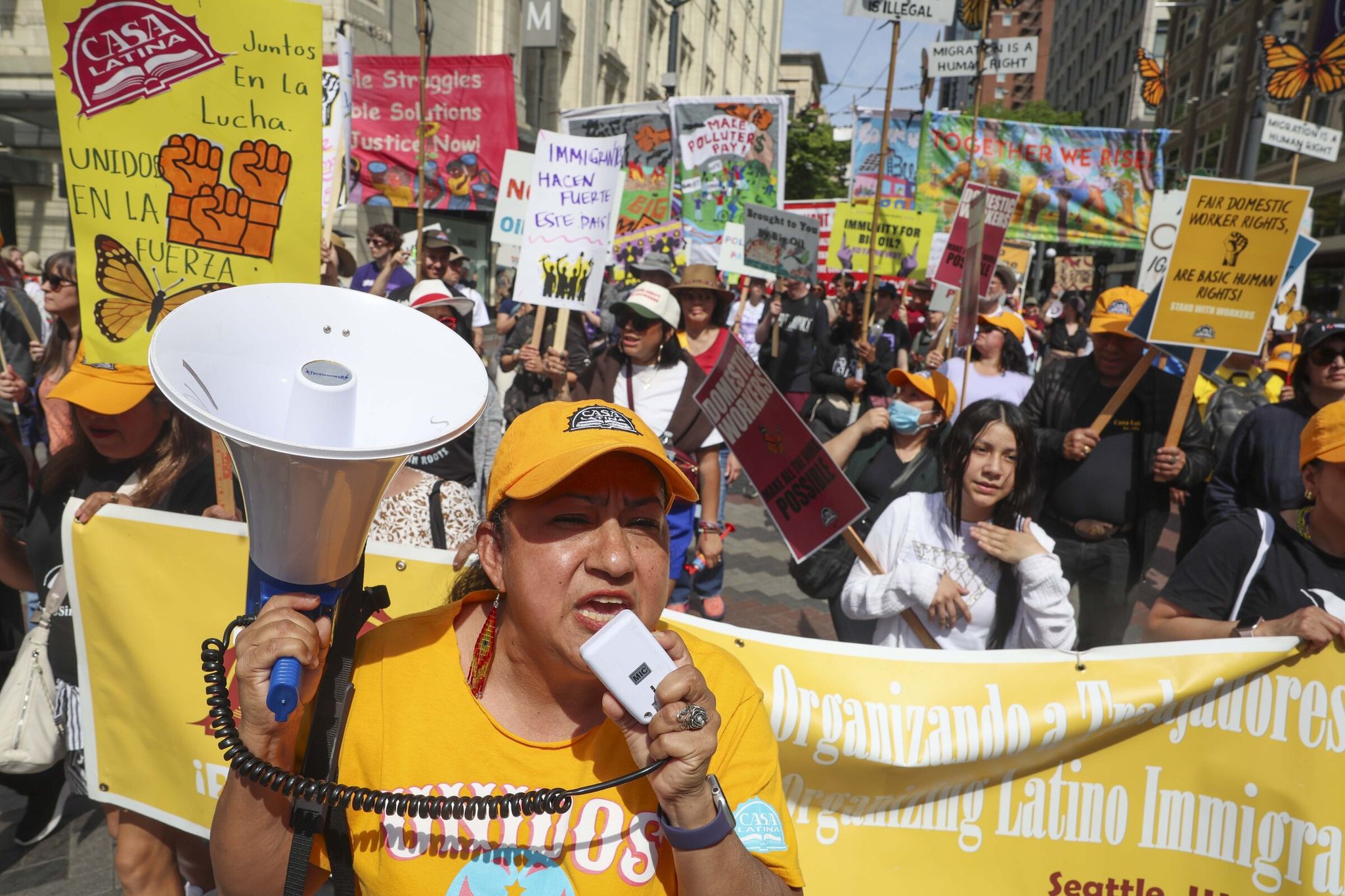
Thousands of participants in May Day protests across the state of Washington, including several hundred in Seattle, walked off the job and took to the streets to demand workers’ rights and oppose the Trump administration’s toughened immigration policies. The action was part of nationwide events timed to International Workers’ Solidarity Day, commemorating the 1886 strike when half a million workers in North America demanded an eight-hour workday.
Besides the traditional calls for higher pay and better working conditions, this year’s protests focused on defending immigrants’ rights and abolishing the Immigration and Customs Enforcement agency (ICE). The demonstrations were a response to a sharp rise in arrests, detentions, and deportations over the past two years under Trump’s leadership.
On Friday morning, hundreds gathered at Cal Anderson Park in the Capitol Hill neighborhood of Seattle — a historically liberal and politically active area with many students, artists, and activists that became an epicenter of BLM protests in 2020. Many held signs reading “Stop the war on Iran,” “Immigrants make America great,” and “Unions: lead the fight against ICE!” Attendees came to the rally instead of going to work or school to support the nationwide May Day strike.
Organizers also called for an economic boycott, urging people to buy nothing on Friday in response to rapidly rising gasoline and food prices and amid billions in government spending on the war in Iran. Speakers, including union representatives and activists, addressed the crowd in Spanish and English, demanding taxes on billionaires and large corporations, an end to funding for deportations and military actions, and a redirection of funds to public programs.
April Sims, president of the Washington State Labor Council, urged hundreds of “working people” to unite against “the billionaires and the politicians who serve them.” Her organization is part of the largest AFL-CIO federations and represents roughly 615,000 union workers in the state. “They want to see us divided and powerless, but look around — are we powerless?” Sims shouted as the crowd yelled a loud “No!”
Other speakers, including a barista and a man who had previously been held at the ICE Federal Detention Center in Tacoma — a city about 50 miles south of Seattle with a major port and a contract with private prison company GEO Group — accused the Trump administration of exploiting immigrants and “regular workers,” and blamed private companies for profiting from “ICE terror.” Participants, some waving Palestinian flags and wearing shirts bearing union logos, left the park and marched through the city streets.
Eliana Pezola, a 70-year-old immigrant from Peru, and her 69-year-old husband Ken Sharma held hands during the march. “Immigrants are what makes the country strong,” Pezola said. “We hurt ourselves by not giving immigrants opportunities.” Sharma added, “Everyone should live where they feel safe. That is our common goal.”
Protesters also highlighted local issues: they criticized Seattle City Councilmember Kshama Sawant (note: original Russian named Katie Wilson representing the left-liberal wing — if the intended reference was to a different local councilmember, keep the original name as appropriate) for refusing to turn off police surveillance cameras that activists say violate citizens’ privacy and are used to monitor protesters. The march route also passed the famous “Amazon Spheres” — three glass domes downtown with a tropical garden inside, which symbolize the company’s wealth and corporate power. Activists handed out leaflets reading “Amazon supplies ICE… Fight the corporation in our hometown.” They noted that Amazon Web Services provides cloud computing and data storage to ICE, helping process migrant information and run surveillance systems, which activists say makes the company complicit in deportations and family separations. The company has also been criticized for exploiting immigrant labor and poor working conditions in its warehouses.
Inez Gonzalez, organizer with the International Migrants Alliance, said, “It is the United States and American transnational corporations that are literally torturing the whole world.” She added that politicians’ statements of support for movements mean nothing “until our people are free.”
The protest remained peaceful, and police reported only two incidents: the arrest of a motorcyclist for dangerous riding on a sidewalk and the detention of a minor for attempting to flee from police. At one point a passerby made a Nazi salute, but most demonstrators ignored him. By evening, participants gathered at Lake Union Park, where the action continued at booths hosted by various organizations.
Based on: May Day protests for immigrant, worker rights draw thousands across WA