
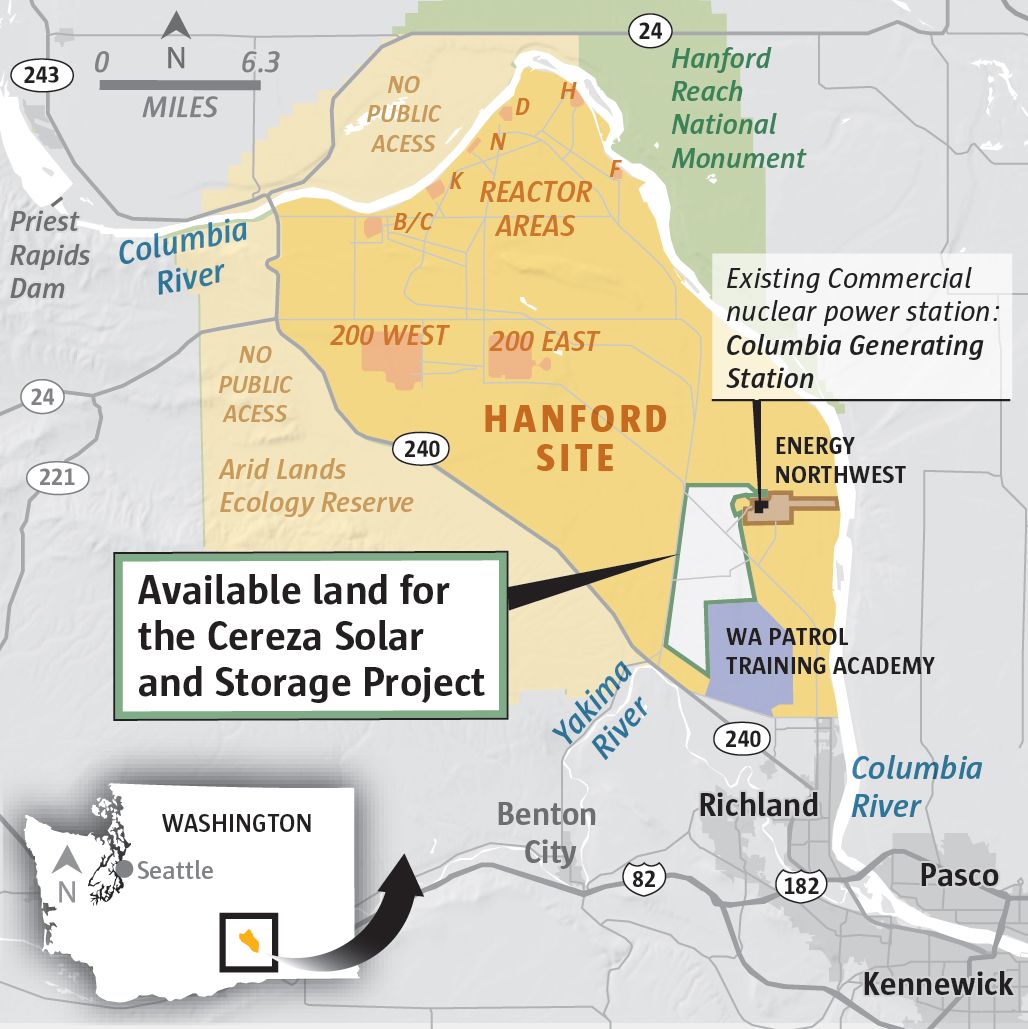
Rights to build what could become the largest solar-and-storage project in the U.S. were sold to a new developer before any construction began. Hecate Energy, the company originally selected by the U.S. Department of Energy (DOE), announced the sale of the Cereza Solar and Storage Project to Savion. The project is planned for up to 8,000 acres of unused land on the southeastern edge of the Hanford site in Washington state. Today Hanford is the country’s largest nuclear cleanup site, providing thousands of jobs and substantial federal funding to the region. The land—where plutonium for the nuclear arsenal was produced during the Cold War—is now being considered for new energy projects as part of a future decarbonized grid.
The deal means Savion, one of the nation’s largest developers of industrial solar and battery projects, will lead development of the 2-gigawatt project with Hecate providing support. Hecate Energy’s leadership said the sale demonstrates their capability to develop and bring large, complex energy projects to market. Hecate itself recently announced a merger that will make it a public company.
The project is the largest in the federal “Cleanup to Clean Energy” initiative, aimed at converting lands formerly used by the nation’s nuclear program into clean energy sites. But there are potential challenges in integrating the variable power from the solar panels into the region’s grid. As an alternative energy consumer, data centers are being considered; they are the largest and fastest-growing energy users in Washington because of the concentration of tech-company headquarters. They are actively seeking decarbonized energy for their power-hungry operations, making them natural strategic partners for new energy projects.
The Biden administration estimates the Hanford solar plant could begin operating within five to seven years. It would be built west of the local Patrol Academy, stretching north from Highway 240 past the Energy Northwest campus. That public nonprofit consortium of Washington public utilities plays a key role in the state’s power supply. It operates a diverse set of generating assets, including the region’s only commercial nuclear plant, Columbia, hydroelectric dams and wind projects, complementing the powerful hydropower system and helping meet climate goals.
The historical context matters: much of the Hanford land will become part of a national monument or protected area once the multibillion-dollar environmental cleanup is complete. The solar project must be fully removed and the land returned to its current condition by the time that cleanup ends, which will take decades. That requirement is a mandatory DOE condition.
Former Energy Secretary Jennifer Granholm said the DOE is turning thousands of acres of Hanford land into a thriving center of zero-carbon generation, setting an example for cleanup and creating new economic opportunities for the local community. Expanding clean energy creates well‑paying jobs and improves the environment.
Based on: Huge solar and battery project planned in WA sold to new developer