
According to U.S. Census Bureau data for July 2025, the share of non-Hispanic white residents in King County (where Seattle is located) has fallen to 50.1%. That means the county is now on the verge of being, for the first time in its history, without a single racial or ethnic group accounting for a majority. If current trends continue, next year’s census data will record the absence of a dominant group.
Of the 39 counties in Washington state, 38 still have a clear ethnic majority, and in nearly all cases it is non-Hispanic whites. The exceptions are three counties (Adams, Franklin and Yakima), where the majority is Hispanic. The only county that has already crossed that line is Grant in central Washington: there, whites make up about 48%, while Hispanics account for 46%. The reason for such a stark difference between King County and the state’s agricultural regions is the fundamentally different structure of their economies. In King County, the “knowledge” economy dominates: technology, finance, healthcare, and services. Global corporate headquarters, research centers and universities are located here, which draws specialists from around the world. In Yakima, Adams and Franklin counties, by contrast, agriculture with seasonal labor forms the backbone of the economy, where workers from Latin America are in demand—so those counties have a high share of Hispanic residents but very little Asian migration.
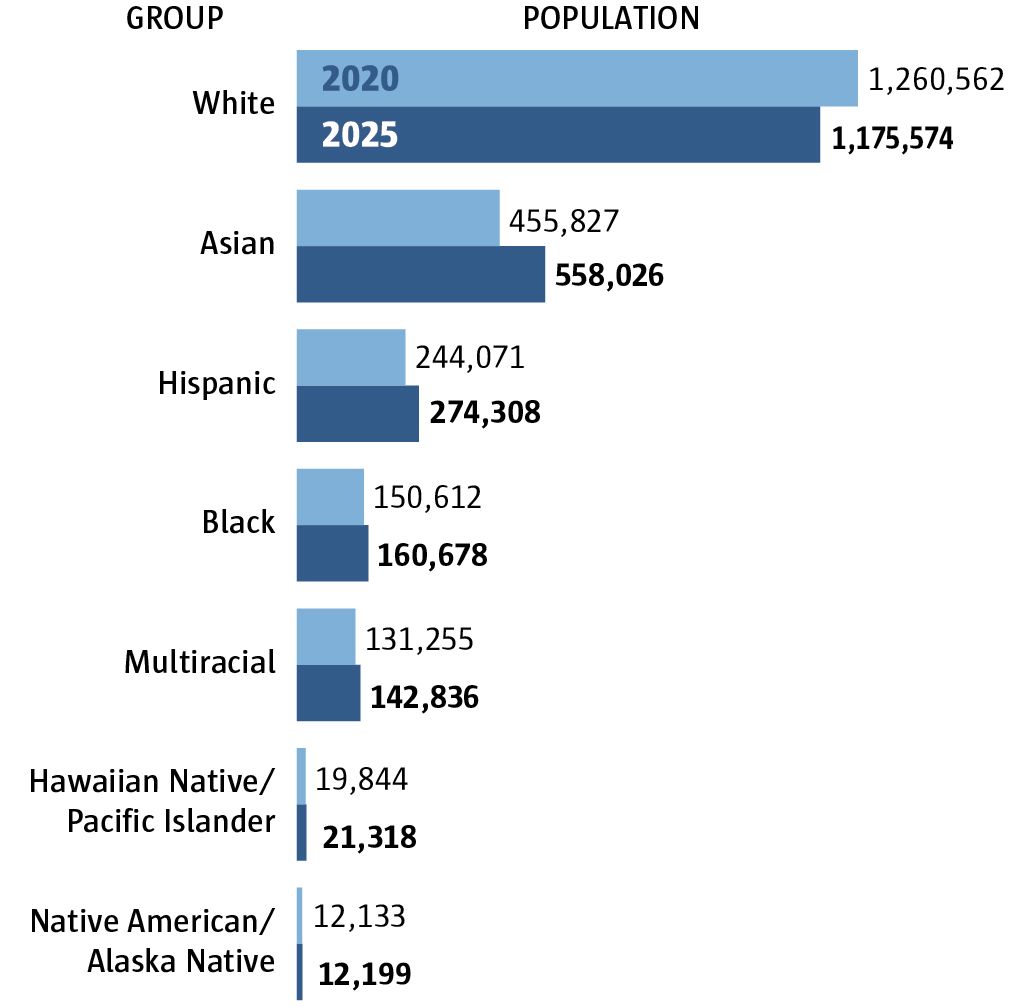
A key driver of the shift in King County is diverging trends: from 2020 to 2025, the non-Hispanic white population declined by roughly 85,000 people (to 1.18 million), while the overall population grew by nearly 71,000 (to 2.34 million). That means all of the increase came from people of other races and ethnicities, while whites still remain the largest group.
The most noticeable growth is among the Asian population, which increased by 22%—more than 102,000 people—to 558,000 (about 24% of the county’s residents). This surge is largely tied to the activity of the region’s biggest technology companies. Microsoft’s headquarters in Redmond and Amazon’s main office in Seattle actively hire highly skilled specialists from around the world, especially from India, China and Taiwan, using H-1B visa programs. High salaries, career-growth opportunities and a well-developed infrastructure for relocating employees have led to a large influx of Asian engineers and developers, who often settle near their place of work. Family reunification programs and an already established Asian diaspora also help new immigrants adapt faster. The Hispanic population increased by 30,000 (to 274,000), the Black population by 10,000 (to 160,000), and the number of people identifying as belonging to two or more races rose by 11,000 (to 143,000).
The decline in the white population can be explained by two factors: a high median age (which leads to natural decrease—more deaths than births) and out-migration to other counties in the United States. The growth of the nonwhite population, meanwhile, is driven by international immigration, which has long been the main contributor to population gains. However, the Trump administration’s tough immigration policy is already beginning to show effects: in 2025, net international migration into King County fell to 28,400 people, down from 40,000 the year before.
Notably, many cities within the county—for example, Renton, Federal Way, Kent, Bellevue and Redmond—have long lived without an ethnic majority. Seattle remains the main “stronghold” of homogeneity: the Pacific Northwest’s largest city is still 59% non-Hispanic white, according to the latest census. This uneven distribution of diversity is explained by the fact that the main campuses of the tech giants—especially Microsoft in Redmond and Amazon offices in Bellevue—are located in the suburbs. Incoming specialists tended to live closer to where they worked, where housing was more available and there were more opportunities to build new neighborhoods. Historically, however, Seattle has been a more “white” city, with persistent social and economic barriers: high housing costs downtown, gentrification, and less active construction of affordable housing for migrants. As a result, for example, in Redmond the share of Asians has already surpassed 40%, while in Seattle it is around 16%, although diversity has been growing there in recent years. In this way, King County is moving toward demographic diversity unevenly, and the broader national milestone will be reached specifically thanks to the suburbs.
Based on: King County is on the verge of a major demographic milestone