
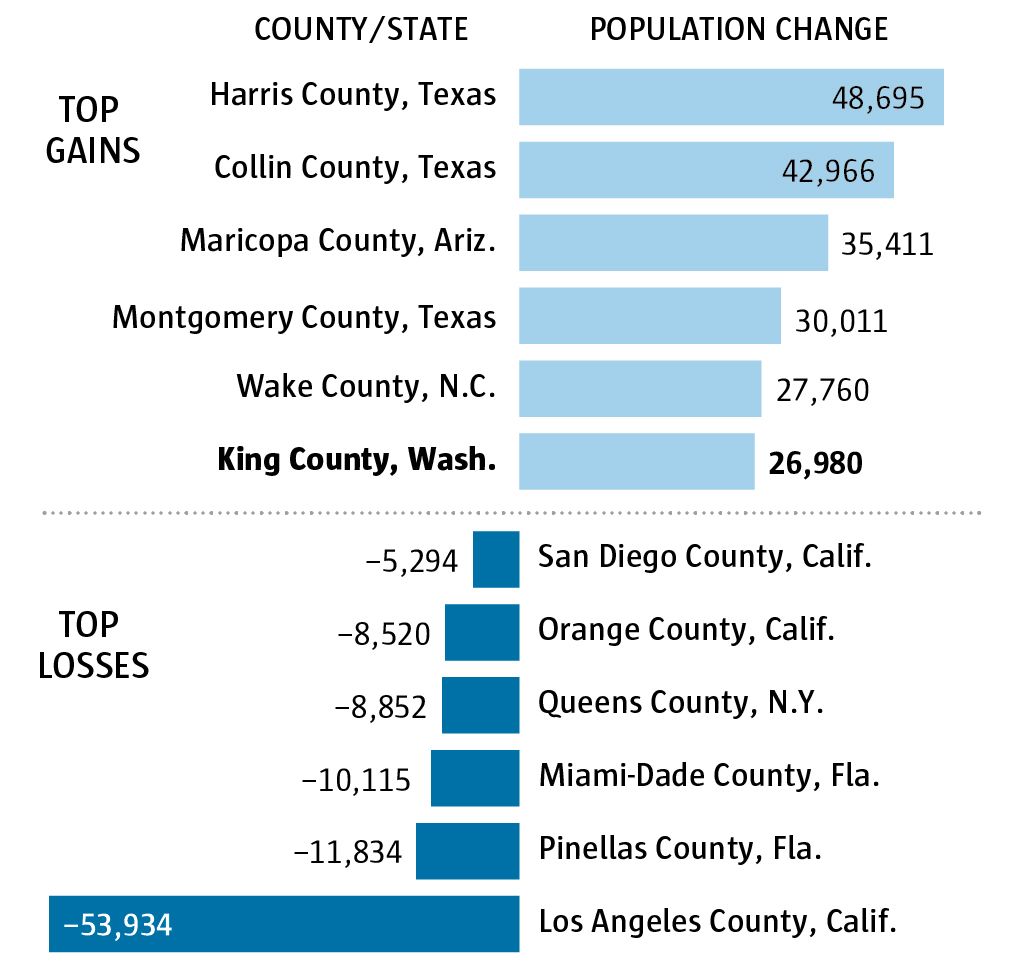
The population of King County, home to Seattle, continues to increase, though at a slower pace than before. From July 2024 to July 2025, the number of residents rose by roughly 27,000 people, equivalent to 1.2% growth. Despite the slowdown compared with the previous year, the county ranked sixth nationwide by absolute increase, an impressive result.
The primary driver of growth remains international migration: over the year, about 28,400 more foreign migrants moved into the county than left. However, this inflow has fallen significantly compared with last year’s figures. King County’s appeal to foreigners—despite high living costs and a cool climate—is explained by its concentration of high-paying jobs in the tech industry, headquarters and startups, leading universities such as the University of Washington, as well as liberal social policies, developed infrastructure, and established international communities. Natural increase (the difference between births and deaths) stayed steady at about 7,400 people. At the same time, the county still loses residents to other parts of the U.S., although that outflow has diminished.
The negative net domestic migration (about 9,100 people) is largely due to people moving to neighboring Pierce and Snohomish counties, where housing is significantly cheaper. These counties, together with King County, form the Seattle metropolitan area and are economically intertwined. Pierce County’s main centers include Tacoma, a major port and industrial hub, and Puyallup. In Snohomish County, Everett is an important aerospace and manufacturing center, along with Marysville. Many residents of these counties work in Seattle’s tech sector, while local businesses support logistics, manufacturing, and services for the entire metro area. Those counties themselves are also growing: Snohomish grew by 1.1%, and Pierce by 0.7%.
Nationally, the fastest growth rates are traditionally seen in Sun Belt counties—warm southern states like Texas and Arizona—which attract people with lower costs of living and favorable climates. King County was the only county in the top ten by numeric gain that is not in that region. This exception is explained by the fact that its growth is mainly driven by international migration and an inflow of highly skilled workers into the tech sector, offsetting local factors. The largest population decline was recorded in Los Angeles County.
Within Washington state, King County grew faster than the state average (0.9%). The highest percentage growth was recorded in sparsely populated eastern counties such as Columbia (2.4%), though in absolute numbers that was fewer than a hundred people.
Thus, despite a slowdown in pace and a continuing outflow of some residents seeking more affordable housing, King County demonstrates steady demographic growth, largely sustained by international migration that leans on the region’s strong economy and quality of life.

Based on: King County population still growing, but more slowly, new data shows