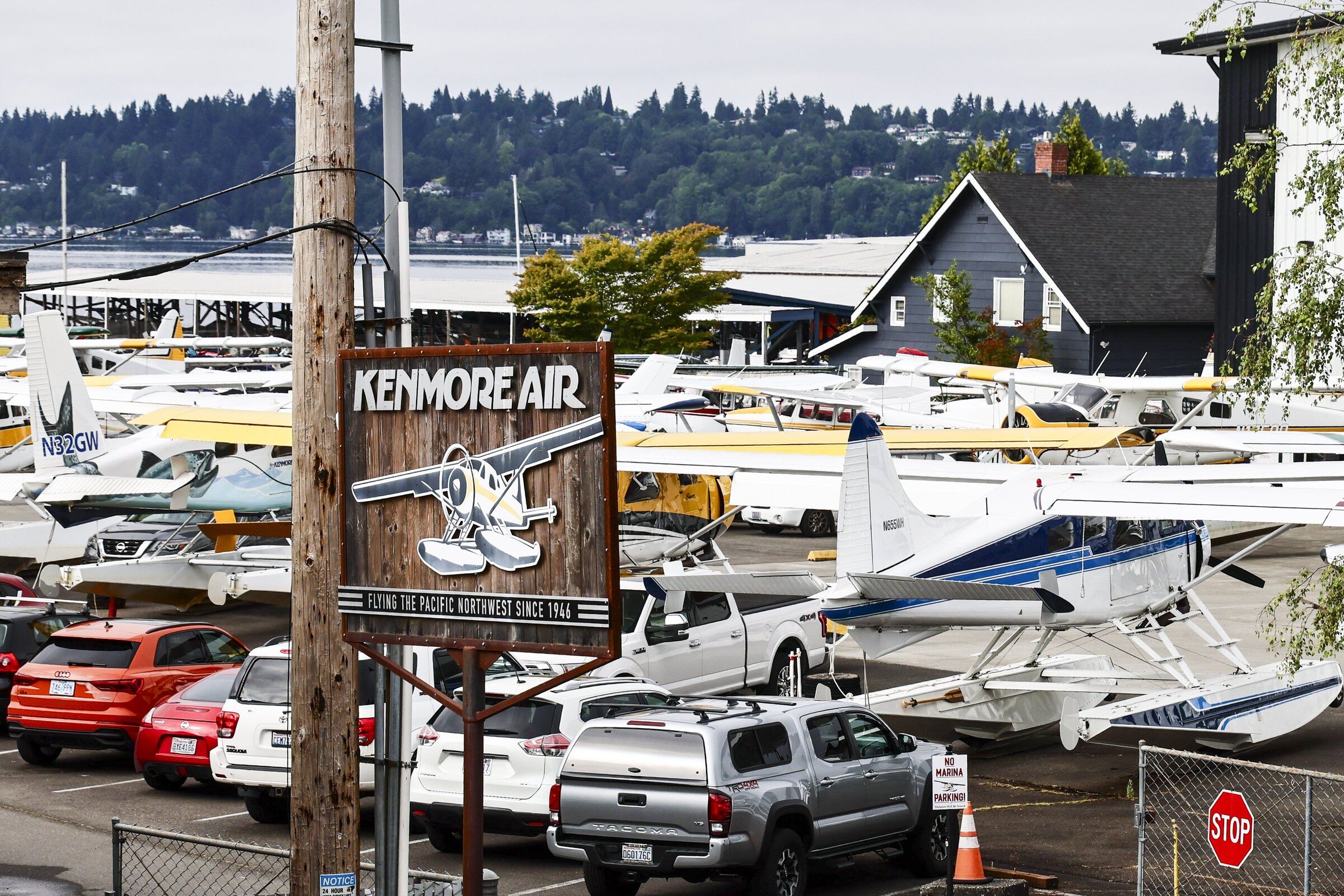
In the digest: the Kenmore Air seaplane made an emergency landing with a fire; flights were canceled. Neeru Hosla became the first woman to buy an NFL team. An analysis of five reasons why the Seattle Seahawks could repeat their success.
Kenmore Air flights canceled after emergency landing with a fire
The seaplane airline Kenmore Air, based in Seattle, announced the cancellation of all flights for Friday after one of its aircraft made an emergency water landing and caught fire the night before. The incident occurred at approximately 5:15 p.m. near Sucia Island, north of Orcas Island in the San Juan archipelago. There were 10 passengers and a pilot aboard. Fortunately, everyone was rescued, but sustained injuries of varying severity. One person is in critical condition; however, according to the San Juan County Sheriff’s Office, there were no fatalities. The company has already contacted customers regarding rebooking or refunds. In its statement, Kenmore Air emphasized that it understands the inconvenience for passengers and thanks them for their patience during this difficult time.
Incidents like this are rare, but they do happen in a region where seaplane aviation is a familiar way to connect the many islands. That’s why canceling all flights the next day is a standard precaution and part of emergency response protocols. It’s also important to understand that Kenmore Air is not just a small charter company—it is one of the oldest and best-known seaplane operators in the U.S. Pacific Northwest. Its routes connect Seattle, Victoria, Vancouver, and numerous San Juan Islands, and it carries hundreds of passengers every day. The incident covered by The Seattle Times drew immediate attention because fires on the water are unusual, even though emergency water landings themselves are a trained scenario.
There are currently no official figures on the cause of the crash—whether it was an engine failure, pilot error, or a bird strike. However, the fact that the aircraft caught fire after the water landing raises questions. Jet fuel doesn’t ignite on water as easily as aviation gasoline used by some piston seaplanes. But if fuel leaked and a spark came from electrical systems or friction, a fire is possible. The good news is that everyone managed to get off the aircraft in time—which points to coordinated crew action and the speed of the rescue services. A warning system operates in the region, and the Coast Guard as well as local boat operators often arrive first.
For the company itself, it’s a serious blow to its reputation. While passengers usually choose seaplanes for speed and the romance of flying over fjords, any incident reduces trust. Canceling flights demonstrates that safety comes before commercial gain. Over the coming days, the National Transportation Safety Board (NTSB) will send a team to investigate. We can expect that pre-flight procedures, checks of fuel systems, and evacuation algorithms will be reviewed. In aviation history, incidents like this serve as important lessons—for example, after the Hudson River crash, some engine standards were changed. Possibly, this case will also lead to new recommendations for seaplane operators.
In the meantime, dozens of passengers who planned to fly on Friday will have to look for alternative routes: ferries or scheduled flights. For locals who are accustomed to Kenmore Air’s timetable, it’s a major inconvenience. But everyone understands that investigation and restoration of flights will take time. The key point is that there were no deaths. And that offers hope that the airline will be able to return to normal operations—possibly even with strengthened safety measures.
Neeru Hosla: the first woman — controlling owner of the Seattle Seahawks without inheritance and with Indian roots
When news broke in July that the Hosla family was buying the Seattle Seahawks, many expected the controlling stake would go to Vinod Hosla—the famous Silicon Valley venture capitalist. But an NFL memo revealed an unexpected twist: the controlling owner would be his wife, Neeru Hosla. This move not only changes how the club is managed, but also breaks several stereotypes at once in professional American football.
As explained in a story by The Seattle Times, under NFL rules each team must appoint one controlling owner who has voting rights at all league meetings. That role went to Neeru. The deal is valued at $9.612 billion, and the Hosla family must own at least 30% of the shares—what the league requires. Notably, using Neeru as a nominee owner helped the family win the bidding process for the team, because this option appealed to Jody Allen, the late Paul Allen’s sister, who currently runs the club on behalf of the estate.
The NFL already has several women owners, but all of them inherited teams. Sheila Ford Hamp (Detroit Lions), Carly Irsay-Gordon (Indianapolis Colts), Gayle Benson (New Orleans Saints), and Amy Adams Strunk (Tennessee Titans)—each gained control after the death of her husband or father. Neeru Hosla will be the first to acquire a team rather than inherit one. Sportic analyst Eben Novy-Williams called it “a breakthrough of the gender barrier.” In addition, the Seahawks will become the third NFL team (after the Jacksonville Jaguars and the Minnesota Vikings) whose primary owner was born outside the United States—both Vinod and Neeru are from India.
But who is this woman who will now represent the Seahawks at owner meetings? Neeru Hosla is not a typical billionaire. She earned a master’s degree in molecular biology from San Jose State University and a master’s degree in education from Stanford. She worked as a cancer researcher, but left science due to concerns about her health during pregnancy. She devoted her career to education: in 2007, she founded the nonprofit CK-12 Foundation, which provides free, open educational materials. According to Forbes, by 2022 more than 200 million students worldwide had used the foundation’s tools. She served on the Wikimedia Foundation’s board and spent 17 years on the board of an elite private school where her children studied.
Neeru herself ties her passion for education to her childhood in India, where her parents spent up to 70% of their income educating three children. “Even one child passing through a system we don’t care about is a crime,” Forbes quotes her as saying.
At the moment, it’s unclear how actively Neeru will be involved in the club’s day-to-day life. According to sources, her son Neil Hosla (with experience working with the San Francisco 49ers) will take over current operations, while Vinod has said he does not plan to run the Seahawks, focusing instead on investments. Natalie Welch of the University of Seattle notes that Neeru’s education experience fits well with the sports business model. After the NFL approves the deal, the Hosla family is expected to hold a press conference where it will outline details of their roles.
Are the Seahawks back in the shadows? Five reasons to believe in a title defense
The defending NFL champions, the Seattle Seahawks, begin their preseason with an unexpectedly low level of noise around the team. After the triumph at Super Bowl 60, when the New England Patriots were methodically dismantled, attention seemed like it would be focused on Mike Macdonald’s group. However, already during the offseason, fans and analysts shifted to the Los Angeles Rams, who landed Myles Garrett, and the Patriots, who added A.J. Brown. The Seahawks themselves aren’t prone to big announcements—their credo remains the line Macdonald used after winning the conference: “We didn’t care.” And while bookmakers always bet on the field, not on one team, Seattle has at least five strong arguments to seriously consider repeating that success.
First and foremost is continuity. Unlike last year, when Macdonald completely rebuilt the offense, this time the changes are minimal. Yes, the offensive coordinator Clint Kubiak and Super Bowl MVP Kenneth Walker III are gone, but nearly all of the starting offensive players remain, except Walker. New coordinator Brian Flueiry, previously with San Francisco, promises to preserve the core of Kyle Shanahan’s scheme while adding his own work. Quarterback Sam Darnold, accustomed to changing teams and coordinators, says the transition was easy. The essence of the offense—an emphasis on explosive plays—remains the same.
Second is the running game, which raises questions after Walker’s departure and a knee injury for Zack Charbonnet (torn ACL). Still, it’s worth remembering that in the 2025 regular season, the Seahawks only started to get the run game going late in the year, ranking as low as 22nd in rushing yards per game up to Week 15. At the same time, the team went 12–3 thanks to Darnold and Jasson Smith-Njigba. The draft selection of Jjdayrian Price from Notre Dame is a signal that the club is betting on quick breaks rather than “heavy” rushing. Even though Price didn’t have experience with 20+ carries per game, he’s known for his ability to escape. Plus, the offensive line—unexpectedly one of the team’s strengths—returns intact.
Third is the untapped potential of receiver Rashid Shaheed. Acquired during the previous season from New Orleans, he only occasionally looked like his old self (15 catches in nine games). Even so, general manager John Schneider re-signed him for three years and $51 million, seeing him as a key element of the offense. Even without statistics, Shaheed’s presence stretches the opponent’s defense—opening space for Smith-Njigba and reducing dependence on the run. Add in the progressing Tory Horton, who had shown promise as a deep-threat before injury.
Fourth is the defense of the “dark side,” as it’s called in Seattle. Last season, the team was the most reliable in points allowed and finished eighth in franchise history by DVOA (an advanced efficiency metric adjusted for opponents, usually expressed in percentages). Macdonald’s defense is built on controlling the running game with rare double-box looks (a scheme with eight players near the line of scrimmage) and confusing blitz packages that overwhelm quarterbacks. The fearsome tandem of defensive tackles returns—Leonard Williams and Byron Murphy II. The edge defense lost Boye Mafe, but DeMarcus Lawrence, Uchenna Nwosu, and Derrick Hall provide depth. The secondary has been refreshed—Coby Bryant and Riq Woolen are gone, but Devon Witherspoon and Josh Jobe look solid, and Nick Emmanuelffor is developing as the nickelback.
Fifth and decisive is the lack of an obviously weak spot. Recall how Patrick Mahomes attacked the Bills cornerback Kaiir Elam in the 2024 playoffs, or how the Seahawks broke the Patriots’ left edge in the Super Bowl. Seattle doesn’t have such an obvious vulnerable point. The biggest concern is right guard Anthony Bradford, whose mistakes showed up in three close games versus the Rams (13% pressure allowed; 16 pressures allowed out of 41 for the season). But even that didn’t stop the Seahawks from allowing only 27 sacks despite aggressive passing. The safety position after Coby Bryant’s departure looks unsettled, but second-round rookie Bud Clark (15 interceptions in TCUs) could solidify it, while Tai Okada is proven enough that if Clark needs time, he can handle it.
As the author of the USA Today interview noted: “It seems like the championship title, record price for the team, and a spot in Hard Knocks (the documentary series on preparing for the season) only buy temporary attention from the public.” But if the Seahawks preserve their unique chemistry and depth, their title rematch could become the biggest surprise of the year.