
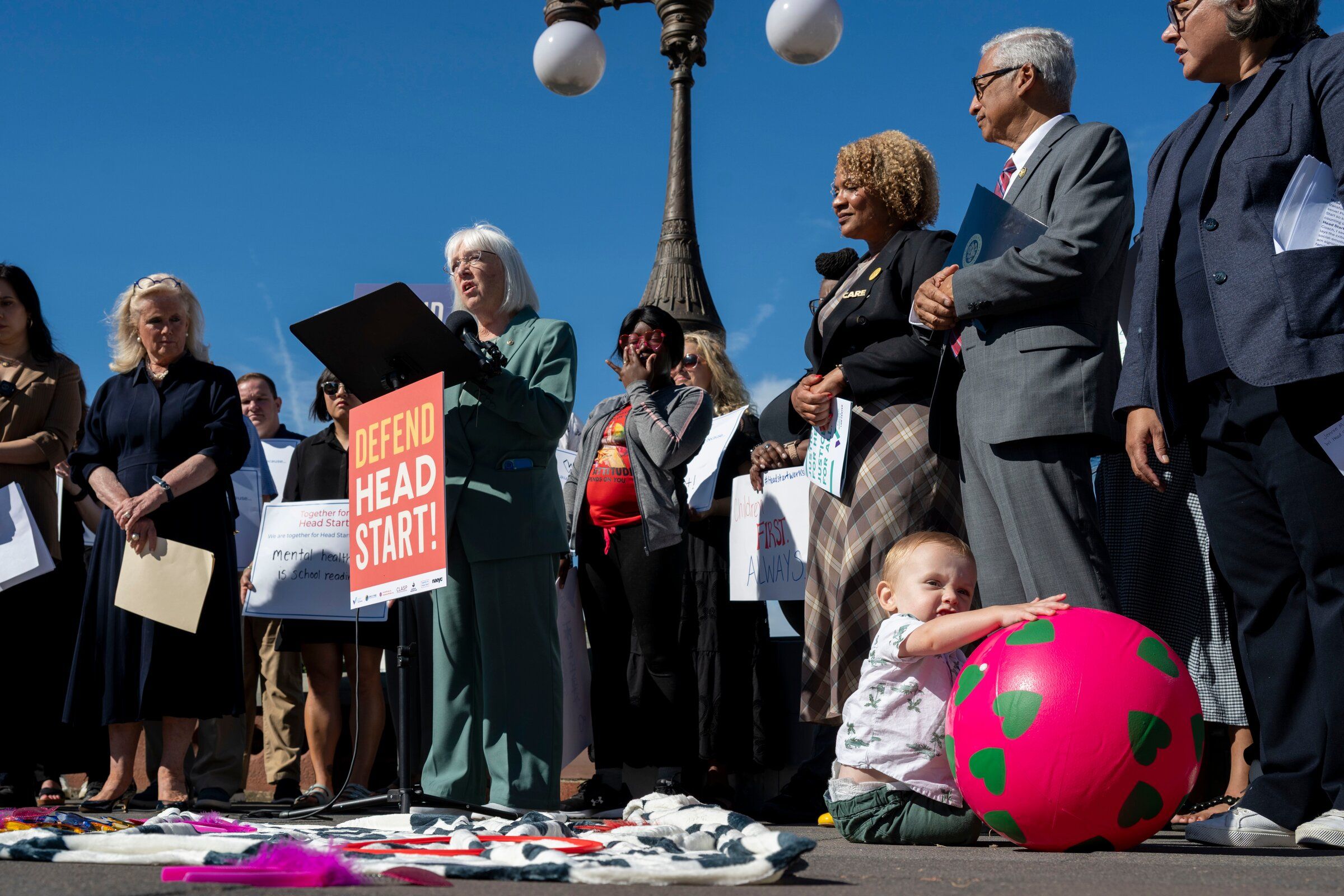
Senator Patty Murray joined parents, activists and lawmakers in Washington on Tuesday, September 15, to protest the Donald Trump administration’s proposed restructuring of Head Start, the federal early-development program for low-income families. The proposal does not formally involve a direct cut to the budget approved by Congress. Instead, it would eliminate most uniform federal rules. Critics say those rules are what make Head Start a program for education, health care and social support—not simply affordable child care.
The dispute centers on a proposal from the U.S. Department of Health and Human Services, published on August 7. The department wants to replace more than 100 pages of existing standards with a short set of rules, giving states and local operators more authority over class sizes, adult-to-child ratios, staff qualifications, transportation and a range of health services. The administration calls the move a reduction in excessive bureaucracy and promises to use the savings to create new slots for children.
But to Murray, one of the program’s most prominent defenders in Congress, the formula represents not freedom but the government’s abandonment of its responsibility. At a news conference, she recalled that Head Start was created as a comprehensive system: preschool classes are paired with vision, hearing and developmental screenings, dental care, nutrition, parent support and connections to social services. Eliminating federal requirements, she said, would make it possible to save money precisely on the elements that are hardest for a family living paycheck to paycheck to replace.
Head Start was established in 1965 as part of President Lyndon Johnson’s War on Poverty. Today, it serves about 700,000 children nationwide, including children without stable housing, children in foster care and children with disabilities. In Washington state, according to an estimate cited by Murray, about 15,000 children use the program. In Seattle itself, Head Start is operated by public schools. It serves 3- and 4-year-olds from low-income families, as well as families experiencing homelessness, receiving public assistance or raising foster children.
For parents, the value of the program is often measured not in regulatory language but in moments that do not fit into budget tables. Lori Pittman, an activist from Washington state, said she turned to Head Start during a severe family crisis. Program staff encouraged her to return to school and later helped her find a job. She now says that support enabled her family to escape poverty. Stories like hers have become the main argument against the proposed changes: Children do not come to class as isolated students, but as members of families that often need education, food, health care and a stable daily routine at the same time.
Critics are particularly concerned that the proposal would allow federal standards limiting class sizes and teacher workloads to be dropped, while removing several detailed requirements governing the timing of medical, dental and developmental screenings. The department itself acknowledges that the new rules could change staffing and allow some centers to shorten class hours or reduce the volume of services. Supporters of the changes respond that operators would not be required to weaken their current practices and that states could establish their own rules. Opponents, however, fear that amid chronic funding shortages, “flexibility” would quickly become another word for cuts.
Washington has another recent reason to distrust promises of a seamless transition. In April 2025, the administration closed five of Head Start’s 10 regional offices, including the Seattle office that served the entire state. Earlier, delays in federal payments had already forced service providers in central Washington to lay off employees and close classrooms while families scrambled to find care for their children. These episodes have transformed the current dispute over rules into a broader question about how fragile the system is—and how much parents’ ability to work each day depends on it.
The proposal has not yet become law: the public-comment period is scheduled to end October 6. After that, the department may revise the document, adopt it in final form or face legal and political obstacles. Murray is urging parents and educators to submit comments to the federal government. In her remarks, it sounded like a simple reminder of Head Start’s nature: The program has existed for six decades not because Washington once wrote a successful set of regulations, but because families have repeatedly shown that early help for a child can change the trajectory of an entire family.
Based on: WA parents, lawmakers rally in D.C. against Head Start cuts