
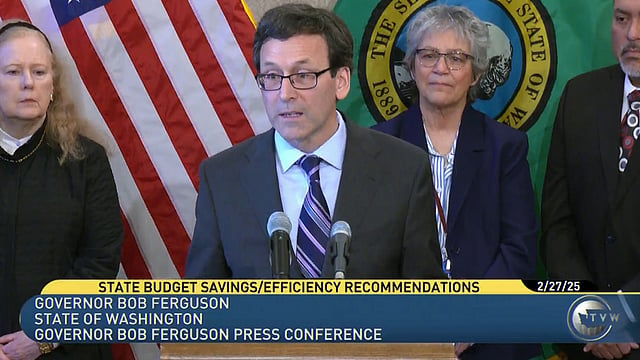
Washington state faces a deficit of roughly $4 billion, and Gov. Bob Ferguson has asked agencies to prepare options for cuts. But unions, social service organizations and progressive activists say that is no reason to embrace austerity: they argue that cutting support for families, schools and health care will only entrench the state’s longstanding problem—a tax system in which a significant share of the burden falls on consumption and is therefore felt most acutely by lower-income residents.
In Olympia, the budget crisis has long ceased to be a purely accounting drama. It has become a debate over what the government is obliged to preserve when money is tight: support programs, classroom resources, care for older people, affordable housing—or Washington state’s traditional political caution around taxes. In mid-November, the Ferguson administration said the state was about $4 billion short of what it needed to maintain current services and make necessary investments through the end of fiscal year 2028.
The state Office of Financial Management directed agencies to submit scenarios for 10% and 15% cuts to general funds. Officials were told to look for quick savings: cancel, delay or scale back programs outside an agency’s core mission; review grants, travel expenses, contracts and vacant positions. Proposals are due by November 23. The transportation revenue forecast has also worsened: hundreds of millions of dollars are now missing to meet existing commitments in 2027–29.
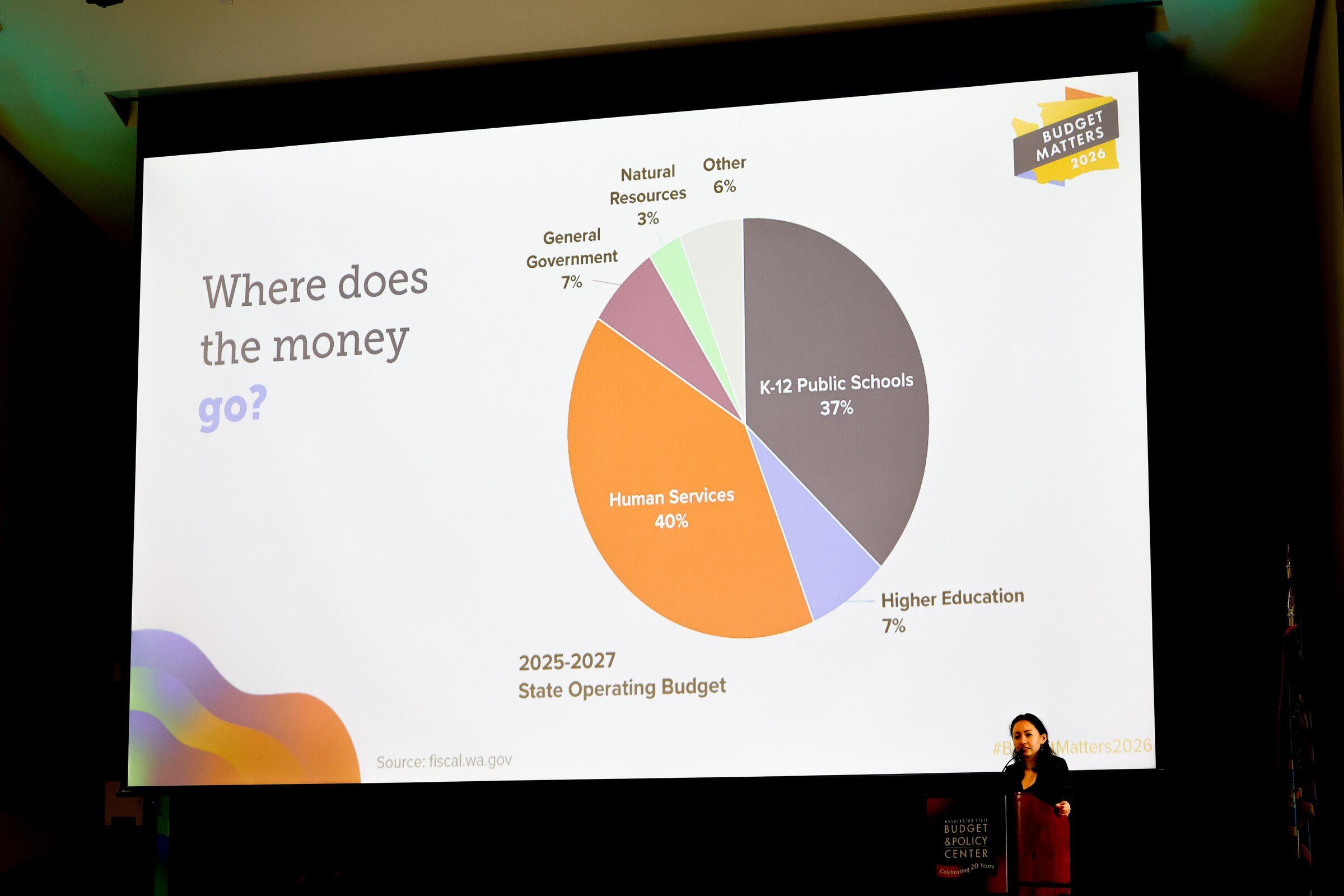
The request came just a year and a half after Ferguson signed a two-year operating budget for 2025–27 worth nearly $78 billion. Lawmakers balanced it through a mix of spending, cuts and revenue increases: some business taxes went up, the range of services subject to sales tax was expanded, and capital gains and estate taxes were increased. Now the governor, who had previously allowed for new revenue sources as a last resort, is signaling that the next budget should begin not with a new tax but with a search for savings.
Progressives see a different lesson in this sequence. The Balance Our Tax Code coalition, which brings together more than 100 unions, nonprofits and community organizations, insists that the gap must not be closed at the expense of people who already rely on school meals, Medicaid, housing subsidies and food assistance. The coalition argues that Washington’s tax system remains “upside down”: sales taxes and other levies take a larger share of earnings from low-income families than from wealthy asset owners. Activists therefore want not only to protect existing services but also to expand spending on education, child care, health care and support for working families.
The results of the November 3 vote have become a key argument for them. Voters rejected Initiative I-645, which would have repealed the new tax on high-income residents; preliminary results showed that more than 57% of those who voted opposed repeal. The law itself, passed by the legislature and signed by Ferguson in March, sets a 9.9% rate on income above $1 million a year. But this victory does not plug the current budget hole: the tax takes effect in 2028, and the state does not expect its first revenue until 2029.
That time lag gives the debate particular urgency. The new tax on millionaires is expected to bring in billions in the future, but it does little to help the state’s coffers over the next two years. Progressive organizations are therefore returning to a broader set of ideas: a tax on large financial assets, a levy on employers with very large payrolls, and the repeal of certain corporate tax breaks. Supporters of such measures argue that the question is not whether the state can raise more money, but who it chooses to collect it from.
Critics counter that Washington has already gone through a wave of tax increases, and that the rising cost of living, housing and running a small business makes another burden politically and economically risky. In this view, the deficit is the result of spending growing faster than sustainable revenues, not evidence that taxes are too low. For Ferguson, that means playing the uncomfortable role of referee between two camps, each of which sees itself as defending ordinary residents: one speaks of preserving services, the other of keeping money in people’s pockets.
In the coming weeks, agencies will turn this debate into cutback tables, and the governor will turn it into a budget proposal. The decision will then pass to the legislature, where the Democratic majority will choose among cutting programs, delaying promises and another attempt to change the tax balance. In a state that has traditionally treated the absence of a broad-based income tax as part of its political identity, the question is no longer abstract: who, exactly, should pay so the government does not have to retreat?

Based on: As budget gap looms, WA progressives say state isn’t spending enough