
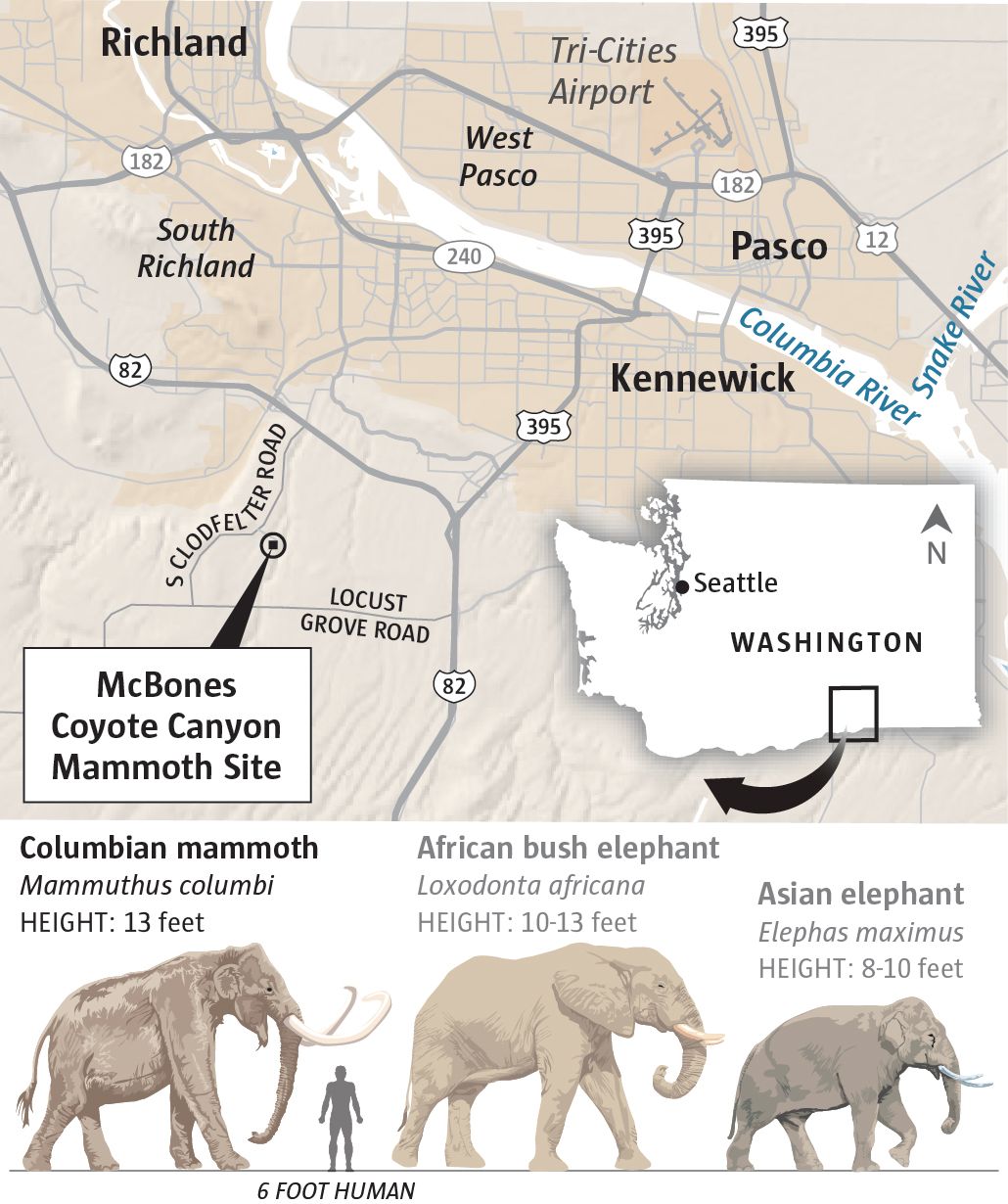
Tickets have gone on sale for unique tours to the mammoth excavation in Coyote Canyon in the Tri-Cities area — the urban agglomeration in the dry southeastern part of Washington state made up of Kennewick, Pasco and Richland. This region, with its semi-arid climate, flat landscapes and steppe expanses, is a striking contrast to the wet, forested western Washington where Seattle is located. Tours, which often sell out quickly, are scheduled over eight days from mid-April through the end of June. Two-hour tours costing $10 per person include a visit to the dig site itself and to the research center, where visitors can see the lab and key finds. Registration for additional tours from July through October opens June 1, and all proceeds fund scientific work.
The site is of enormous scientific value: archaeologists are excavating the skeleton of a Columbian mammoth that researchers believe died during a massive glacial flood about 17,000 years ago. That catastrophe was part of a series of giant Missoula floods near the end of the last ice age. Those floods occurred when an ice dam holding back the huge Lake Missoula failed, releasing colossal volumes of water that carved canyons and shaped the distinctive landscape of eastern Washington. Water constricted by the narrow Walla Walla Canyon inundated what is now the Tri-Cities area. The mammoth likely drowned, and its carcass was deposited on a hillside slope as the waters retreated, becoming buried in sedimentary deposits characteristic of such surges. The elevation of the dig site is about 320 meters, consistent with a possible level of the ancient flood.
The recovered skeleton has remained relatively intact — bones are not scattered over a wide area. Researchers believe it was a large male about 40 years old, standing 3 to 4 meters at the shoulder, making it larger than modern elephants. In addition to the giant’s bones, scientists are carefully collecting smaller but no less valuable finds from the surrounding matrix: wings of ancient beetles, squirrel teeth, mouse bones and mollusk shells, all of which help reconstruct a detailed picture of the ecosystem at that time.
The dig functions not only as a scientific field site but also as an active educational venue for schoolchildren, teachers and volunteers. The exact location is not disclosed publicly to protect the site from possible vandalism — coordinates are revealed only after registering for a tour. You can book an individual or group tour and check the current schedule on the project’s official website, mcbones.org.
Based on: Tours open for mammoth research dig site in Tri-Cities