
According to scientists’ estimates, Alaska is home to up to 30,000 insect species, but only about 9,000 have been described so far. Every decade, the list grows by roughly a thousand species. Derek Sykes, an entomologist at the University of Alaska Fairbanks, has been trying to close the gap for two decades—one beetle, fly, and bee at a time.
At the University’s Museum of the North, there is an insect collection that, researchers hope, will one day include every species found in the state. The museum itself is Alaska’s largest natural history and ethnographic museum: it houses hundreds of thousands of specimens of plants, animals, insects, fossils, and cultural artifacts from across Alaska and other Arctic regions. Its collections provide a vast trove of data on biodiversity and changes in Arctic ecosystems, serving as an anchor dataset for research into climate, species migrations, and the history of Northern Indigenous peoples.
As curator of the collection, Sykes acknowledges that it may be less than half complete. Since 2006, he has expanded it from about 1,000 records to more than 400,000—representing roughly 2 million specimens. Sykes’s work is not simply about filling shelves in a museum basement: museum collections become permanent records of biodiversity, allowing future scientists to study species that, over time, may become rare or disappear entirely. Alaska is still in the early stages of documenting its diversity, while other parts of the world have had a two-century head start. In Sweden, for example—at similar latitudes but smaller in area—more than 30,000 species have already been identified.
Most of the species awaiting description in Alaska are lesser-known beetles and flies that likely have always lived here. Only a small fraction of finds are new to the state—for example, ticks from continental U.S. regions. Such introduced species number fewer than 100. This makes Alaska, according to Sykes, “the most ecologically untouched state in the United States.” At first glance, it sits alongside oil production on the North Slope and the effects of climate change. But much of the landscape remains wild: vast national parks, wildlife refuges, rivers, and forests are barely affected by industrial development, population density is extremely low, and oil drilling is concentrated in a limited area. Human pressure on landscapes here is minimal compared with other states.
Hunting for new species takes Sykes and his colleagues to the most remote places: the volcanic islands of the Aleutian chain, the Pribilof Islands, St. Paul Island (called Savuunğa), the North Slope, burned interior areas after wildfires, and the wet forests of Southeast Alaska. These places are unique in their own ways. The Aleutian chain and the Pribilof Islands are remote volcanic archipelagos between Asia and North America. Isolation and volcanic soils have helped foster many endemic species. They are also home to key breeding sites for seabirds and haul-out areas for marine mammals, including northern sea lions. Savuunğa is an Inuit village on St. Lawrence Island in the Bering Sea. This isolated island has been little affected by human economic activity, and it preserves unique Arctic ecosystems where rare and poorly studied insects survive—adapted to harsh conditions. The North Slope is an expansive Arctic tundra north of the Brooks Range, with permafrost, extremely cold winters, and a short, cool summer. For field researchers, it is a severe test: deep freezes, biting winds, polar night, and the lack of roads and infrastructure make transport and equipment delivery difficult.
After several weeks in the field, the entomologist returns to Fairbanks with cases filled with insects preserved in ethanol, paper envelopes, and tiny vials. The fieldwork ends, but months of cataloging and species identification lie ahead. Preserving insects requires unexpected methods. Bees, for instance, are rinsed in ethanol with soap and then dried with a hair dryer to restore their fluffy look—needed for species-level identification. Under the lab lights, Sykes and his colleagues spot unfamiliar specimens thanks to their close familiarity with known insect families.
Behind that knowledge is years of specialization. Sykes is a world expert on carrion beetles, and he has described several of their species, including one named for his wife and found in Nepal. DNA sequencing offers another clue: if an insect belongs to a known group but its genetic data do not match international databases, it may be an undescribed species.
Taxonomy, Sykes says, is more complicated than it seems. Even if a species looks new or unique to a particular location, it’s possible that no one has simply looked for it elsewhere. Some people think most of Earth’s biodiversity has already been documented, but the entomologist says that is only the tip of the iceberg: “A lot of science hasn’t been discovered yet, and what students study are just tools for understanding the unknown.”
There aren’t many entomologists in Alaska, and most do applied research—for example, how insects affect forests intended for timber harvesting. Sykes, however, focuses on broad documentation. “From the museum perspective, there’s a sense of urgency: let’s document it and put it in the museum so that 100 years from now, even if a lot has gone extinct, we still have specimens of what was,” he explains.
When Sykes started his career, there were plenty of insects in Alaska—what he calls “low-hanging fruit”—easy-to-find species. But rare species take far longer to track down. He compares the process to collecting Pokémon cards: “There are common and rare ones, and you have to buy a lot of common ones before you get the rare ones.” Twenty years ago, he collected everything. Now that the common species have largely already been collected, the strategy has changed.
Despite being relatively young, Alaska’s collection is among the top fifteen in the world by the volume of data published online. That has been made possible by the barcodes Sykes introduced for every specimen: “Each specimen is born digital” even before it receives a label. That is why the University of Alaska Fairbanks became the leading hub for documenting Alaska insects, rather than major museums in the contiguous United States. It is located in the heart of the state, giving researchers direct access to field sites and unique ecosystems. Arctic research has historically been built here, and the museum houses one of the largest collections of arthropods from northern regions. Major museums in the contiguous U.S. focus on other areas, whereas this university combines local infrastructure, experts in polar biology, and long-running specimen collection efforts.
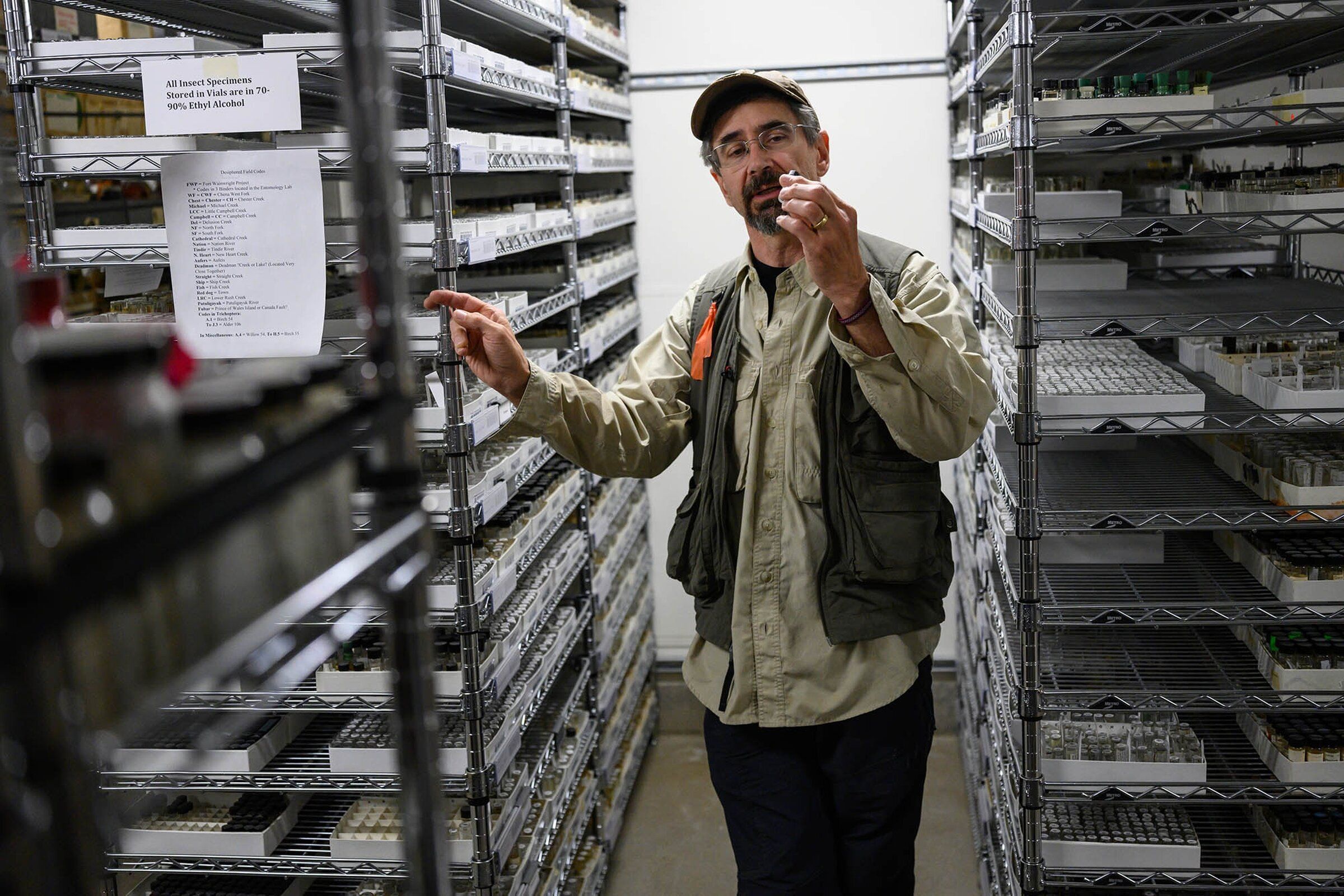
The collection is stored in a basement in organized cabinets, protected for decades. With about ten years left in Sykes’s career, he hopes the university will continue investing in the position and find a successor with a similar vision.
Based on: University of Alaska entomologist aims to collect every insect in the state