
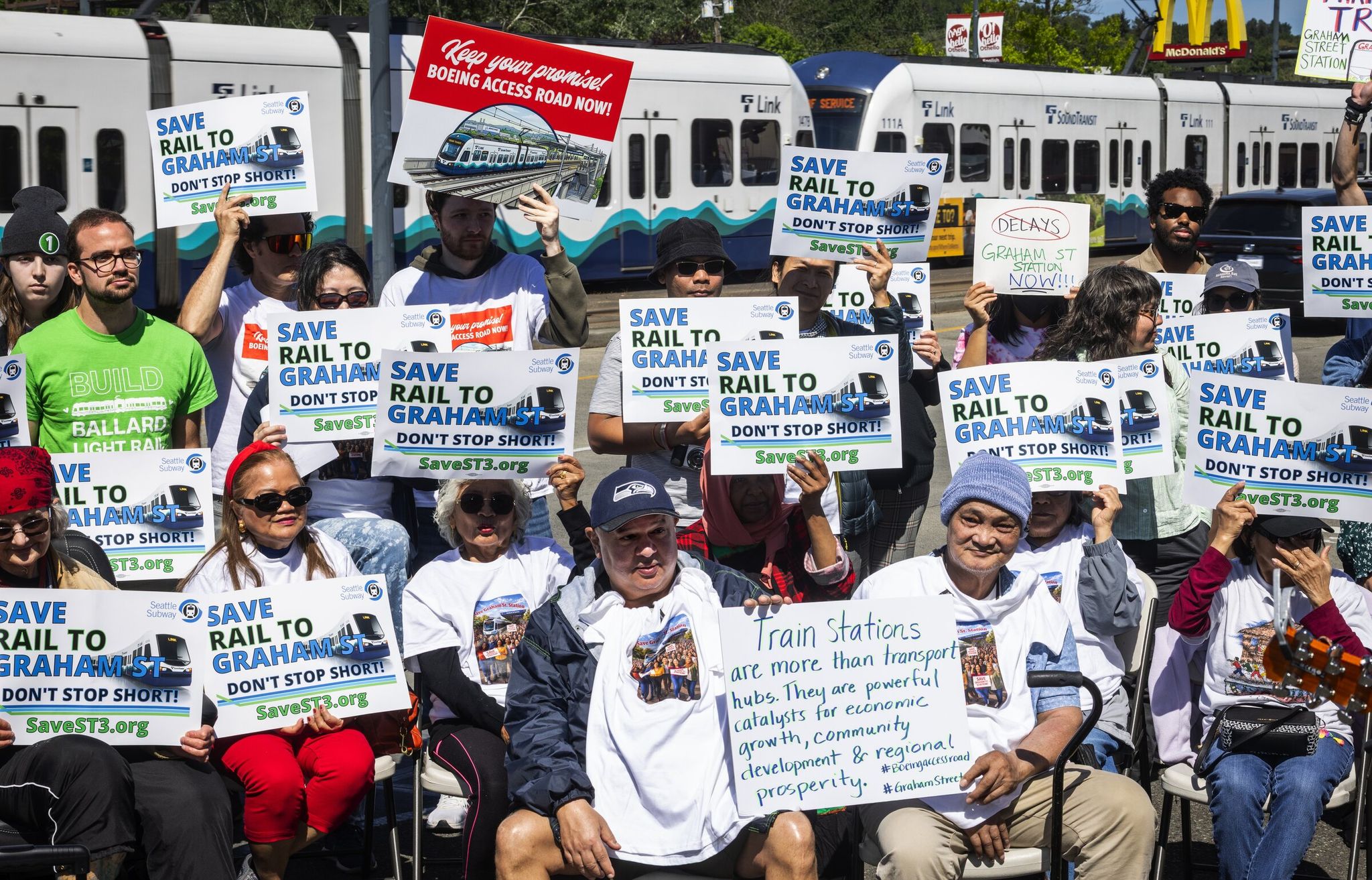
After three decades of bureaucratic delays and community battles, the light-rail station on Graham Street in the Rainier Valley has finally gotten the green light. At a Sound Transit board meeting in late May, the station was preserved thanks to persistent local activists and the support of Seattle Mayor Katie Wilson, King County Executive Girmay Zahilay, and County Councilmember Teresa Mosqueda.
The decision is a major victory for Seattle’s South End, which for years has suffered from underinvestment, gentrification, and displacement. Rainier Valley has historically been lower-income and less politically influential than other parts of the city. While the other stations on Line 1, opened in 2009, were routed on a priority corridor to the airport and downtown, funding for the southwest extension, including Graham Street, was approved only as part of the ST2 package in 2008. Work was repeatedly delayed by land acquisition issues, disputes with neighbors, and budget shortfalls. The 30-year delay therefore reflects systemic inequality in how resources are distributed between wealthier and poorer neighborhoods. Tenant Organizers & Advocates executive director Violet Lavatay emphasized that the community refused to wait another 30 years and organized protests to make their voices heard.
For many residents the station became a symbol of the fight for equitable access to transit. Mayor Wilson said “no more promises” and that southern communities deserve fair access to modern infrastructure. Sound Transit estimates the $214 million station will open in 2031.
But saving the station is only the first step. Local organizations such as Puget Sound Sage are already focused on preventing the displacement of current residents. Gentrification is the process by which historically inexpensive neighborhoods attract wealthier residents, driving up rents and property taxes. New transit projects, like the Line 1 extension, make these areas more attractive to developers and increase land values. As a result, shops, churches, and homes that have served local residents for decades are replaced by expensive condominiums and coffee shops, and people are pushed to more distant suburbs, losing social ties and jobs. Expert Howard Greenwich noted that transit only benefits people if they “still live in their neighborhoods 10–20 years from now.” Activists are pushing for affordable housing policies and protections for small businesses, churches, and cultural centers.
Safety remains an urgent concern. In Rainier Valley, unlike other parts of Line 1, trains run at surface level through busy neighborhoods, intersecting with pedestrian crossings. Because some sections lack automatic gates and signals, and visibility is limited by track curves and poor lighting, people often cross tracks at unsafe locations or fail to clear the tracks in time. This has already led to numerous collisions with pedestrians and vehicles. Sound Transit planned to install barriers as far back as 2018, but the work was postponed due to bureaucratic delays and funding shortages. Residents have long demanded gates and fencing, but so far without success.
Sound Transit promises that protective gates will be installed at existing stations (Columbia City, Othello, Rainier Beach) by 2030. Additional barriers are scheduled for the most dangerous sections in 2025, but full upgrades could be delayed until 2028. A final decision for Graham Street station has been postponed — it will be made after consultation with the city and the public. Experience has shown that Sound Transit’s timelines can be quite vague.
Activists intend to keep up the pressure through to opening day. “We will hold them accountable,” Lavatay said, noting that many of the older fighters for the station have nearly lost hope but continue to push. “Some may not live to see it, but we fight for future generations,” she added.
Based on: Good news for Graham Street light rail station after decades of delays