
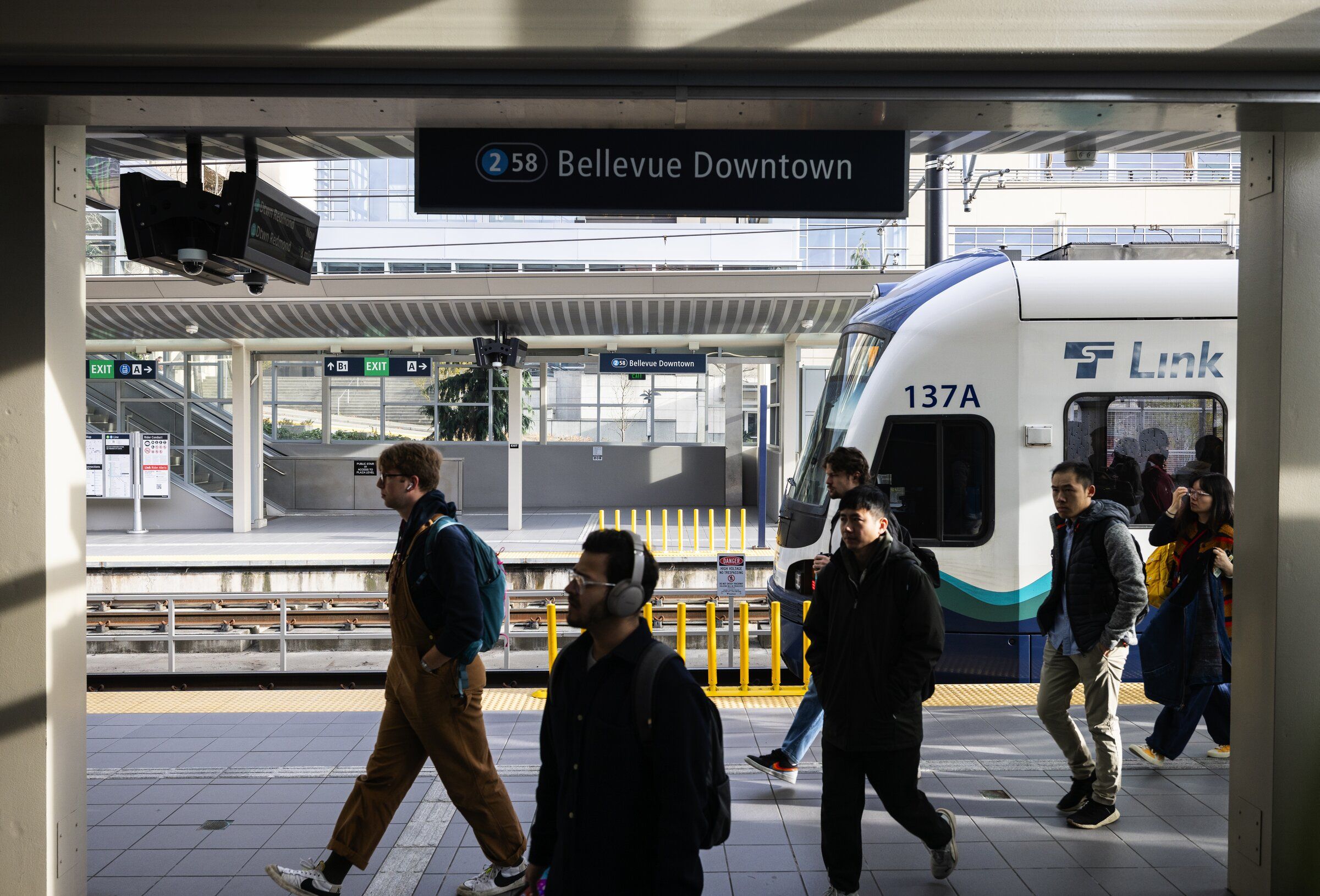
On Monday, Bellevue began rolling out two free shuttle vans that ferry riders from the Bellevue Downtown light-rail station throughout the downtown core. The blue, battery-powered Volkswagen vans—marked “Bellevue Light Rail Shuttle”—depart from the sidewalk by the station from 8 a.m. to 6 p.m. on weekdays. No app is required: just board the seven-passenger van. The pilot program runs through December.
The shuttles will drop you anywhere within the large downtown service area: from Bellevue Square and the Meadenbauer waterfront to the financial district, hotels, and residential complexes in the center of the city. The route also covers neighborhoods east of I-405—Overlake Medical Center, the Bellevue Botanical Garden, and Lake Bellevue, Wilburton, and the Spring District. Popular grocery stores are included as well, including H Mart, Uwajimaya, and Whole Foods. Uwajimaya deserves special mention: the family-run Asian grocery chain was founded in the late 1920s by Japanese immigrant Fujimatsu Moriguchi, survived the internment of Japanese people during World War II, and has long served as a symbol of resilience and preserving traditions for the Asian American community. Its flagship store is in Seattle’s historic International District, and in Bellevue shoppers can find not only Japanese groceries, but also books and cookware—as well as attend holidays and cultural events.
The new service is different from the one residents already know as BellHop. Those vehicles are booked through an app or called from the street, and trips can be quite varied—without necessarily being tied to light-rail stations. BellHop has been operating for three years. Using five electric Kia vehicles, it has carried 265,000 passengers, about half of whom are Bellevue residents. The new shuttle vans build on that service, but are aimed specifically at people coming by train.
The shuttle launch comes amid a sharp surge in ridership following the opening of the March segment of Line 2 between Seattle and Bellevue. This spring, Bellevue Downtown station recorded about 3,700 boardings and roughly the same number of alightings each day—double the figures before the opening. The new project’s budget includes $150,000 from Amazon, while marketing support is provided by the city and Sound Transit. Amazon’s contribution is not incidental: even though the company’s headquarters is in Seattle, it is considered one of the biggest employers in Bellevue as well, where it has offices employing thousands of workers. Free shuttles help solve the “last mile” problem—employees and local residents can travel from the station to work without creating traffic congestion or wasting time searching for parking. Amazon, Microsoft, and other tech giants have already transformed Bellevue from a bedroom suburb into a business hub of its own, with skyscrapers and thousands of jobs, so the company’s interest in transportation infrastructure is hardly surprising. Whether the service continues after December will depend on ridership numbers, feedback, and funding.
These shuttles are designed to address a classic “first-and-last mile” problem in public transportation: many people do not use the metro if getting to the station is difficult. A representative from Visit Bellevue, Anna Yang, said that at the station, people with suitcases often show up looking lost—so during the first month, a special consultant will be on hand to meet morning riders. While the shuttle vans are not yet equipped with wheelchair ramps, city officials are considering adding them.
The service also has deeper roots. The light-rail station was built nearly a mile from the shopping center largely due to the persistent resistance of Kemper Freeman, owner of Bellevue Square, a millionaire and a representative of the family that built one of the region’s major retail empires in Seattle’s eastern suburbs. For decades, he publicly opposed the rail line, fearing that tracks near his shopping complex would bring noise, chaos, and “undesirable” visitors. Using his considerable influence over local politics, Freeman helped change the route: the line was placed away from the main shopping district, meaning it now takes nearly a mile to walk to the famous mall. In addition, many pedestrians often simply avoid crossing I-405 because of the dangerous layout. Still, there is already a pleasant walking route along Northeast Sixth Street, and the city is designing a wider bridge over the highway into the Wilburton area.
Visit Bellevue emphasizes that this is a step toward a more sustainable future for the city—one not completely dependent on cars. Visit Bellevue executive director Brad Jones noted that during BellHop’s operation, it saved about 35,000 gallons of gasoline compared with similar trips in conventional gas-powered vehicles. How successful the new vans will be will be clear in December, but officials are clearly betting on making light rail convenient for everyone.
Based on: Downtown Bellevue adds free shuttle vans to meet you at light rail