
On the northern part of the Olympic Peninsula, the public Elwha Legacy Forests Coalition raised funds to protect 29 acres—about 12 hectares—of mature forest in the Doc Holliday timber sale west of Port Angeles. Rather than engage in a lengthy legal battle with state authorities, activists negotiated directly with the logger, Webster Logging: the company agreed not to harvest the selected areas in exchange for compensation for the timber, its work, and mandatory state fees. It is a rare example in Washington of forest preservation achieved not by canceling a sale, but by effectively buying back the right to harvest it.
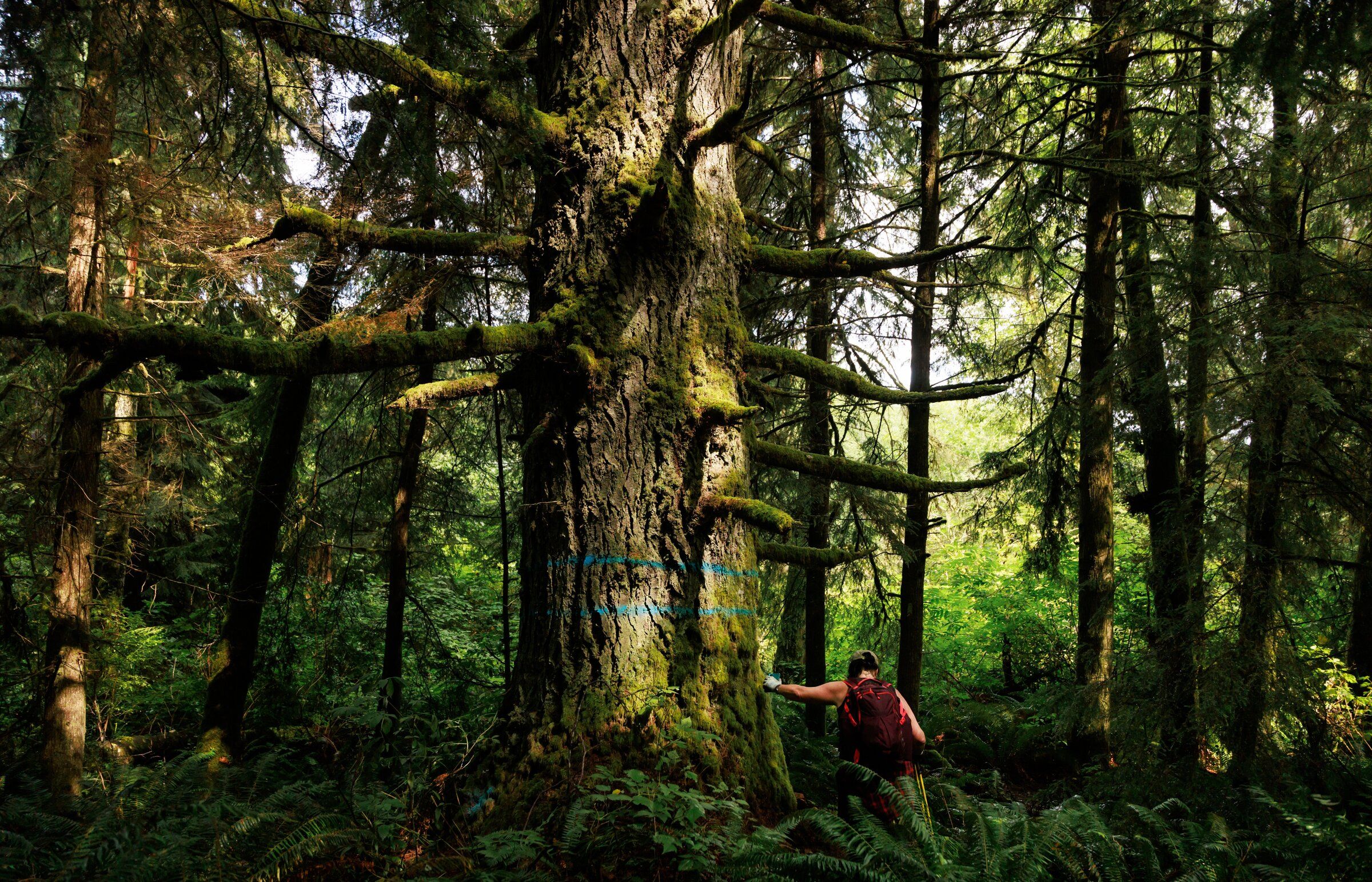
For the Olympic Peninsula, this is more than a story about several dozen acres. The region’s wet coastal conifer forests exist on a timescale poorly suited to the schedule of timber auctions: trees grow for decades, while a single contract can determine whether they are cut down. Conservationists call the protected parcels “legacy forests”—not old-growth forest in the strict legal sense, but naturally regenerated, structurally complex stands with large trees, multiple layers of vegetation, and signs of developing into future old-growth forest.
The Doc Holliday sale was authorized by the Washington State Department of Natural Resources in 2024. Bruce Webster, owner of Webster Logging, paid the state $620,000 for the right to harvest 74 acres. To the state, such land is not an abstract preserve, but a trust asset: timber revenues must support schools, counties, and local services. That obligation often turns a forest dispute into a conflict not between nature and indifference, but between different public needs—each with a very specific price.
The first test of the new approach involved two acres near Sadie Creek Campground. In May, the coalition raised $32,000 and agreed with Webster Logging that the company would not cut the trees around the campground. Then, in August, activists found roughly $260,000 to preserve another 13 acres. The logger gave them time to raise money for the remaining 14 acres as well, and by mid-September the campaign had reached its goal.
The fundraising effort brought in $563,000 in total; more than 7,500 donors took part over the course of a month. Significant support came from the Holdfast Collective—a nonprofit organization linked to outdoor gear maker Patagonia—which donated $75,000, as well as from an anonymous donor who contributed $72,000. The money was intended to cover not only the value of the timber, but also the logger’s expenses and the fee charged by the Department of Natural Resources to the timber-sale purchaser.
Webster Logging’s role in the deal is also important. The company did not sell the land—it does not own it, and the land remains under state management—but gave up part of the harvesting rights it had already purchased. Webster had previously said he had no objection to the arrangement as long as he received what he would have earned from logging. For activists, it is a practical compromise: rather than asking the timber industry to act charitably, it recognizes that mature forest has a value society can pay for as directly as it pays for logs.
There is, however, a significant caveat to this victory. The Department of Natural Resources was not a party to the agreement, so the current protection is not equivalent to permanent conservation status: theoretically, the state could put these parcels up for sale again someday. Commissioner of Public Lands Dave Upthegrove has called such arrangements uncharted legal territory; the agency is developing a possible system of conservation leases or agreements that would allow the state to participate officially in deals of this kind.
Upthegrove has already ordered 77,000 acres of older, structurally complex state forests to be set aside for protection, while leaving 29,000 acres of similar stands available for harvesting. The dispute over the Olympic Peninsula has not disappeared, but the deal surrounding Doc Holliday demonstrates another way to conduct it. Several dozen acres of forest will not, by themselves, change the state’s economy, but they have changed the language of the debate: between the demand to log and the demand not to log, a third option has emerged—to pay for the forest to remain a forest.
Based on: Trees in WA temperate rainforest spared from chopping block