Digest: A staffing crisis paralyzed Seattle-area ferries, the Seahawks won despite a franchise-worst record, and the Kraken routed the Flames.
Washington state ferry system disruption: Crew shortage paralyzes service
On Sunday, ferry passengers in the Seattle area faced widespread schedule disruptions affecting several key routes at once. According to KIRO 7 News Seattle, the disruption was caused not by a technical failure aboard the vessels but by an acute shortage of qualified personnel. Several ferries remained out of service all day, while routes normally served by two vessels were forced to operate with just one.
The situation affected popular routes including Seattle–Bainbridge, Seattle–Bremerton and Mukilteo–Clinton. In addition, two of the four ferries serving the Anacortes–San Juan Islands route were pulled from service. Passengers returning after the Seahawks game found themselves in a difficult situation. Tyler Terry and his companion, for example, arrived at the Colman Dock terminal for an evening sailing to Bremerton only to learn that the next vessel would not depart for another hour. “I’m lucky I don’t have work tomorrow. I think we’ll just try to make the best of it,” he said.
Washington State Ferries spokesperson Justin Fujioka stressed that the cancellations were a serious measure taken out of necessity. He said the vessels themselves were fully operational, but key positions were unstaffed, including captains, chief mates, senior engineers and assistant engineers. These specialists hold the necessary licenses and qualifications, and when one becomes ill or takes family leave, the system cannot quickly find a replacement. The agency has already launched workforce-development programs to expand its pool of trained employees, but passengers, like Terry, are hoping for a faster solution. “I hope they get this figured out, because we’re surely not the only ones stuck here without a backup plan,” he added.
Several points help illustrate the scale of the problem. Washington State Ferries is one of the largest ferry systems in the United States, and its operation depends critically on strict maritime-certification requirements. Captains and engineers must hold federal licenses, and their training takes years, making rapid replacement impossible. The shortage of so-called “credentialed” specialists is not simply a labor shortage but a structural vulnerability in which even one sick employee can disrupt an entire route’s schedule. In this case, the issue is neither a strike nor mechanical failures, but a systemic shortage of people with the required credentials.
The central point is that the crisis is organizational and personnel-related, not technical. Washington State Ferries is trying to notify passengers more quickly through mobile alerts and its website, but those measures only mitigate the consequences; they do not address the root problem. For residents who depend on ferries as their primary means of transportation, such disruptions mean ruined plans, delays and additional expenses. In the long term, the situation could recur if workforce-training programs do not produce results quickly. For now, passengers can only check for updates and hope for the best, while the ferry system works to accelerate recruitment and training for these essential specialists.
The Seahawks won, but they played like a team with plenty left to learn
A matchup between two NFL teams in Seattle ended with the home side winning 30–23. The result was a perfect illustration of how a team can win a game while simultaneously looking like one in the midst of a deep crisis. The Seattle Seahawks, the reigning Super Bowl champions, hosted the Los Angeles Chargers, who had already lost their first three games of the season. After this game, the Chargers had four straight losses, while the Seahawks stood at three wins and one loss. But looking only at the numbers misses the main point: Seattle won not because of its strength, but rather in spite of its own mistakes—so many of them that the coaching staff will have to analyze this game for weeks. The game, played October 4, 2026, will be remembered for at least two reasons: first, the Seahawks set a franchise record for penalty yards; second, both teams threw interceptions on their very first scrimmage plays—a feat that, according to Sportradar, had not occurred since 1991.
The unexpected star of the game was Emanuel Wilson, a backup running back in his first season with Seattle after spending four years with other teams. He was thrust into the spotlight after rookie Jadarian Price was placed on injured reserve the day before the game because of a flare-up of a chest injury suffered in practice. Wilson responded with 81 rushing yards on 21 carries and three receptions for 39 yards, including a touchdown reception and a rushing touchdown. His postgame comment—“It was like Moses parting the Red Sea. Everybody just got into their blocks”—was probably the quote of the night.
Seahawks quarterback Sam Darnold threw for 168 yards and two touchdowns, but he was also intercepted once and sacked three times. His statistics offered a typical portrait of an inconsistent performance: effective enough in key moments, but marked by persistent flaws. Chargers quarterback Justin Herbert, by contrast, had a game he would probably like to forget as soon as possible: 189 yards, one touchdown, two interceptions and four sacks for 35 lost yards. Herbert has now thrown six interceptions and been sacked 12 times this season. That is more than poor statistics—it indicates that Los Angeles’ offensive line is struggling and that the quarterback is making decisions under constant pressure.
The game began with chaos, setting the tone for the afternoon. On the Chargers’ first play, Seattle’s Drake Thomas intercepted a pass from Herbert intended for Oronde Gadsden. But on the Seahawks’ first play, Darnold threw toward Wilson, and the ball ended up in the hands of Tuli Tuipulotu. It was an extremely rare sequence: both teams traded interceptions on their opening scrimmage plays, something that, according to Sportradar, had not happened since at least 1991. That start established a nervous rhythm, with both teams repeatedly making mistakes, losing the ball and giving their opponent opportunities that were either converted or wasted.
By the middle of the third quarter, Seattle led 27–6, and the game appeared to be over. Darnold threw a six-yard touchdown pass to Tory Horton, and the home team seemed in control. But the Chargers did not give up. Herbert found Kimani Vidal for a nine-yard touchdown, Omarion Hampton added a two-yard rushing touchdown, and Cameron Dicker kicked two field goals to cut the deficit to 30–23 with 2:14 remaining. Los Angeles still had a chance after taking possession with 1:42 left on the clock. But Herbert was sacked and lost the ball, allowing Seattle to recover and preserve the victory.
Seahawks coach Mike Macdonald was measured in his assessment afterward: “We’re really grateful for where we are right now and excited to move forward. But we also understand that we definitely have a lot of room for improvement in how we operate, how we handle the football and, obviously, penalties are something we need to address.” Those words were not merely a coaching formality. Seattle truly set a franchise low: 14 penalties for 150 yards. The Chargers were not far behind, with 16 penalties for 130 yards. Combined, the teams accumulated 280 penalty yards, turning the game into a succession of stoppages, whistles and discussions.
The historical context surrounding the Chargers also deserves mention. The only team in NFL history to reach the playoffs after starting a season with four losses was the 1992 San Diego Chargers. That team began 0–4, then defeated Seattle 17–6 on October 4, finished 11–5 and won the AFC West. The matching date and opponent are almost mystical. Jim Harbaugh, the Chargers’ current coach, clearly knows the story. “What I saw from our players was resolve, an attitude that never quits,” he said. “That’s throughout the team.” It may have been an attempt to preserve morale in the locker room, but the fact remains that Los Angeles has allowed 24 or more points in each of its first four games, and the defense looks not merely weak but systemically flawed.
Injuries added to the drama. Chargers cornerback Donte Jackson left in the first quarter with a hamstring injury; tackle Joe Alt left in the second quarter with a neck injury and did not return; and wide receiver Ladd McConkey aggravated a foot injury and remained in the locker room after halftime. Seattle defensive tackle Leonard Williams limped to the medical tent in the third quarter with an ankle injury but returned for the Chargers’ final possession. Those losses, particularly along Los Angeles’ offensive line, help explain why Herbert spent much of the game on the ground.
What should we take away from this game? First, Seattle remains a team with a high ceiling, but its foundation is cracking: penalties, interceptions and an inability to protect a lead could cost the Seahawks against stronger opponents. Second, the Chargers are at a point where the statistics are no longer merely concerning but catastrophic: 0–4, at least 24 points allowed in every game, six interceptions by Herbert and 12 sacks. The 1992 precedent offers hope, but that team had a different defense and a different offensive line. Third, this game is a reminder that in the NFL, victory does not always mean superiority. Sometimes it simply means making slightly fewer mistakes than the opponent. In the next round, the Chargers will host Denver, while Seattle will face San Francisco. If the Seahawks do not solve their penalty problem and the Chargers cannot protect their quarterback, both teams could end up somewhere no one expects. A full game report and statistics are available at CBS Sports.
Kraken rout Flames in home opener: Samoskevich’s two goals signal Seattle’s new wave
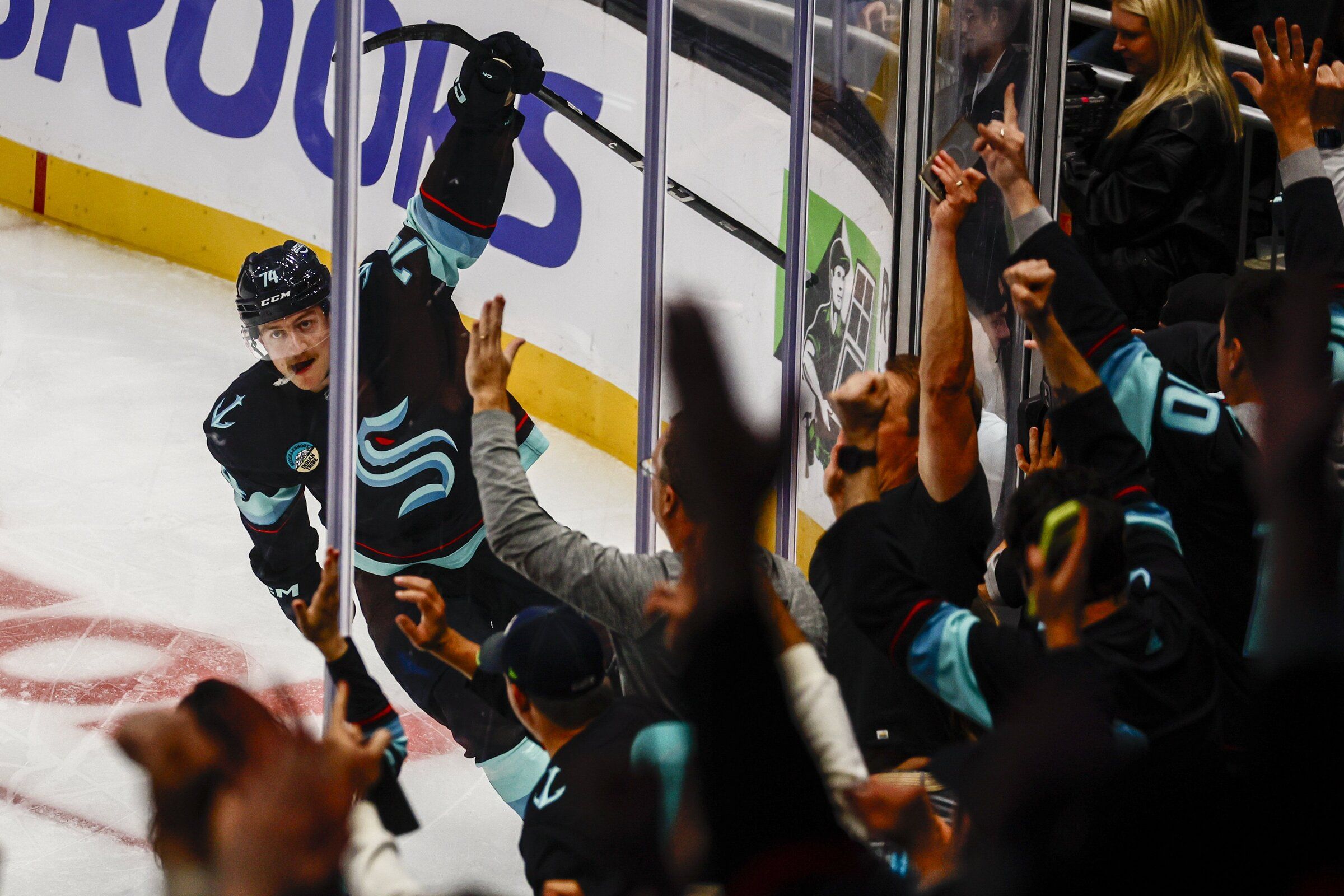
In their first home game of the season, the Seattle Kraken routed the Calgary Flames 6–1, with rookie Mackie Samoskevich emerging as the star of the night after scoring twice. For a club that tried to strengthen its attack over the summer, this was more than a convincing victory—it was a signal that a new wave of players is ready to take responsibility. Calgary is rebuilding and, in the view of most experts, is destined to fight near the bottom of the NHL’s 32-team standings. Seattle was not expected to shine in national projections either, but the Kraken have clearly had no trouble with the Flames: they beat Calgary twice in the preseason, then repeated the feat in the regular-season opener in Calgary, winning 6–1, and now did so again in their home debut. On Sunday, Calgary looked dismal while Seattle improved to 2–1.
The most important aspect of the victory was not just the score but who did the scoring. The Kraken quickly took a 3–0 lead, with all three goals coming from newcomers. The future is already knocking: 20-year-old second-year center Berkly Catton opened the scoring less than three minutes after the opening faceoff. Kaapo Kakko sent a pass toward Shane Wright, but the puck did not reach him. Catton was nearby, nearly skated past it, then scooped it up behind his back and fired—1–0. Catton could have made it 4–0, but his shot at an empty net sailed high.
Samoskevich scored his first goal in a Kraken sweater about two minutes after Catton, at 4:40 of his second game with Seattle. He missed the season opener in Calgary because of a preseason injury. “It’s definitely tough when you go through camp and then have to slow down again,” Samoskevich said. He was initially slated for a role on the fourth line but moved up to the top line with Matty Beniers and Jared McCann, with whom he had spent much of the preseason. Goaltender Joey Daccord has not played behind Samoskevich for long, but he has already seen his “elite shot” and “crazy hands.” “I’ve seen his speed. He can fly,” Daccord said. “(Brandon Montour) chipped the puck, and I thought he might have a chance. Great play… in tight, an incredible finish to find the hole.”
Bobby McMann, acquired from the Toronto Maple Leafs before the trade deadline and signed to a long-term contract over the summer, made it 3–0 with his second goal of the season. The next goal came later but was worth the wait. Wright took a pass from Catton and, in one smooth motion, sent the puck behind his back without looking, beating Calgary goaltender Dustin Wolf, who made 21 saves, midway through the second period.
The Kraken came within one Beniers goal of a “roommates’ hat trick.” Samoskevich, Catton and Beniers are living together this season. Beniers eventually collected “rent” in the form of an assist on Samoskevich’s second goal. “Berk and I are going to be happy tonight,” Samoskevich joked. “We’re playing well. We’re getting along well both at home and in the locker room.” The crowd appeared to be enjoying itself. “The fans were rocking, for sure,” Samoskevich said. “We felt it right away. It definitely gave us good energy. I’m looking forward to the rest of the year, for sure.”
A new voice rallied the crowd during stoppages. Angelica Salem had served as the arena’s co-host since the inaugural season through last year and had also worked with the Seattle Storm, Sounders and Reign. In September, she announced on social media that she was moving to Salt Lake City. Marika Davis took her place. Davis graduated from Kansas State University and previously held several roles, including in-game host, with MLS club Sporting Kansas City, according to her LinkedIn profile.
Daccord had another chance at a shutout after losing one on Thursday, but once again surrendered a goal late in the third period. He finished with 32 saves. It was déjà vu: 39 seconds later, Kraken captain Jordan Eberle answered with a goal. On Thursday, Kakko scored 26 seconds after Daccord’s shutout bid was spoiled. Both goals made the score 6–1 for Seattle.
Kraken draft pick Ville Ottavainen made his season debut as the sixth defenseman. That role had gone to three different players in the first three regular-season games: Cale Fleury and Josh Mahura had also filled it. Another homegrown player, fourth-line sparkplug Jacob Melanson, was placed on injured reserve with an upper-body injury when Samoskevich returned from IR on Saturday. Melanson is described as week-to-week.
This victory was more than a rout of a weak opponent. It showed that Seattle can build its offense around young and new players who already look ready for the NHL. Samoskevich, Catton and Beniers are not only living together but also developing chemistry on the ice—a potentially more important asset for a team still searching for its identity than any preseason projection. The season is long, but the home opener was exactly what fans wanted: energetic, productive and filled with the feeling that the future has already arrived.