
At the José Martí Child Development Center in Seattle, Washington Governor Bob Ferguson urged voters on November 3 to reject Initiative I-645, which would repeal a new tax on income above $1 million. His argument was not aimed at an abstract debate over tax policy, but at a more immediate concern for families: repealing the tax, he said, would deprive the state of future funding for childcare subsidies, schools, health care and other programs already facing budget pressure.
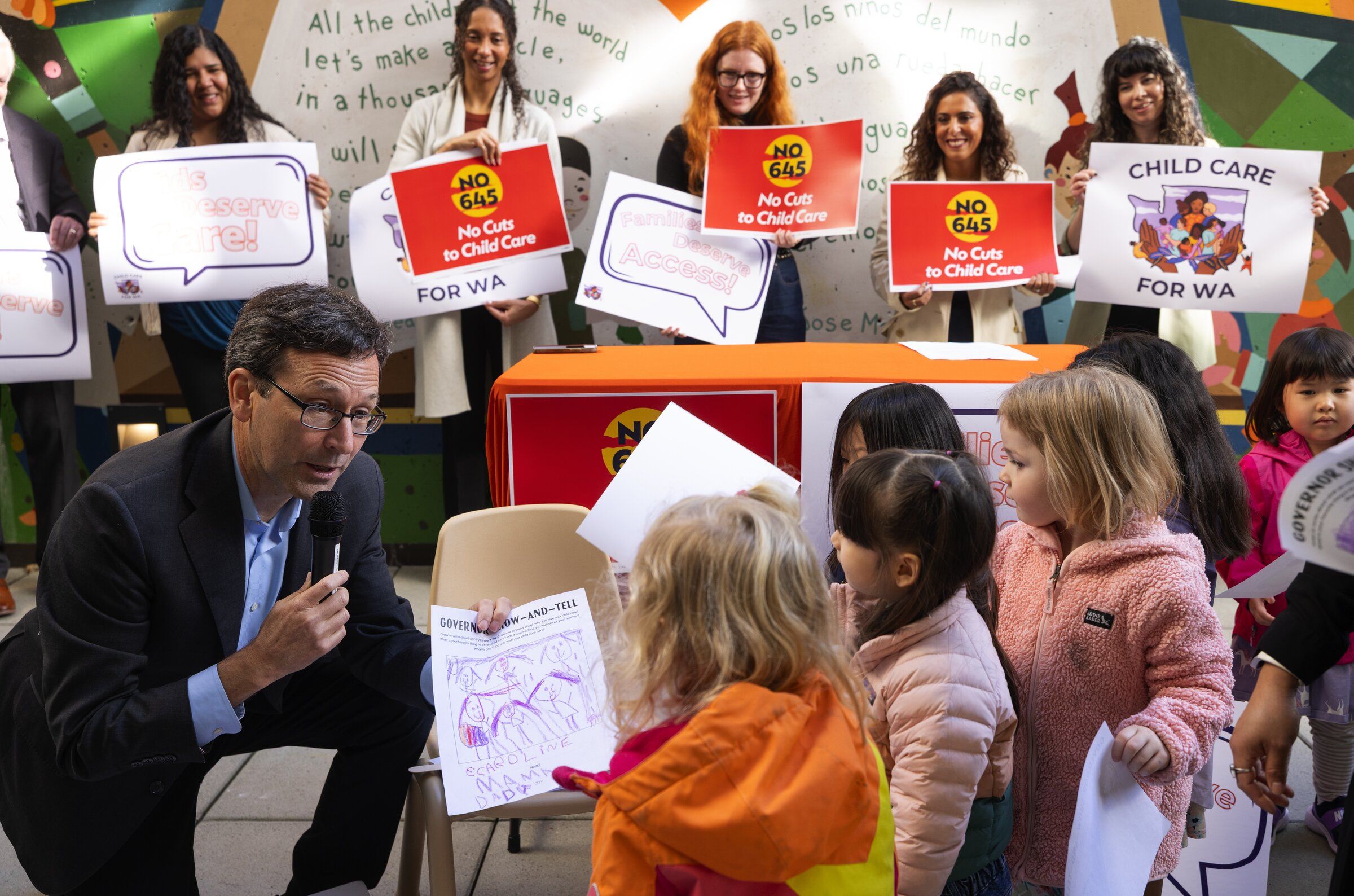
The governor’s visit to the José Martí Child Development Center at Cedar Crossing on Tuesday, October 20, was staged as a tangible response to a debate usually conducted in Olympia in the language of percentages and legal wording. While children showed visitors their drawings, Ferguson spoke about the cost parents face when childcare becomes unaffordable. Five percent of the revenue from the new tax, he stressed, is earmarked by law for early learning and childcare programs.
The tax is part of ESSB 6346, which Ferguson signed on March 30, 2026. Starting January 1, 2028, the state is to levy 9.9 percent on an individual’s taxable income above $1 million; the first payments are expected in 2029. The first $1 million in income is exempt, and homes, other real estate and other assets are not subject to the tax in themselves. Lawmakers estimated that it would affect roughly the wealthiest half of one percent of households in the state.
Most of the revenue is to go into the state’s general fund, supporting K–12 education, health care, social services and higher education, as well as an expanded Working Families Tax Credit and reductions in some sales taxes and taxes on small businesses. Starting in July 2029, five percent of annual collections must be transferred to the Fair Start for Kids Account, a fund for early learning and childcare. Current estimates suggest that, once fully implemented, the tax could bring in about $3 billion a year.
This is where the tax connects to the Working Connections Child Care program. It helps families with lower incomes pay for licensed childcare while parents work, study or complete approved training. Families make a monthly copayment based on their income and the number of children, and the state covers the rest. According to figures cited during the campaign against I-645, about 51,000 children and their families across Washington receive this support.
Center director Jasmine Calderon Shadlow said cuts to Working Connections would hit especially hard for families already trying to balance work, housing and the cost of raising a child. For these parents, the subsidy is not a perk in the ordinary sense; it is what allows them to keep working. For childcare centers, losing reimbursements also risks shifting the shortfall onto other clients or reducing the number of available places.
Initiative I-645 was launched after the conservative group Let’s Go Washington, led by hedge fund founder Brian Heywood, gathered more than 500,000 signatures; 308,911 were required to put the measure on the ballot. The initiative would not only repeal the tax on income above $1 million, but also prohibit the state and local governments from imposing taxes on personal income or taxes measured by income. Supporters say it would put a barrier in the way of gradually extending an income tax to ordinary families and small businesses.
Ferguson’s response is to promise that he will not support lowering the $1 million threshold. But the debate has already grown beyond that one pledge from the governor. Supporters of the tax see it as a rare attempt to make a system that relies mainly on consumption taxes less burdensome for low-income residents. Opponents see it as a precedent that could make the $1 million limit no longer politically untouchable.
The wording on the ballot will be an unusual reversal for voters: a “yes” vote on I-645 means repealing the tax, while a “no” vote means keeping it. The tax is not being collected yet, so the vote is primarily about the state’s future budget—and what the state’s finances will look like in 2029, when families’ need for childcare will already be very much a present-day concern.


Based on: ‘Millionaires tax’ repeal would threaten childcare subsidies, governor warns