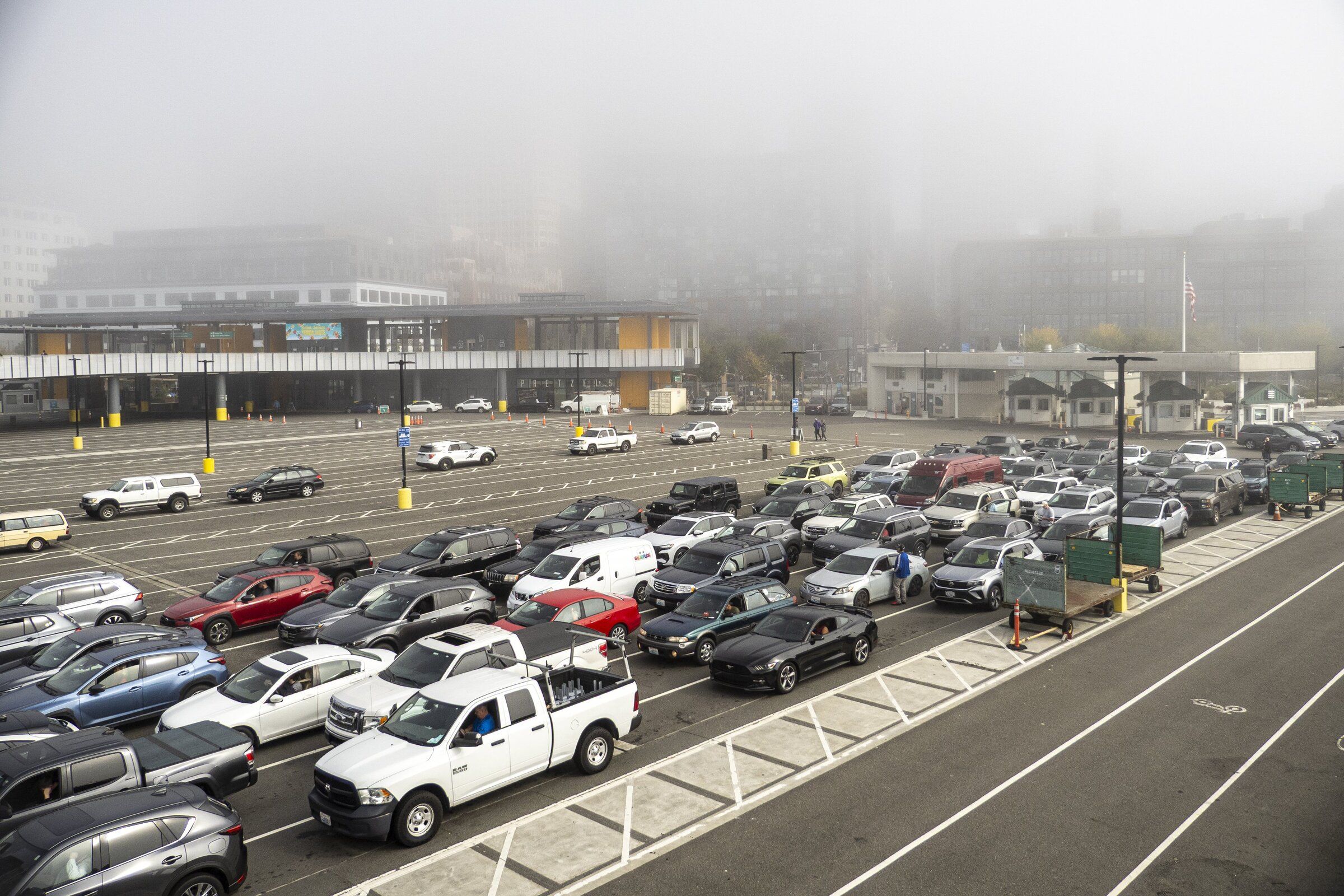
Washington’s ferry system has been paralyzed by a wave of sick calls, while the Seahawks’ victory was overshadowed by a franchise record for penalties.
“A Lot to Clean Up”: Seattle Beats Chargers but Sets Penalty Record
A 30–23 victory over the Los Angeles Chargers improved the Seattle Seahawks’ record to 3–1, but the win could hardly be called a clean performance. The team struggled with disciplinary violations throughout the game—committing 14 penalties for a franchise-record 150 yards. That became the main focus of former NFL quarterback Brock Huard’s analysis. In his view, this aspect of the game outweighed the positive result.
In his analysis for Seattle Sports, Huard highlighted the fine line between aggressiveness and recklessness that defines a quarterback’s play. Sam Darnold, he said, generally handled that challenge well—with the exception of a “pretty brutal interception” on the very first play—and protected the ball. However, the team’s overall mentality clearly crossed that line. Huard recalled the “Ministers of Violence” shirts players wore during training camp, emphasizing that when a team proclaims itself to be extremely aggressive and physical, it must understand where acceptable toughness ends. On Sunday, that boundary was crossed, at times “embarrassingly,” according to the analyst. He cited specific violations: roughing the passer, repeatedly; headbutts; and shoves after plays had gone out of bounds. The players had been frustrated after losing the previous week, and that frustration spilled over into uncontrolled aggression.
The Seahawks were fortunate that their opponent was weakened. The Chargers had lost several key players, while quarterback Justin Herbert turned the ball over three times. Seattle recorded four takeaways in all, allowing it to keep control of the game despite its many mistakes. Huard acknowledged that it was difficult to be negative after a victory, especially with the team sitting at 3–1, and that wins should be celebrated. But, he stressed, “there is definitely a lot to clean up” before the San Francisco 49ers arrive next week.
What the terms mean: “roughing the passer” refers to illegal or excessively forceful contact with the quarterback after he has released the ball or while he is in a vulnerable position; it carries a significant penalty. “Ministers of Violence” refers to the head coach’s philosophy of dominant, physically aggressive play that must not cross the line into rule violations. Fourteen penalties for 150 yards are more than a statistic—they indicate a loss of discipline that could cost Seattle a game against a strong opponent such as the 49ers. The key takeaway: the Seahawks are prepared to play aggressively, but they have yet to learn how to balance intensity with adherence to the rules, leaving them vulnerable in the games ahead.
Washington Ferry Crisis: How 23 Sick Calls Paralyzed an Entire Transit System
On Monday, March 10, Washington state faced an unprecedented transportation collapse. Most ferry routes across Puget Sound were either fully canceled or placed on reduced service after 23 engine-room employees simultaneously called in sick. The resulting crew shortage caused “significant disruptions” throughout the system, according to Washington State Ferries officials. Of the fleet’s 18 vessels, 13 were taken out of service—a situation without precedent in the past decade.
According to an official statement from Washington State Ferries, all of the employees who called in sick are members of the Marine Engineers’ Beneficial Association. Gov. Bob Ferguson met Monday with union leaders and state representatives, signaling that he viewed the incident as a coordinated action. The union, however, categorically denied organizing the mass sick calls, saying it learned about them “the same way the public did—from media reports.” Roland Rexha, secretary-treasurer of the national union, emphasized that the incident was not part of collective bargaining: The engineers’ contract for 2026–2028 had already been agreed to in July following arbitration.
Nevertheless, the roots of the crisis go far deeper than a single day of mass absences. The union has spent several years seeking higher wages to achieve parity with workers on the upper decks, who earn roughly 20% more annually. Engineers are also demanding fewer overtime hours, which they say are exhausting employees. According to the union, engineers work seven-day schedules, and overtime can exceed 1,500 hours a year. “Using volunteers to work overtime in order to meet minimum safety requirements is irresponsible; moreover, it is a path to disaster,” the union said in a statement. Rexha described the system as “unsustainable,” held together “with chewing gum and duct tape.”
The situation is particularly serious because, according to the union, the state staffs vessels at the legal minimum and has abandoned requirements from the previous contract that called for an additional crew member to fill in for sick workers. As a result, engineers are forced to work “offensively excessive amounts of overtime,” leading to disruptions when employees “throw up their hands.” The union also said Washington State Ferries management wants to freeze engineers’ wages at a level 20% below that of their shipboard colleagues, which has “destroyed morale and created incentives for qualified professionals to look for work elsewhere.” According to the union, marine engineers in the public and private sectors earn 40% more than engine-room employees on the state’s ferries. The ferry agency, meanwhile, said chief engineers have a base salary of $157,000 a year, which can exceed $350,000 with overtime. Critics noted that this figure represents the upper end of the scale, while many engineers earn considerably less.
Gov. Ferguson, himself a regular ferry passenger, called the incident a significant hardship and inconvenience for state residents. “I was very direct in our meeting: My expectation is that every vessel on every route will be fully operational no later than the first sailing tomorrow morning,” he said. However, no one could guarantee that the ferries would actually resume full service on Tuesday.
The consequences for passengers were substantial. The Seattle–Bainbridge route stopped operating entirely after the 5:30 a.m. sailing. The Edmonds–Kingston route halted after 7:10 a.m. In the San Juan Islands, only the Samish continued serving all stops from Anacortes to Lopez, Shaw, Orcas and Friday Harbor, while two other vessels were taken out of service. The Kennewick ferry on the Port Townsend–Coupeville route did not sail at all on Monday. The Fauntleroy–Vashon–Southworth triangle route operated with only its third vessel, which was later canceled as well. The Seattle–Bremerton route shifted to one-boat service, and the morning sailings of the second vessel, Chimacum, were canceled. The Mukilteo–Clinton route also shifted to one-boat service, resulting in three-hour waits for drivers.
People caught at the center of the disruption described the situation with a mixture of concern and understanding. Bo Bowen of Freeland, who usually takes the 6:30 a.m. ferry from Clinton, left his car behind on Monday and switched to the walk-on route. “I wish they would find another way to negotiate or express their concerns,” he said. “We have a large group of people who use this route, and turning a 15-minute trip into a one-and-a-half-hour wait creates a lot of problems.” Aaron Kessler of Mukilteo, who was heading to visit a friend on Whidbey Island, had already been waiting an hour and 20 minutes instead of the usual 15 to 20 minutes. “There is no schedule,” a ticket seller told him. “We’re operating on a load-and-go basis.”
Washington State Ferries spokesperson Justin Fujioka, who has worked for the agency for nine years, said he had never seen a disruption on this scale. About 75 engine-room employees are needed each day to operate 21 ferries in two 12-hour shifts. When an employee calls in sick, the state can ask others to fill in, but they are not required to agree. If enough people decline to work on their day off, vessels cannot sail.
The context of the crisis becomes clearer when looking at 2024, when the union representing 400 engine-room workers raised similar complaints about excessive work and inadequate pay. At the time, the issue involved tens of thousands of overtime hours and thousands of canceled sailings caused by employee “burnout.” On Monday, the union called the situation “a crisis created by Washington State Ferries management” and “a desperate cry for help from an exhausted and frustrated group of highly skilled and dedicated workers.”
The situation remains tense. Gov. Ferguson promised to work on increasing staffing while also demanding the immediate restoration of service. The union, for its part, insists that its members want to provide safe and reliable service to passengers—and that passengers value fair treatment for workers. Rexha noted: “They value these workers.” Until the two sides reach a compromise on pay and working conditions, however, the Puget Sound ferry system connecting the islands and mainland communities will remain vulnerable to a single mass sick call.
Washington Ferry Disruption: 72% of Fleet Halted by Crew Shortage
On Monday morning, Washington State Ferries (WSF) faced a major disruption that affected thousands of passengers from the San Juan Islands to Seattle. The cause was a shortage of qualified staff: 23 engine-room employees simultaneously reported being sick. According to KOMO News, 13 of the 18 ferries—or 72% of the entire fleet—were taken out of service. Some routes were completely canceled, while others shifted to one-boat service, sharply reducing capacity and throwing schedules into chaos.
The situation was made worse by WSF’s inability to find replacements for the absent employees despite active efforts by dispatchers. In an official statement, the agency explained that when a replacement is needed, it contacts qualified employees already authorized to work in engine rooms. However, WSF said that everyone who could have filled the shifts “declined to fill those positions and provide ferry service.” This prompted suspicions of organized sabotage. One passenger who was turned away at Seattle’s Colman Dock while attempting to board a ferry to Bremerton said a dock employee described what was happening as a “quiet strike.” Although WSF has not officially confirmed that explanation, the agency acknowledged that it was “examining what may be contributing to the number of callouts and the difficulty filling open positions.”
The problem was especially acute on key routes connecting the mainland with islands and peninsulas. As of 11 a.m., the following routes had been canceled or shifted to one-boat service: Anacortes/San Juan Islands, Port Townsend/Coupeville, Edmonds/Kingston, Mukilteo/Clinton, Seattle/Bremerton and Seattle/Bainbridge. For residents of these areas, ferries are often the only way to reach work, school or a hospital, so even temporary disruptions can have serious consequences. Authorities advised passengers to check the latest information on the Travel Alert Bulletins page and the real-time vessel tracking system, as the situation continued to change.
The context extends beyond a single incident. Washington’s ferry system has long faced staffing shortages, exacerbated by the pandemic and a broader shortage of qualified mariners in the labor market. Engine-room mechanics and engineers require specialized certification, and training takes years, making it impossible to quickly replace missing workers. Under these conditions, simultaneous sick calls by 23 specialists can paralyze an entire fleet. WSF said: “We understand how disruptive this is for thousands of Washington residents. We expect our employees to return to work as soon as possible.” However, the lack of a clear timeline for restoring normal service left passengers uncertain.
The key question is whether this was a spontaneous outbreak of illness or a coordinated action. If the “quiet strike” theory is confirmed, it could point to deep dissatisfaction with working conditions or contract negotiations. In either case, the incident exposed the fragility of transportation infrastructure that depends on a narrow group of certified specialists. For a region where ferries carry millions of passengers each year, such a disruption is not merely a logistical inconvenience but a direct threat to economic activity and quality of life. How quickly WSF can restore passengers’ trust and fill the crew shortage will become clear in the coming weeks, but one thing is already evident: the system needs structural solutions, not emergency patchwork.