
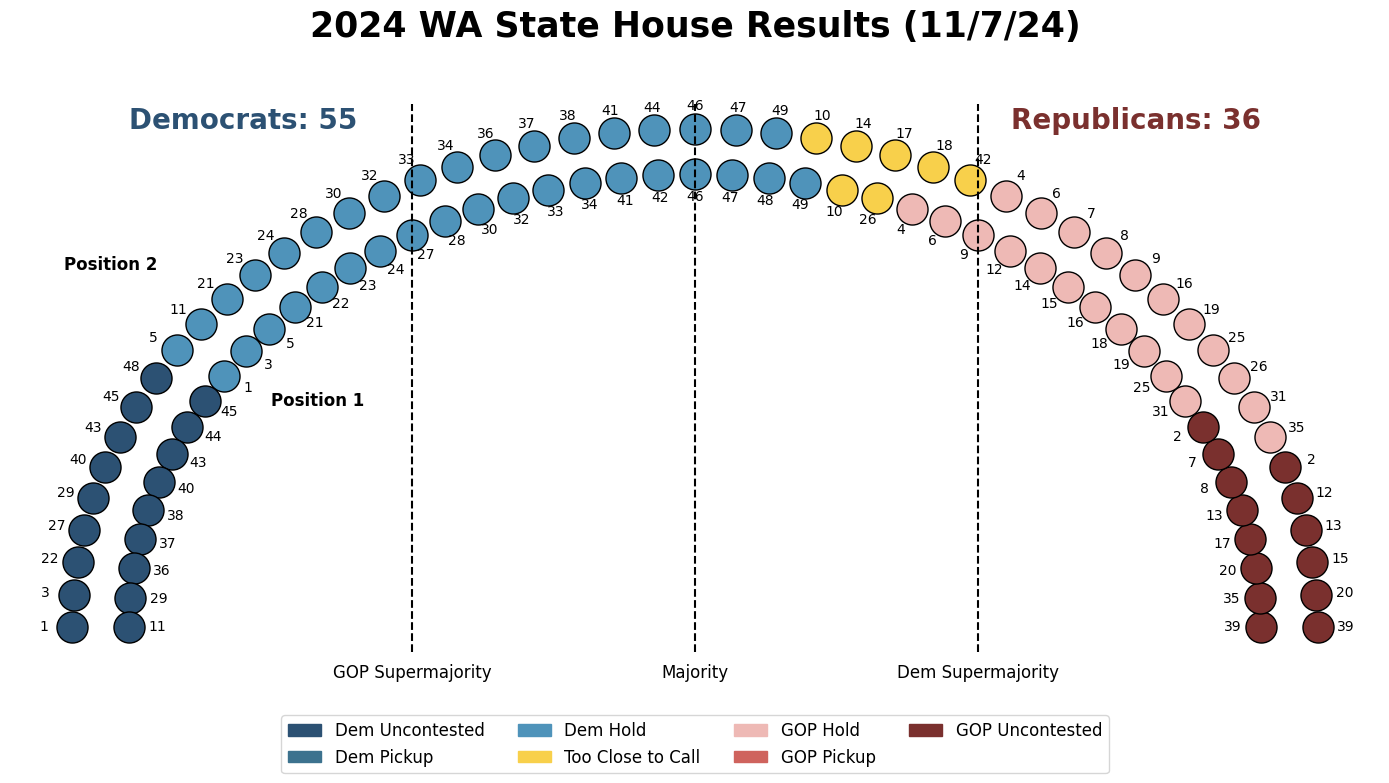
The Washington State Democratic Party said on November 6 that it had secured two-thirds of the seats in the state House of Representatives—a threshold it had not reached since the postwar years. But the result is not yet official: ballots are still being counted, and Republicans say the announcement is premature. Meanwhile, Seattle’s 37th Legislative District elected two new Democrats: Kaleb Tevold will replace the state’s longest-serving sitting legislator, Sharon Tomiko Santos, and Jaelynn Scott is poised to become the first openly transgender legislator in state history.
Before the election, Democrats controlled the House by a margin of 59 to 39. The chamber has 98 seats, and a two-thirds majority requires 66. According to preliminary results, Democrats have reached that figure: their candidates are leading or have effectively won in seven formerly Republican districts, stretching from the state’s southwest to the Yakima Valley and Puget Sound.
The political significance of this arithmetic far outweighs that of a single additional seat. A two-thirds majority allows the House to override a gubernatorial veto and send amendments to the state constitution to a public vote. But constitutional amendments also require the same level of support in the state Senate, where Democrats still lack a supermajority. So the lower chamber’s triumph does not eliminate the need for compromise—at least in the other wing of the Capitol in Olympia.
Republicans insist it is too early to celebrate. Washington conducts almost all voting by mail, and late-arriving ballots often change the initial picture. In several districts, the margins are in the hundreds; particular attention is focused on the 12th District, where incumbent Republican Brian Burnett led Democrat Stacey Willoughby by only about 100 votes as of Friday. The dispute will be officially settled on December 3, the deadline for the secretary of state to certify the general election results.
Even so, the scale of the shift is already apparent. Republicans lost ground in Clark County, on the Oregon border, where Democrats are leading several incumbents, as well as in the 14th District, which covers part of the Yakima Valley and Yakama Reservation lands. Democratic candidates Chelsea Dimas and Ezequiel Morfin are leading Republicans Gloria Mendoza and Deb Manjarres. The results are especially painful for a party that held this area for many years.
In the 37th District, the change is different: this is not a seat changing hands between parties, but an intraparty renewal. Kaleb Tevold, a 31-year-old employee of the education nonprofit Rainier Scholars and a member of the Seattle Planning Commission, defeated Sharon Tomiko Santos, the state’s longest-serving sitting legislator. The district includes Beacon Hill, Rainier Valley, Columbia City and Seattle’s Central District—neighborhoods where high housing costs are not an abstraction but a constant threat of displacement. Tevold built his campaign around social housing, tenant protections, school funding and easing the burden of medical debt.
In the district’s second race, Jaelynn Scott is leading independent candidate Yvonne McCorckle by a wide margin. Scott heads the Lavender Rights Project, an organization that provides legal and social support to Black transgender and gender-diverse residents of the state. Her election would be historic not only for Washington: Scott is described as the first openly transgender African American woman elected to a state legislature in the country. Her campaign paired advocacy for transgender residents with broader calls to raise taxes on large corporations and the wealthy, and to invest in public housing, health care and education.
The election showed that the Democratic victory in Washington is not built solely on Seattle’s familiar advantage. It also came from the suburbs, southwestern districts and areas east of the Cascade Mountains. But the new House will face a test no less demanding than that confronting the weakened Republican opposition: a larger majority gives Democrats rare freedom to act—and fewer opportunities to blame failures on others’ resistance.


Based on: WA Dems claim House supermajority victory; GOP says that’s ‘premature’