
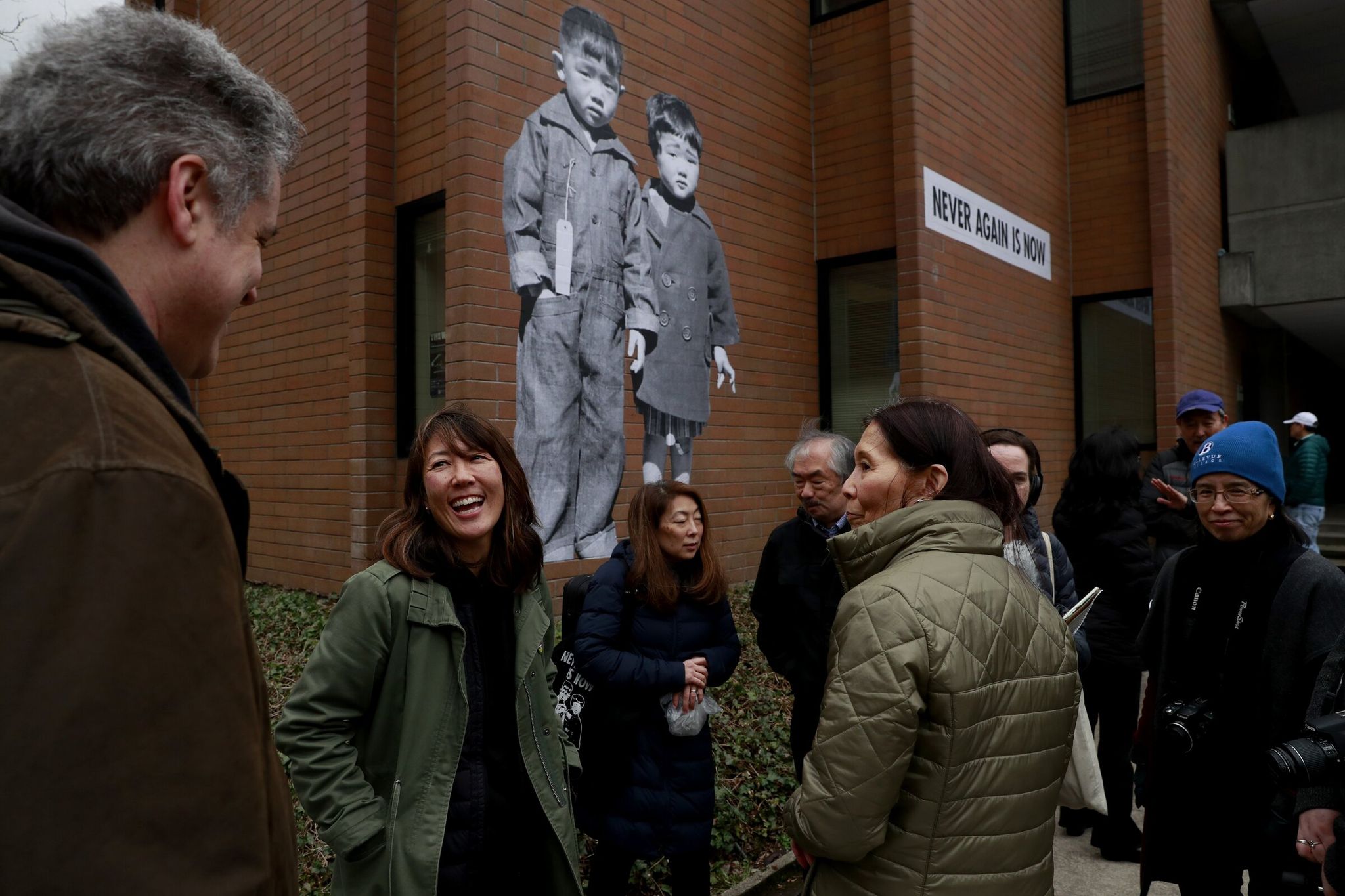
Bellevue College in Washington state announced plans to permanently install on its campus the mural "Never Again — Is Now," which was vandalized and censored in 2020. A dedication ceremony for the permanent installation is scheduled for May this year. The decision symbolizes the college's recognition of the dark history of the internment of Japanese Americans during World War II, as well as its own mistake — an attempt to erase part of that history.
The mural was created by Seattle artist Erin Shigaki and depicts two Japanese American children on the day they were sent to an internment camp in California. The work was originally unveiled at the college on February 19 — the date President Franklin Roosevelt signed the notorious order for forced relocation. Today that date is observed in Seattle and Washington with memorial ceremonies, educational programs at museums, and readings of the names of the interned, including at the fairgrounds in Puyallup, the site of the former "Camp Harmony." For Shigaki the subject is deeply personal: her relatives, like thousands of other Japanese Americans from Seattle, were confined in such camps.
The incident occurred shortly after the mural was installed in 2020. Someone painted over part of the artist’s text in white paint, removing a reference to the "anti-Japanese agitation led by Eastside businessman Miller Freeman." Freeman, an influential early-20th-century publisher and developer, played a key role in Bellevue's development, founding a local newspaper and investing in infrastructure that helped transform the area from farmland into a suburb. However, his legacy is marred by his active anti-Japanese stance and leadership of the Anti-Japanese League of Washington. The Eastside, which includes Bellevue, was during the war a predominantly rural area of farms and small communities, demographically mostly white Americans — a contrast to the more diverse Seattle. An internal college investigation placed responsibility for the censorship on a vice president, though her motives remained unclear.
"When our mural was censored, I experienced intergenerational trauma firsthand," Shigaki shared. "I felt like a gutted fish. I was paralyzed, bewildered, enraged and deeply saddened." Shortly after the controversy, the college president at the time and the vice president involved in the incident resigned, and months of debate about what happened roiled the academic community.
Current college president David May said making the mural permanent is "a commitment not to turn away from uncomfortable moments, realities and conversations." For the artist the decision became an act of healing: "It was a chance to see and make sure that together we are whole and will continue to fight for ourselves, our ancestors and future Americans."
The permanent installation will include broader historical context about the period of internment, for which the U.S. government issued an official apology in 1988. It will also reference the 2020 incident, which May called "a terrible moment" in the college's history. As Shigaki hopes, the mural will serve an educational purpose, asking: "Can we acknowledge our mistakes and truly learn from them?"
Based on: Bellevue College to rededicate ‘Never Again is Now’ mural defaced in 2020