
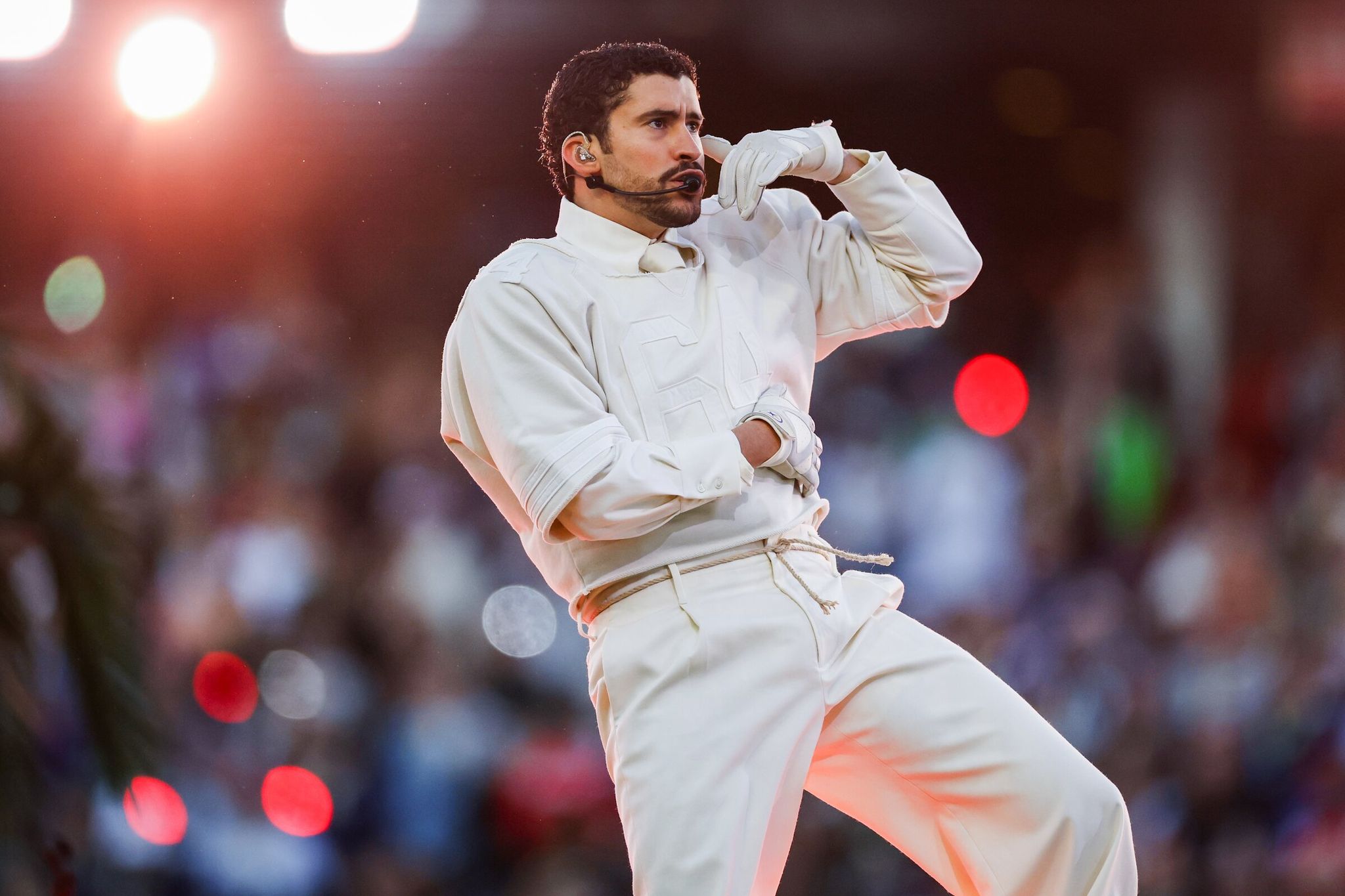
Last Sunday Bad Bunny made history, becoming the first headliner of the legendary Super Bowl halftime show whose set was performed entirely in Spanish. That language — the second most spoken in the U.S. with more than 40 million speakers — took center stage on America’s biggest platform, underscoring its enormous role in the country’s cultural diversity. Over 13 minutes, the 31-year-old Puerto Rican superstar, born Benito Antonio Martínez Ocasio, ruled the stage, which recreated the atmosphere of a street plaza from his native island, proving that Latin culture deserves the spotlight.
His performance was a vivid showcase of the genre diversity that has made him one of the most-streamed artists in the world. Bad Bunny skillfully blended the energetic rhythms of reggaetón and Latin trap with Puerto Rican folk plena, salsa, and pop melodies. His simple call to the audience — stand up and dance — became more than entertainment; it was an act of pure, unfiltered pride in one’s roots.
The stage, stretched across the entire football field, became a maze of artificial turf where, amid performers dressed as tall plants, Bad Bunny displayed his energy by climbing mock telephone poles — a nod to the prolonged power outages in Puerto Rico after Hurricane Maria. Amid that storm of emotion there was a tender, personal moment: a giant screen showed a video of the musician handing a Grammy to a boy who resembled him as a child.
The night’s biggest surprise was the special guests. Contrary to many fans’ expectations, it was not Cardi B who joined the stage but Lady Gaga, in a sky-colored dress and wearing a Flor de Maga — Puerto Rico’s national flower. She performed a salsa version of one of her hits. They were also joined by the “King of Latin Pop,” Ricky Martin. The choice of guests — public supporters of the LGBTQ+ community — was a quiet but eloquent statement of tolerance.
The performance capped a period in which Bad Bunny had increasingly served as a political platform. Back in October, after his headliner announcement, he quipped in a monologue on Saturday Night Live that critics should learn Spanish in four months. And last week he caused a stir by shouting “ICE, get out!” in his Grammy acceptance speech, sharply criticizing immigration policy. Criticism of ICE (U.S. Immigration and Customs Enforcement) — the federal agency that has become a symbol of hardline immigration policy — is a significant political statement expressing support for immigrant rights. That stance resonates in places like Washington state, where laws limit local cooperation with federal immigration authorities and “sanctuary” protections exist for immigrants, making such celebrity statements especially potent.
But on Sunday nothing dampened the celebration. The stadium was swept by what fans called “Benito fever.” He closed his show with a moving ballad from his latest album that turned into a love letter not only to Puerto Rico but to Latinos everywhere. To its soundtrack, flags of Mexico, Colombia and other countries were carried across the field.
As the final note, a message flashed high on the screen that summed up the night: “The only thing stronger than hate is love.” Bad Bunny proved that the power of culture and the sincerity of art can unite thousands of people above any barriers.
Based on: Bad Bunny’s Super Bowl halftime show puts Latino pride center stage